


Albert Einstein is the most famous physicist of all time, despite the fact that many of us have no idea why that is.
Astronomer Jeffrey Bennett wants to change that. Our view of the physical laws of the universe has been shaped by Einstein’s General Theory of Relativity for 100 years, so the least we can do is try to understand it, he said.
Bennett has been on a mission, and on a speaking tour over the past year, presenting an explanation of Einstein’s theory in a single hour — with no math.
Tucson is his 25th and final stop during a year that celebrates the International Year of Light and the 100th anniversary of the publication of the General Theory of Relativity.
Bennett, who taught for 20 years at the University of Colorado in Boulder and worked in NASA’s astrophysical division, now spends his time writing textbooks, children’s books and popular science books.
His children’s books have been sent to the International Space Station and read aloud by orbiting astronauts.
Bennett makes two appearances at the University of Arizona next week. On Sunday, he will speak at Flandrau Science Center after the presentation of a planetarium show based on his children’s book “Max Goes to the Moon.”
Then on Monday, he will deliver the Steward Observatory public evening lecture, where he promises to provide an understanding of Einstein and relativity, based on his book “What Is Relativity? An Intuitive Introduction to Einstein’s Ideas and Why They Matter.”
You don’t need a deep understanding of math or science to attend, he said. “I’ve had many middle-schoolers come away saying they really learned something. If the middle-schoolers can do it, so can the grown-ups.”
He offers a simple explanation of the famous E=mc2 equation: “It tells us that mass can be transformed into energy and vice versa in certain circumstances.”
Of course it’s more complicated than that, but simply knowing what the theory says is crucial, Bennett said, and simply related.
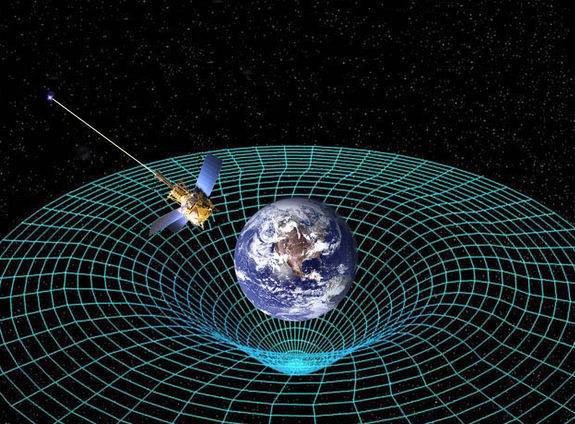
Bring in gravity, as Einstein did 100 years ago with his General Theory of Relativity, and things get even more mind-bending — space and time combine into a four-dimensional fabric that is warped by objects with mass.
“It is important to understand what Einstein’s theory tells us about the gravity curvature of space-time,” Bennett said.
Schools still teach a Newtonian approach, thinking that the complicated math involved in Einstein’s theory is an impediment to even talking about it.
We don’t do that in other areas of science, he said. We teach children the basic concepts of atoms without needing to explain the more complex processes of quantum theory.
Astronomer Thomas Fleming, who teaches general education courses in astronomy at the UA, said he used to shy away from broaching the subject of relativity in his gen-ed “Stars” class. A full understanding required knowledge of tensor calculus and differential geometry.
Then he began using Bennett’s approach. He ended up writing the PowerPoint slides that accompany Bennett’s textbook and now spends a week of classes dealing with relativity.
His reasoning is much like Bennett’s.
“If you accept the fact that a person with a bachelor’s degree is an educated person, you should know, not only that Einstein is a genius, but why he is a genius. If you want to understand things like black holes, for instance, you need to understand relativity.”
One reason for the reluctance to teach relativity is that Einstein’s updating of Newton’s theories about gravity aren’t needed to explain most physical phenomena.
“The Newtonian sense still works real well in everyday life — even in rocket science, sending things off to a new planet — you can do that with Newtonian physics,” Bennett said. “But Newton’s view of it is incomplete. Relativity is our modern understanding of space-time and gravity.”
Most of us learn in school that gravity is the weak force of attraction between objects that have mass, but even Newton himself, as Bennett points out in his lecture, thought the notion that bodies would attract each other through the vacuum of space was a bit unbelievable.
Newton considered it “so great an absurdity that, I believe, no man who has, in philosophical matters, a competent faculty of thinking, could ever fall into it.”
But the math worked. “Newton was right in most instances, if you restrict yourself to slow speeds or are in areas with very small amounts of gravity,” Fleming said.
“If you start approaching the speed of light, it no longer applies, and if you approach an area of great mass, it doesn’t work.”
In Einstein’s theory, the speed of light is a constant, but time can slow down and space can bend. The two are combined in a fourth-dimensional fabric of “space-time.”
Einstein published the General Theory of Relativity in 1915, and its predicted effects were tested in an experiment during a total solar eclipse four years later. Light from stars bent around the sun, following the predicted curvature. Because photons of light have no mass, the phenomenon could not be explained by Newtonian physics.
Einstein became instantly famous. “He was a rock star,” Fleming said.
Other proofs followed — deviations in the orbit of Mercury caused by its proximity to our massive sun, the gravitational lensing of radio waves from distant quasars, and many others.
Scientists continue to challenge relativity in increasingly extreme circumstances — there are plans to test it at the event horizons of black holes and at speeds approaching the speed of light in the Large Hadron Collider, for example.
Fleming said the concepts are most easily approached in the “thought experiments” Einstein created to illustrate them. “They’re brain teasers. They’re puzzles, and anybody can think about them. It’s a nice way of approaching it without scaring students.”
Bennett uses thought experiments in his presentation. If you go, be prepared to think about what happens when you’re traveling in a spaceship at the speed of light — and you turn on the headlights.
You don’t have to be an Einstein to think about it.

