

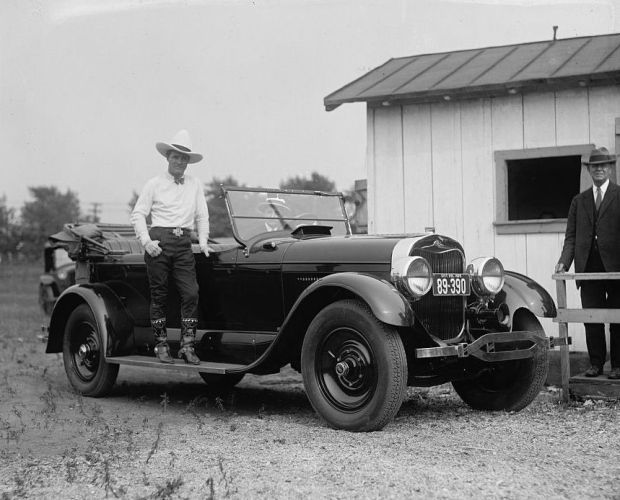
Edward F. “Ed” Echols was born to James and Martha (Wingate) Echols on Nov. 7, 1879, in Stockdale, Texas. His father was from Missouri and his mother hailed from Texas, where he grew up and was involved in the cattle business, even helping his father drive cattle up the Chisolm Trail to Abilene, Kansas.
He would later describe it this way: “Of course I was just a slick-eared button of fourteen, and most of the Indians and cross-timber toughs had been run off by the time I went up what was left of the Chisholm Trail, … but even so, with the new railroad meetin’ us more’n halfway, it wasn’t what you’d call no tourist trip ... for Fancy Dans wanting to take a look-see at the landscape.”
In 1902, he left Texas with his brother Art in a Studebaker wagon that had cost them $60. They arrived late that year in Sulphur Springs Valley in Cochise County. His first job in Arizona was hauling wood at $6 a cord. He also hired out as ranch hand at area properties such as the Chiricahua Cattle Co.

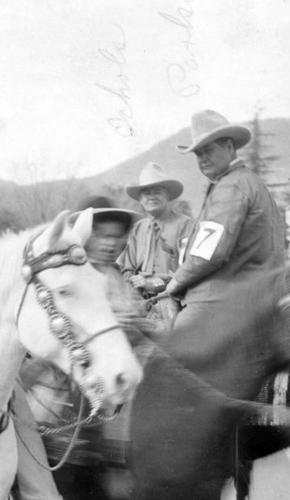
Ed Echols and rancher Bud Parker. Echols was Pima County sheriff.
In 1907, he began working in show business, as an exhibition roper with the Miller Brothers 101 Wild West Show at “a princely wage of $15 a week.” But after touring for six months in places like Chicago and New York, he decided to return home. During that time he met the future Western film actor Tom Mix, with whom he would remain friends for many years.
Five years later in 1912, he traveled to Calgary, Alberta, Canada for the first Frontier Days and Cowboy Championship Contest (later known as the Calgary Stampede). He competed in the roping competition against the best in world, riding away with the grand prize of $1,000 and the title of World’s Champion Roper.
In 1921, Echols received a homestead patent for 640.23 acres of land near the small town of Mescal, near Benson. It’s believed that this formed part of Echol’s Double X Ranch, which also included land he had bought in 1917. The ranch was later sold to Tom and Virginia (Ruthrauff) Beaham. Double X Ranch Road near Mescal is named for this ranch.
In 1924, Leighton Kramer, an Easterner who wintered in Tucson and is the namesake for Kramer Avenue, conceived the idea of a rodeo and rodeo parade in Tucson and called upon local ranchers and cowboys to assist him. Ed Echols was one of the men he called upon for guidance.
In 1925, the soft-spoken, 6-foot Texan was again drawn into entertainment, this time touring Europe with the Tex Austin Show.
In 1930, he wed Bennie F. Akers of Spartanburg, South Carolina.
In 1934, he ran for Pima County sheriff and asked another old-time friend, film star Will Rogers, to stump for him. Rogers flew into Arizona and gave an impassioned speech on behalf of his friend at a Democratic Party rally. Echols lost the election — and learned the speech had been mistakenly given in Douglas, which is in Cochise County.
For the next couple years he worked as Pima County cattle inspector. In 1936 he was elected sheriff of Pima County, a role he held for 10 years. It was during this period, on Oct. 12, 1940 — after having visited Tom Mix that morning at the Santa Rita Hotel — that he found himself rushing across the county line toward Florence, to the site where Mix had crashed and died.
 |
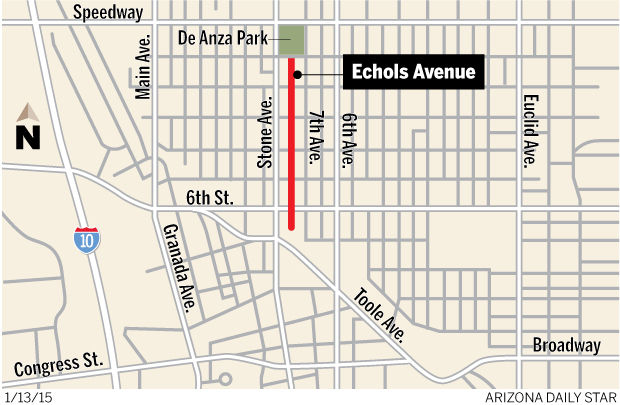
Around 1944, Echols and his wife moved to 29 E. Second St., at the corner of Second Street and an unnamed alley.
Following his time as sheriff, he served for many years as a constable in Tucson’s Precinct No. 2., retiring in 1962.
Echols was best known for his role in the Tucson Rodeo and Parade, known collectively as La Fiesta de Los Vaqueros. He was grand marshal of the Tucson Rodeo Parade many times, a title awarded to prominent citizens such as Lute Olson, Gov. Raul Castro and Jim Click. He even gained the nickname “Mr. Rodeo.”
Echols died in 1969.
On May 4, 1951, the Tucson City Council passed Ordinance No. 1247, naming the alley that bordered his house Echols Lane. By 1956 it was changed to Echols Avenue.

