

It was 1875 or 1876 when brothers Henry T. and Leonard G. “Len” Redfield rode up the San Pedro Valley into the town of Tres Alamos. With them were Henry’s wife, Malvina and his son, Leonard.

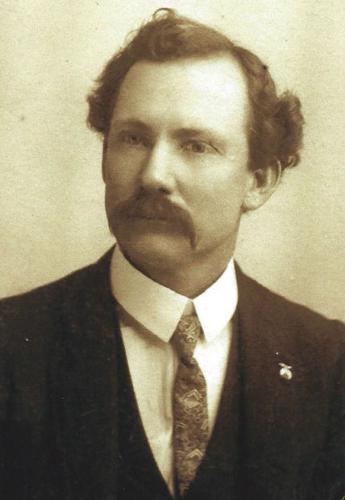
Leonard Darius Redfield, son of Henry T. Redfield, postmaster of Benson. Courtesy of Ethel Amator
The family was hungry, so Henry traded his saddle for a sack of corn and rode north for about 9 miles, bareback. They settled there, about a mile or two from the bank of the river, and built a one-room log cabin.
Before long their cattle, bearing the Triangle Dot brand, wandered the valley and foraged on bear grass, juniper and manzanita. The Redfields flourished on cattle and its by-products, with Henry traveling by buckboard to Tombstone to sell butter for $1 a pound. His son carried mail from Tres Alamos to the Redfield ranch.
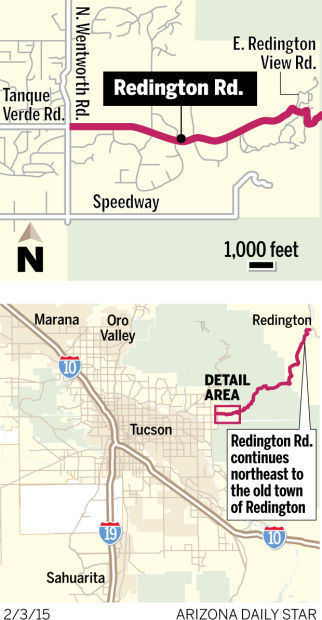
Within a few years several families lived in the area and, by 1879, a petition was sent to the Post Office Department to establish the Redfield post office. It was rejected and the brothers coined the name Redington (sometimes spelled Reddington) instead. Henry was appointed the first postmaster and the town later took the name from the post office.
By 1880, Frank Carpenter, a nephew of the Redfields’, was living in Redington along with Len Redfield, John Rhodes (later an Arizona Ranger), and Henry, Malvina and Leonard.
During the early years of Redington, outlaws used an area near town as a hideout after a stage coach robbery near Riverside (now Ray, Arizona) that involved the murder of a Wells Fargo employee. Pinal County Sheriff A.J. Doran and his posse followed Joe Tuttle to the Redfield ranch. They arrested Tuttle, as well as Len Redfield and Frank Carpenter, after searching the property and finding a mail sack believed to be from an earlier robbery. While in prison in Florence, Tuttle confessed that he and another man committed the robbery and said Redfield was to get a cut for hiding the money. Redfield denied the accusation.
 |
Henry, believing his brother’s life was in danger, headed to Florence with U.S. Deputy Marshal J.W. Evans of Tucson with plans to move Len to Phoenix to keep him safe. Upon hearing this, a mob overwhelmed the local authorities and lynched Tuttle and Redfield. There was little evidence — if any — of Redfield’s involvement in the crime.
On Oct. 20, 1883, the Arizona Weekly Citizen said Henry Buehman, administrator of Leonard G. Redfield’s estate, had deeded “all the right, title and interest of the said estate, (for) $8,000” to Benjamin and Briggs Goodrich and T.F. Hudson. It also said that Henry T. Redfield had sold 160 acres on the San Pedro River for $5,000 to the same men.
The remaining Redfields relocated to Benson, where Henry started a livery business but died of an overdose of laudanum in 1886. His son served as postmaster of Benson from 1896 to 1940, believed to be the longest term in U.S. history.
Around 1884, rancher William H. Bayless of Bayless and Berkalew Co. moved his operations to the San Pedro Valley. Over the next several years he bought up homesteads, ranches and other land.
Around 1890, as a result of an intense drought, many ranchers had a difficult time surviving, and Bayless and Berkalew Co. bought even more land. The purchases eventually became the 200,000-acre Carlink Ranch. The name of the ranch is derived from the link that connects railroad cars together.
 |
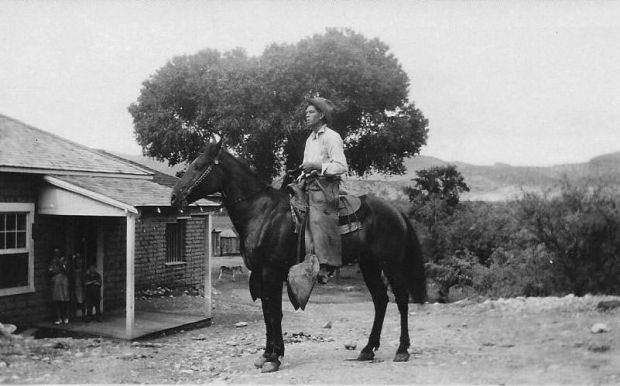
In a sense the Carlink Ranch became Redington, because the school and general store/post office were located on the land and everyone from the surrounding area came there to attend school, shop and pick up their mail.
Chuck Smallhouse, Bayless’ great-grandson, grew up on the Carlink Ranch from the mid-1930s through the late-1940s.
“When I was in the first or second grade, the one-room schoolhouse burned down and was rebuilt with two rooms, although only one was used as the main school room and the other used for storage and the teachings of various arts such as pottery, woodworking and drawing,” he said. “The main room was also used for events such as Christmas parties, student plays and community dances, with music by local musicians. While it was a school, there was no water or electricity. Two pupils took turns carrying water in large pails to the schoolhouse each day, and there were two outhouses. The famous author and teacher Eulalia “Sister” Bourne at one time taught there.”
In 1957, the small community of ranches and farms got electricity.
Redington has remained a small ranching community. The Carlink Ranch, now 60,000 acres, is run by Andrew and Stefanie Smallhouse.

