


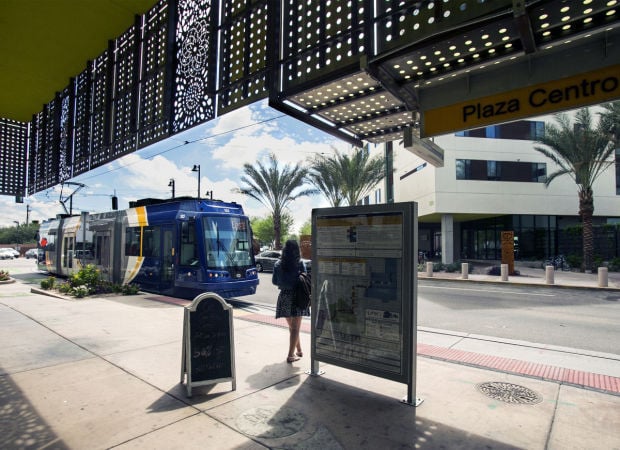
Do you dream of having your own streetcar? The Tucson City Council could make that dream come true.
City leaders have begun to consider selling naming rights for streetcars, stations stops, maps, schedules and websites.
For those who don’t share that dream, imagine reading the eegee’s-sponsored streetcar map, checking the UA Athletic Department-funded schedule on a website brought to you by Jim Click Automotive, all while riding the National Association of Call Center’s No. 4 streetcar.
And look, there’s state Rep. Steve Farley at the Geraldo Rivera Congress Street stop, and that’s the mayor at the Joe Bonanno Memorial stop on Avenida del Convento.
Imagine.
Jokes aside, Tucson City Councilman Richard Fimbres said the proposal is all about finding new revenue.
“We’ve got to find ways to pay the operations costs of both systems,” Fimbres said, referring to Sun Tran and Sun Link Streetcar.
The city started wrapping busses with advertising a few years ago, and these days you hardly see one without some lawyer’s face 10 feet tall on the side of it.
For fiscal 2015, bus advertising brought in about $390,000. Streetcar advertising was expected to bring in about $100,000.
There’s no estimates currently for how much the naming rights campaign would bring in.
Councilman Steve Kozachik said he’s concerned that plans to jump deeper into the advertising game pits the city against private industry.
“The streetcar is going to be rolling past a lot of small businesses on Fourth Avenue or Congress Street,” Kozachik said.
He doesn’t want these local businesses to see an advertisement-laden streetcar stopped in front of their shops while the city hassles them over displaying temporary signs and A-frames.
“I’m not going to support putting something out there in the public that allows us to exceed what we allow the private sector to do,” Kozachik said.
Some would argue the city already does that.
“Is the city supposed to create revenue through advertising in competition with the private sector?” asked Mike Addis, with the sign company Addisigns.
One of Addis’ concerns is the city’s use of advertising on enclosed bus stops. He said as the city has expanded the size and scope of bus stop advertising, it has begun to exceed what the private sector could do.
“If we were to do any of these things as an industry we would be shut down,” he said, noting the city-owned bus-stop advertisements fall in the public right-of-way.
He’s also concerned that city code enforcement hasn’t been evenly and fairly applied, which leaves businesses in a state of confusion and not knowing what to expect.
Fimbres agrees the city has to be evenhanded in its enforcement measures, but said he doesn’t see a conflict with the private sector in selling advertising and naming rights.
“We live off of sales taxes,” he said.“We’re not going to be in competition with the private sector, that’s not what I’m envisioning.”
Let’s hope that’s the case.
No one wants more conflicts between the city and the business community, especially in the form of a Sonoran hot-dog- wrapped streetcar rolling through downtown.
Down the road
As the city of Tucson Department of Transportation’s Downtown Links Phase III project moves forward, Century Link is continuing work to relocate its facilities within the project limits.
Through Thursday, the Sixth Street and Sixth Avenue intersection will be closed to traffic in all directions between 6 p.m. to 5 a.m.
The closure is needed to allow work crews to install underground conduit in the middle of the intersection.
Nearby businesses will remain open and accessible.
The Downtown Links Phase III project includes improved access and connections for pedestrians, bicyclists and motorists, while linking Barraza-Aviation Parkway and the Interstate 10 frontage road.
On Friday, Oct. 15, through Sunday, Oct. 17, volunteers from the Coalition for Sonoran Desert Protection, Sky Island Alliance, Tucson Audubon Society and the Santa Catalina Catholic Church plan to install irrigation and native plants near the wildlife overpass in Oro Valley.
Work will take place from 8 a.m. to 3 p.m.
For more information about the wildlife crossings and the volunteer project, visit www.sonorandesert.org and www.skyislandalliance.org.
Contact reporter Patrick McNamara at 573-4241 or roadrunner@tucson.com. On Twitter @pm929

