

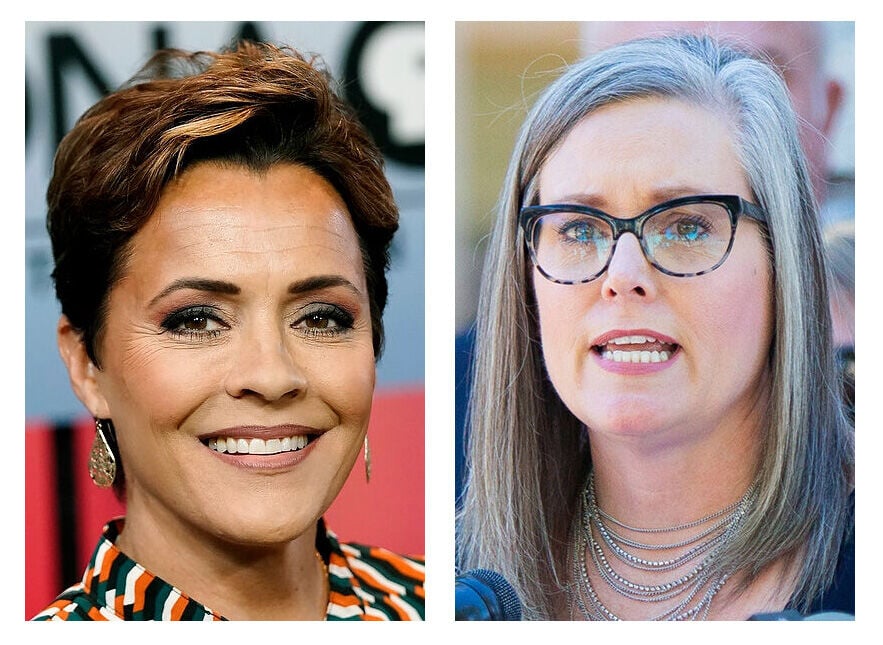
PHOENIX — Democratic gubernatorial hopeful Katie Hobbs is getting the interview she wanted on Arizona PBS despite refusing to participate in a debate with Republican Kari Lake.
And the station’s decision could spell the end of its more than two-decade relationship with the Citizens Clean Elections Commission, which sponsors candidate debates.
Officials at KAET-TV, the Phoenix PBS affiliate, confirmed Wednesday they have offered Hobbs 30 minutes of one-on-one time next week with host Ted Simons. Lake, who had been set to be interviewed Wednesday, will get identical time.
But not together.
That’s exactly what Hobbs demanded after refusing to share a stage with Lake, and exactly what the commission refused to give her.
“Our mission is to have debates, not town halls,’’ said Galen Paton, a commission member, in voting Sept. 8 to reject the consecutive appearances.
The decision Wednesday by KAET, part of the Cronkite School of Journalism at Arizona State University, came as a surprise to Tom Collins. He is executive director of the commission that has conducted candidate debates ahead of every election since being created by voters in 1998.

“As a professional matter here, Cronkite’s decision-making here was unacceptable for an agency like ours that values transparency,’’ Collins said, as he found out about the station’s decision from reporters and not from the school.
On top of that, he told Capitol Media Services, the decision came just hours before the commission-sponsored appearance by Lake on KAET — the one she was offered after Hobbs balked — was set to air Wednesday, but did not.
A spokesman for Cronkite, which had agreed to give Lake her airtime alone following Hobbs’ refusal to debate, defended the decision.
“It is our responsibility as a news agency to provide the public with access to the candidates who are running for office so they can learn more and make informed decisions,’’ the school’s prepared statement said.
Collins responded: “It’s hysterically funny to me as a former journalist that they’re wrapping this up in the First Amendment.”
“They had an opportunity to ensure that all voices were heard from,’’ he said of the commission’s process and rules about debate. Instead, Collins said, by agreeing at the last minute to the demands by Hobbs for her own time after she refused to debate, the school “inserted itself into the political process.’’
Collins said the school had a “professional commitment to us’’ to abide by commission rules, including the one just reaffirmed by the panel that those who refuse to face-to-face debates do not get to dictate that they get separate time.
“And ethics is about, if nothing else, keeping your word,’’ Collins said. “And ethics in government, which is what ASU is, is about transparency. We got neither of those things from the Cronkite school.’’
Lake also accused the station of making a political decision, calling the move a “betrayal.’’
“PBS has unilaterally caved to Katie Hobbs’ demands and bailed her out from the consequences of her cowardly decision to avoid debating me on stage,’’ Lake said in a prepared statement.
She pointed to the vote by the commission to deny Hobbs her own interview, saying the station went behind the commission’s back and agreed to give her what she wanted. Lake suggested there was a partisan motive.
“PBS, a supposedly objective taxpayer-funded entity, is working overtime to help elect Katie Hobbs, who needs all the help she can get,’’ the GOP candidate continued. “PBS has now become complicit in Katie Hobbs’ attempt to destroy 20 years of gubernatorial debate tradition.’’
The station is looking to air back-to-back interviews next week but no date or times are set.
The commission debates are now finished for this election cycle. But Collins said what happened Wednesday will force the commission to have a new conversation with the university ahead of the 2024 election, including whether ASU is willing to abide with commission rules as it had for decades before.
“My belief is the Cronkite School does not intend to have a relationship with the Clean Elections Commission forward,’’ he said. “That is their decision. And if they did not understand that when they made this decision, then they are critically unsophisticated in their thinking.’’
He acknowledged that nothing in the agreement with Cronkite lets the commission tell KAET who it will or will not interview outside the scope of commission-sponsored debates. “But the issue is this is a real departure from what was done and an unexplained departure,’’ Collins said.
Lake said she is continuing to push for a debate even though early voting for the Nov. 8 general election already started.
But now that Hobbs got what she wanted in the first place, without the risks that come with a debate, there is little incentive for the Democrat to change her mind.
In refusing the debate, Nicole DeMont, Hobbs’ campaign manager, told commissioners that Lake’s actions during the GOP primary debate showed she would make the general election debate into a “spectacle.’’ That specifically included Lake’s contention the 2020 election was stolen from Donald Trump.
“You can’t debate a conspiracy theorist,’’ DeMont said. “When she decides to come back to reality, accept the results of our free and fair elections, then we can start to have a real policy debate.’’
But attorney Tim LaSota, representing Lake, told the commissioners they should not change the rules to protect Hobbs against uncomfortable questions. And he said there was no reason to believe debate host Simons could not keep the discussion fair, calling Hobbs’ excuses for not wanting to debate “a cop out.’’
Strictly speaking, only candidates that get public funds for their campaigns, administered by the commission, are legally required to participate in the commission-sponsored debates. And both Hobbs and Lake are using private donations.
But the record shows that virtually every gubernatorial candidate, publicly funded or not, has participated.
Still, there is precedent for the commission’s decision to give airtime to candidates when their foes refuse to debate.
In 2018, Republican gubernatorial hopeful Ken Bennett got an interview after incumbent Doug Ducey refused to participate in a debate ahead of the primary. A Ducey campaign official said the debate refusal was because Bennett, who had been president of the Senate as well as secretary of state, was a “fringe’’ candidate.
And just months ago, Democrat Marco Lopez was interviewed by Simons after Hobbs would not debate him for the party’s nomination. At that time, however, Hobbs did not seek time of her own.

Candidates answer questions about a variety of issues from the Arizona Daily Star Opinion team and readers.

