


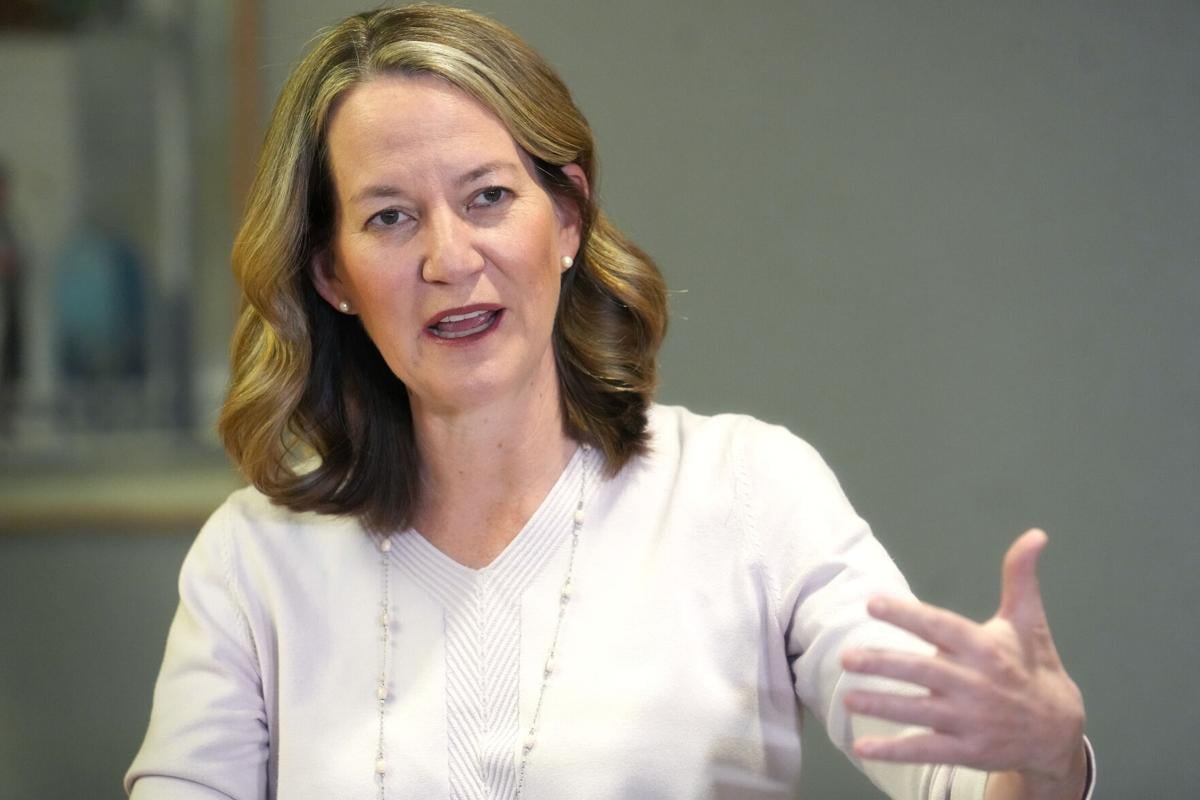
PHOENIX — A statewide recount confirmed Democrat Kris Mayes was elected the new state attorney general.
But her margin of victory over Abe Hamadeh was smaller than originally reported.
Official returns had put Mayes 511 votes ahead of her Republican opponent out of more than 2.5 million ballots counted in the race. That fell within the margin under which state law mandates a recount.
The recount tally, announced Thursday by Maricopa County Superior Court Judge Timothy Thomason, sliced that to 280, with Mayes picking up an extra 196 votes from the original reports and Hamadeh adding 427.
The recounts in 11 of the state’s 15 counties produced different results for one or both of the candidates.
The biggest shift came in Pinal County, which gave Hamadeh another 392 votes on top of his 82,724 initially reported there. Mayes’ tally in Pinal County went up 115 votes from her 58,953 initially reported.
In a prepared statement, Pinal County election officials said “human error’’ was the only explanation about why the change in votes there was larger than in any other county. But the statement said it still was an election consistency rate of 99.65%.
“Although not perfect, this consistency rate is within the state’s predetermined 0.5% statutory margin,’’ it said.
Differences ‘not unexpected’
Under Arizona law, recounts are conducted the same way the initial results were tallied. There is no hand count. Ballots are run through tabulators.
Differences between the originally tally and recount results “are not unexpected,” said a press aide to Democratic Secretary of State Katie Hobbs.
“Election administration is very much a human process and, as such, is subject to human error,’’ said the aide, Sophia Solis, in a news release.
Among things that can affect the tally, Solis said, are marks made by voters being read differently during the second count.
She also noted that recounts, like the original election, encounter situations where a tabulator cannot determine the voter’s intent, perhaps due to stray marks. That then requires a panel consisting of people from both major political parties to examine the ballot and agree on what the voter wanted.
Hamadeh, who unsuccessfully sued to overturn the election returns, remained adamant Thursday that Mayes should not be declared the victor.
Hamadeh: ‘Unusually high discrepancy rate’
“This recount has an unusually high discrepancy rate and swing,’’ he said in a Twitter post.
Hamadeh repeated his complaint there has not been a complete hand inspection of the ballots. “The outcome of this election is uncertain,’’ he said.
However, that’s not what Mohave County Superior Court Judge Lee Jantzen ruled last week when Hamadeh challenged the results.
“The bottom line is, you just haven’t proven your case,’’ Jantzen told Hamadeh’s attorney Tim La Sota. The judge said any mistakes that may have been made in how ballots were counted “were not enough to overcome the presumption the court has to have in election cases ... that the election was done correctly.’’
La Sota has maintained he might have been able to prove the results should be overturned if the judge had allowed him to examine more ballots from Maricopa, Pima and Navajo counties.
But Jantzen said state law permits review of just a random sample of ballots — in this case, 2,300 — and anything more would go beyond the scope of what’s allowed in election contests, which must be resolved quickly.
Hamadeh also contends there are still more than 4,000 votes that have not been counted.
Many of those are “provisional ballots,” his lawyer says. Those are ballots accepted but set aside for a variety of reasons, including the failure to produce required identification at a polling place, the lack of the person’s name on voter registration rolls, or an indication the person already voted.
The last situation became an issue in this race after some Maricopa County voters, finding long lines at some locations due to printer and tabulator issues, chose to leave to go to a nearby site. Unless they formally “checked out’’ of the first polling place, the records listed them as having voted.
“Voters have been disenfranchised,’’ Hamadeh said Thursday.
‘Didn’t just do a rubber stamp’
However, even La Sota acknowledged at the court hearing that county officials said they did go back through the last category and find and count those provisional ballots.
Hamadeh is not ready to concede. “My legal team will be assessing our options to make sure every vote is counted,’’ he said on Twitter.
But attorney Dan Barr, who represents Mayes, said even with a change in the vote totals, the recount should reassure Arizonans the results are accurate.
“They didn’t just do a rubber stamp of what it was,’’ Barr said after Thursday’s vote tallies were announced in court.
Thomason also announced that a recount of the race for state superintendent of public instruction confirmed the victory of Republican Tom Horne over Democratic incumbent Kathy Hoffman. The recount increased Horne’s edge from 8,967 to 9,188.
Election officials assured voters that every ballot would be counted after a printing malfunction at about one-quarter of the polling places across Arizona's most populous county slowed down voting. The snag fueled conspiracy theories about the integrity of the vote in the tightly contested state. Some high-profile Republicans tried to make the case that Democrats were seeking to subvert the vote of Republicans, who tend to show up in greater numbers in person on Election Day. Officials say about 17,000 ballots in Maricopa County, or about 7% of total dropped off Tuesday. The problem slowed down voting in both traditionally Democratic and Republican areas. At one location, some voters there reported waiting several hours to be able to vote.

