



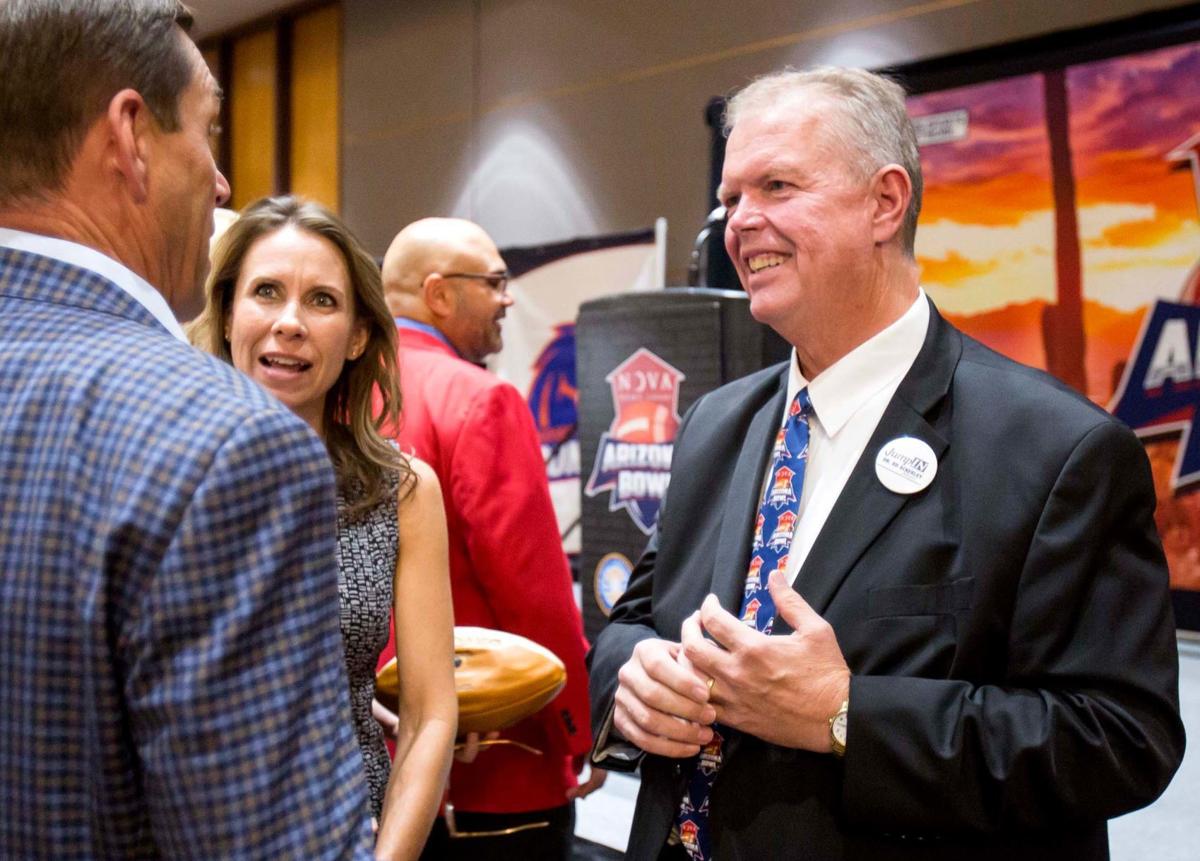
Ed Ackerley, speaking outside City Hall recently, said he saw the opportunity to seek the mayor’s job as his way to serve the Tucson community.
The co-owner of Ackerley Advertising, a full-service advertising agency his parents started in 1968, Ackerley said the city budget would be among his main priorities if elected to the top job in the general election Nov. 5.
He’s running against Democratic Councilwoman Regina Romero, and Green Party candidate Mike Cease.
Ackerley, 60, said the city must focus on funding core services in order to put more money into the police and fire departments, as well as stepping up road maintenance.
He said the priority for the city should be the services specifically outlined in the city charter.
“We need to concentrate the budget in the places that we’re required to do so by the charter,” said Ackerley, a longtime Democrat who switched to being an independent.
Running a business for four decades, he said, has given him a good sense of what the community wants and needs.
“I’ve been preparing for this all of my life, this type of a job,” he said.
Priorities if elected
He suggests that if elected mayor, he’d conduct a through examination of the $1.4 billion city budget.
The council has lost focus, he said, and has funded nonessential services to the detriment of the essential services.
“What has happened over the last 20 years is that we’re trying to do both. We’re trying to do the core services, but then we’re also trying to fund a number of other things,” he said.
When asked for specifics, Ackerley offers examples touted by Romero, who has said she would like to see the city plant a million trees and make Tucson buildings more reliant on green energy sources as ways to reduce the government’s carbon footprint.
The city, he said, struggles to keep trained public-safety personnel here, losing experienced police officers and firefighters to higher-paying jobs in other jurisdictions after a few years of service. “So we trained them in our fire academy or police academy, get them going for a year or two and then they jump to another municipality because of the pay situation,” he said.
Ackerley wants to hire more police officers, saying the current standard figure — he estimates it to be about 800 — simply isn’t enough. City officials say the number of officers is over 900, but that figure includes officers currently in training.
Cutting back on those nonessential services, he believes, will allow the city to give additional raises to law enforcement — most police officers received pay raises earlier this year, as did other city employees.
Ackerley also said the council hasn’t done enough to fix the city’s failing streets.
“We have a backlog of streets that are in disrepair and specifically there’s lots of streets in residential areas that haven’t been touched in 20, 30, 40 years. And the reason for that is they just haven’t had the money to do it,” he said.
Estimates vary but city officials believe it would take up to $700 million to bring all city streets into excellent condition.
Ackerley believes the re-authorization of the Regional Transportation Authority in the coming years could be key to bringing in new revenue. He says if voters are willing to support a half-cent sales tax for another two decades, some of that revenue could be set aside for road maintenance. Currently, RTA revenues are used solely for new construction.
“I think the most creative idea that we have is to get the RTA re-authorized and have maintenance of streets be involved in that process,” he said.
Ackerley also doesn’t support Prop. 205, the ballot initiative that would put into law strict limits of when police officers can ask people they come in contact with about their immigration status.
He said he is concerned about a number of issues related to the initiative, but said the label could hurt Tucson in terms of both tourism as well as companies opting to relocate to the area.
“I think it’s an emotional issue, a lot of people for it thinking that it’s a good thing for our city to declare itself a sanctuary city,” he said. “The sanctuary city label is not a good thing for Tucson right now. We’re having a hard enough time paying for the bills for the things that we already have.
“What we need is people to come to Tucson, to spend money and to be visitors and to be building businesses here so that we have the resources to help people that come through our city on a regular basis,” he said.
An underdog in terms of campaign finance, Ackerley has raised roughly one-tenth of what Romero has since launching his campaign earlier this year. According to the last financial report, Ackerley’s campaign had raised slightly over $25,000 compared to $242,000 raised by Romero.
A political novice, Ackerley has spent the last 10 months attending council meetings, spending time with city staff and even attending debates that he wasn’t invited to participate in.
“I’ve been to every City Council meeting except for one since I declared,” he said. “I’ve been to every city department and talked to every single city department head, division head.”
A Democrat for nearly his entire life, Ackerley switched parties and became an independent right before running for office.
He concedes it was a political calculation. “I could see a window with the Republicans not running a candidate, and the people who I knew were going to be running on the Democratic side, I felt I had a chance against them,” Ackerley said.
Despite being an independent, a number of high-profile local Republicans are backing Ackerley — including the Pima County Republican Party Chairman David Eppihimer.

