


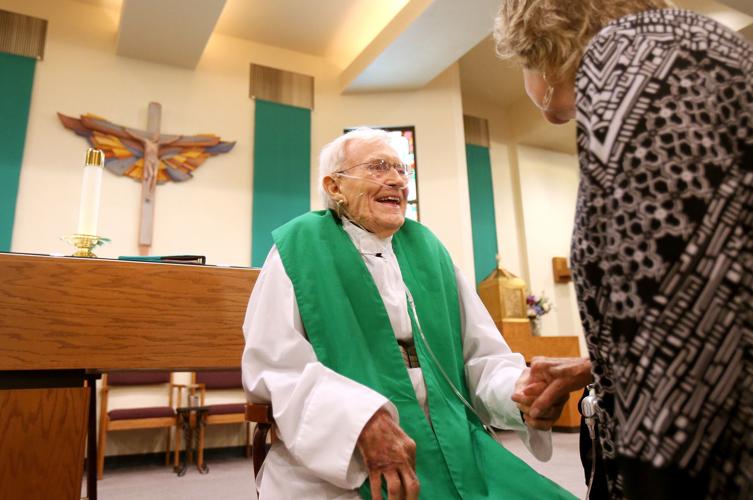


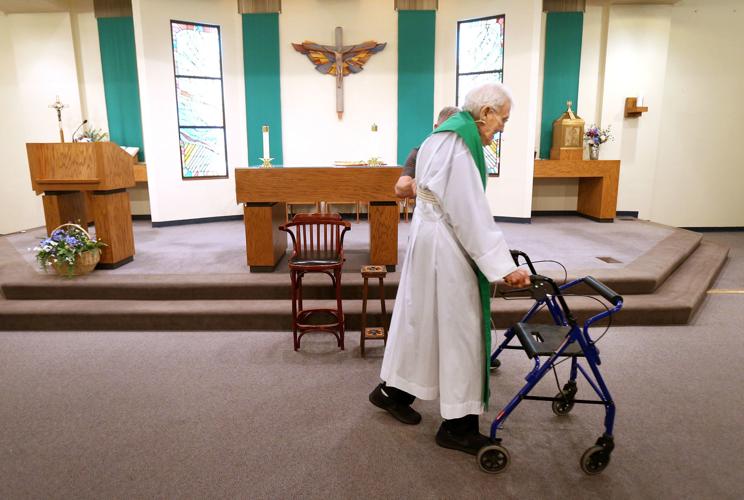

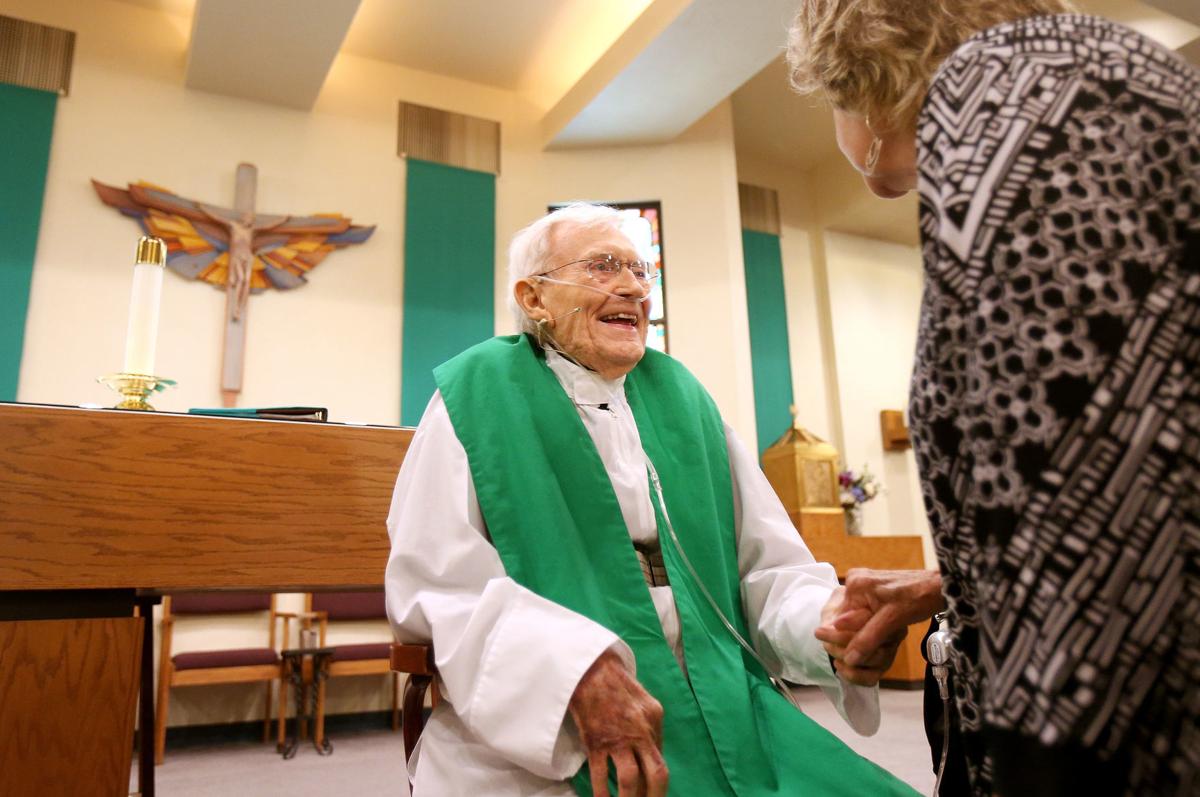
Father Bob uses a walker, wears a nasal tube for oxygen, and sits down for the trademark, charismatic homilies he once delivered walking among parishioners.
His orations, which he always memorizes, continue to command attention.
Last weekend, he cheerfully welcomed the thrum of rain on the church’s roof during the 5 p.m. Saturday Mass before offering up an observation.
“It seems our world, our society, has become more and more angry,” he said, to murmurs of agreement. “There are fewer and fewer subjects people can talk about with each other without anger. ... It’s terrible. What can we do about it? How do we make it right?”
The congregation fell silent, leaving only the sound of the rain. They wanted to hear more.

St. Frances Cabrini Catholic Church has 730 families in its parish. Many live outside parish boundaries but have been drawn to the church by Father Robert “Bob” Fuller.
At 87, Monsignor Robert D. Fuller is the oldest active Tucson Catholic diocesan priest. The last thing he wants to do is retire.
His body, however, is saying otherwise.
“If I could keep going, I’d love it,” he said. “My mind says keep going. My body says no.”
Fuller is scheduled to oversee two more Masses at St. Frances Cabrini Catholic Church on Tucson’s north side this month, including one the morning of June 24. Then he’s planning to move into an assisted living facility.
“The priesthood is extremely valuable to me. That is my life — to deal with people at critical points in their lives,” Fuller said. “I can’t imagine anything more valuable or meaningful.”
Those who know him describe Fuller as a force of life and steady guide for his parishioners, even now when he is in fragile health.
“He relates to people. His homilies are always about how we can do better. And it’s always ‘we’ — we being us and him. He’s very down to earth,” said Jason Wedman, 49, a Tucson physical therapist who was at last Saturday’s Mass with his wife and three children.
“One thing I will say for him is he keeps my kids’ attention. For whatever reason they can relate to what he’s saying,” said Wedman, whose children are 17, 15 and 11.
Wedman said Fuller’s unmistakable joy is one of his allures.
And while numerous health setbacks in recent years left parishioners wondering whether he’d be able to continue, Fuller kept coming back, Wedman said.
“This guy is mentally and physiologically extremely resilient,” Wedman said. “He works hard to achieve that goal and I think his resiliency resonates with a lot of people.”

Father Bob gets assistance putting on a microphone from altar servant David Aubry, left, and nurse Kelly Brown. He has endured numerous health setbacks in recent years.
“Pray, pay and obey”
Fuller made a quick ascent in the Catholic Church — ordained at the age of 25 and chancellor of the Roman Catholic Diocese of Tucson by 31. Three years later, Pope Paul VI named him a monsignor.
In his early career, priests celebrated Mass in Latin with their backs to the congregation.
“The church was highly institutionalized when I started. Catholics were to pray, pay and obey,” Fuller said. “There were no big questions being raised until the 1960s came and there was a whole societal upheaval, in the church, too.”
In 1970 when Fuller was 39, he was appointed pastor of St. Pius X Catholic Church on Tucson’s east side, making waves for allowing what were then considered radical ideas in the church — allowing female altar servers, having lay people give Communion and playing folk music during services.
“Some people thought we were wild liberals. We weren’t wild. We were simply the first church to try things that were allowed by the church,” Fuller said.
“When I went to St. Pius I wanted to open every door and it happened. People took ownership of the church.”
While some of the more traditional parishioners left St. Pius X under Fuller’s leadership, others were attracted to his collegial style. In his 11 years at St. Pius, the church grew from 250 families to 1,700.
Fuller’s work at St. Pius led to a prominent role with a New Jersey-based program to implement Vatican II reforms at parishes around the country. Vatican II refers to the Second Vatican Council, a worldwide meeting of the Roman Catholic Church in the early 1960s that many say was responsible for creating the modern church.
“I have great respect for Catholic traditions,” Fuller told the Star in 1987. “But I can accept change. Survival depends on change. You must plan for it, shape it as it occurs rather than fretting over it.”
Over five years, Fuller logged a million miles flying across the country for the RENEW International program. His job was to help churches break down barriers between priests and people, and create caring,” in an age when neighbors often don’t meet.”
He once described that period as “stepping down from the priestly pedestal” — a process that he said made him feel no less respected but much more loved.
Though Fuller was tapped for leadership posts throughout his career, parish priest has been his longest and most consistent role. His official title is monsignor, but he’s known by parishioners as Father Bob. Jesus did not distinguish people by titles or honors, he’s said on more than one occasion.
“Greatness in people is not found in wealth or power — it is found in service to others,” he said during a November 2017 service.
“Jesus sees each one of us here as very important people. He wants us to see ourselves that way but for the right reason...In all truth, we are more important than we can even imagine.”

The Wedman family, from left, dad Jason; Connor, 15; Griffin, 11; and Lauren, 17, commemorate one of Fuller’s final Mass celebrations at St. Frances Cabrini Catholic Church.
Women as priests?
For the past 31 years Fuller has led St. Frances Cabrini Catholic Church in north Tucson near North Country Club and East Fort Lowell roads. The parish has 730 families as members, including many who live outside of parish boundaries but have been drawn to St. Frances by Father Bob.
Jeanette Schaller, 92, began attending St. Frances in 2000 after her husband died. What has always stood out for Schaller is Fuller’s laid-back style. It’s been easy to talk with him, she said.
“It is the kind of church where you feel like you belong,” she said. “He is a man for all people — loving and accepting of everyone.”
Schaller first met Fuller in 1956, at a reception his mother, Gladys, gave following Fuller’s ordination into the priesthood. The ordination took place at Saints Peter & Paul Catholic Church in central Tucson. Though Fuller was born in Iowa, he grew up primarily in Tucson and graduated from Tucson High School in 1948.
Fuller blessed Schaller and others who were in attendance at his ordination reception, and Schaller still has the ministry card from the occasion, which includes a quotation from the Gospel of Luke: “Thou shalt be with me in Paradise.”
Schaller and others can recall a time when Fuller had seemingly boundless physical energy. He played tennis three times per week, heard confession, and visited people in their homes and in hospitals. Taking care of a parish is about much more than celebrating Mass, Schaller said.
Hundreds of parishioners, including Schaller, attended a retirement party for Fuller in the church’s parish hall on June 3, with several taking the microphone to speak about Fuller’s supportive presence at pivotal moments — the start of a marriage, the death of a child, a crisis of faith.
Fuller led the parish during six U.S. presidencies, during a call for love and peace after 9/11 and through a scandal of clergy abusing children that affected the diocese both nationally and locally.
During the abuse scandal, Fuller was part of a steering committee that represented parishes during the diocese’s Chapter 11 bankruptcy proceedings. He was also consistently candid with the both the media and parishioners.
Parishioner Frank Kalil, 81, has known Fuller for more than 50 years and was the master of ceremonies at the retirement party. He is the one who first suggested Fuller start doing Q&A sessions where parishioners could ask him anything. During those sessions, Fuller has been asked about a range of subjects, including why some people are infertile and why people have to die.
“There have been moments in those sessions that bring tears to my eyes,” Kalil said.
During one Q&A in June 2016, Fuller was asked whether women will ever be allowed into the Catholic priesthood. His answer? It will happen. But not right away.
“It’s been a male-dominated church from the beginning. Let’s be honest. It’s been patriarchal, not matriarchal. That’s the danger — too many men in control and it becomes sometimes very sexist,” he said at the time.
“Women being priests? I’d love to see it. I don’t think I’ll live to see it. The church moves very slowly. I guess it’s like trying to turn a big ocean liner around.”

Parishioners describe Father Bob’s homilies as thought-provoking, and his outlook on life as gentle and positive. He favors the idea of female priests, but “the church moves very slowly.”
Tearful goodbyes
On the day of his retirement party, Fuller was under the weather — he’d been hospitalized and suffered a small stroke the prior week. And on the morning of the party, his sister had died.
Seated in an armchair at the front of the parish hall, he took the microphone and spoke briefly, clearly and gently, the same way he does for his homilies, thanking everyone, and saying how much he has enjoyed his 62 years in the priesthood.
From his armchair, he spent about an hour greeting a receiving line of parishioners, some of them crying as they held his hand.
“I went to Catholic schools for 16 years and Father Fuller’s outlook on life and God is so much more kind and gentle than I’d ever experienced before,” said Sue Lauer, a parishioner in her 70s who was one of those in attendance.
Like many other St. Frances parishioners, Lauer lives outside of the St. Frances parish boundaries — about 10 miles away.
“The greatest commandment is to love one another and he very much follows that,” Lauer said of Fuller. “He’s kind and inclusive and tolerant. He’s very wise.”
Though Fuller’s homilies are not long, Lauer and other parishioners echo similar sentiments about them — they are insightful, thoughtful and touching.
Lauer says Fuller’s words are instructive, too, about how to live life in a “very positive way.” Kalil said they have a universal message about moral law that transcends any particular denomination.
Fuller’s homilies struck a chord with so many of his parishioners that he put them into three volumes of books titled, “Homilies from the Heart.” All proceeds from the sales went to Tucson’s Casa Maria Soup Kitchen.
“To me that says he’s into backing up his beautiful and just words with meaningful action,” said Brian Flagg, who lives and works at Casa Maria. “Some homilies are talk and talk, words, words and more words. He is the opposite. “
While parishioners are sad to see Fuller step down, he deserves some time to himself with no obligations, Lauer said.
“He always said he wanted to die doing what he loved. But he needs to rest,” she said.
Sowing seeds
The way Fuller views the Catholic Church is that it exists to help people, specifically to help and support them in being the people they want to be. But the institution does not hold the appeal it once did, he said recently.
“Some people find it helpful, some don’t,” he said. “Life has become much more complicated.”
Fuller does not begrudge people who leave the church. But he’s consistent and steadfast about both sharing and demonstrating its positive effects. He’s never regretted being a priest, and never seriously thought about doing anything else.
“It’s going to be a real adventure — a whole different kind of life of my own,” he said of retirement.
For now, he is savoring his last days on the job.
His homily about anger came after a reading from the Gospel of Mark about a farmer sowing mustard seeds. He told parishioners that kindness, an antidote to anger, grows like a mustard seed thrown into the Earth. The farmer doesn’t know how the seed grows, but it does, he said.
“But then you say, ‘Oh sure, I can be kind. I could smile at people, I could do nice things and so forth, but that is not going to change the world’,” he said.
“It is. Just be kind. If we do it, that means you and I have become those people who are making the Kingdom of God real in our day.”