

As protests over the police killing of George Floyd in Minneapolis continue across the country, a group of black Tucson artists have banded together to send a message in a big way.
Robbie Lee Harris, Adia Jamille and To-Re-Nee Wolf are gracing the walls of businesses in the Old Pueblo with their artwork as part of a Black Lives Matter mural project.
“It’s a way to be part of the movement and to share my voice,” Jamille said. “My focus has always been on black culture and my experience as a black woman, and this is a good way to do that.”
The project is a collaboration between the artists and Tucson muralist Joe Pagac, who said the relentless cloud of inequality that black people live under was just too much for him.
His instinct was to paint a Black Lives Matter mural, but he knew that wasn’t his mural to paint.
“I wanted to find ways to get black voices out there,” he said.

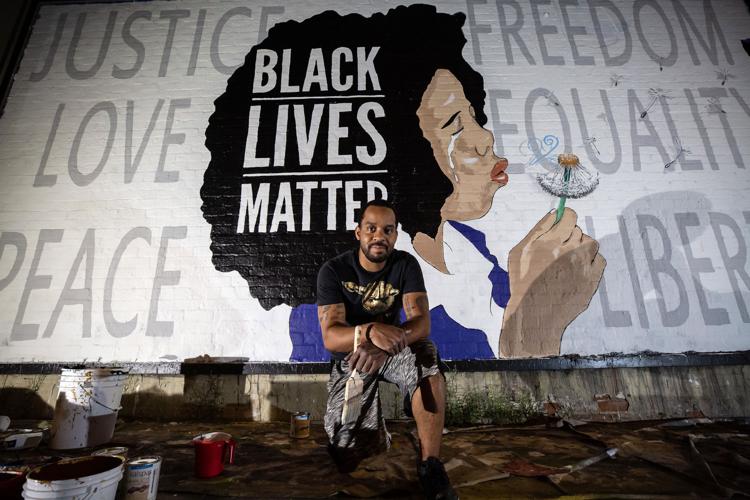
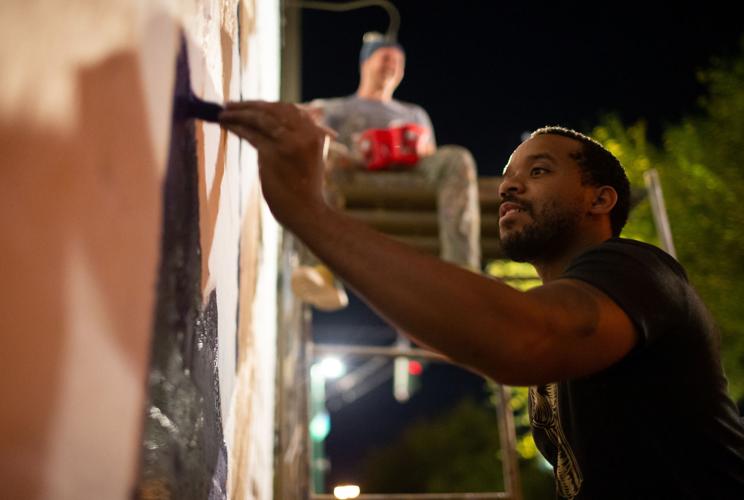
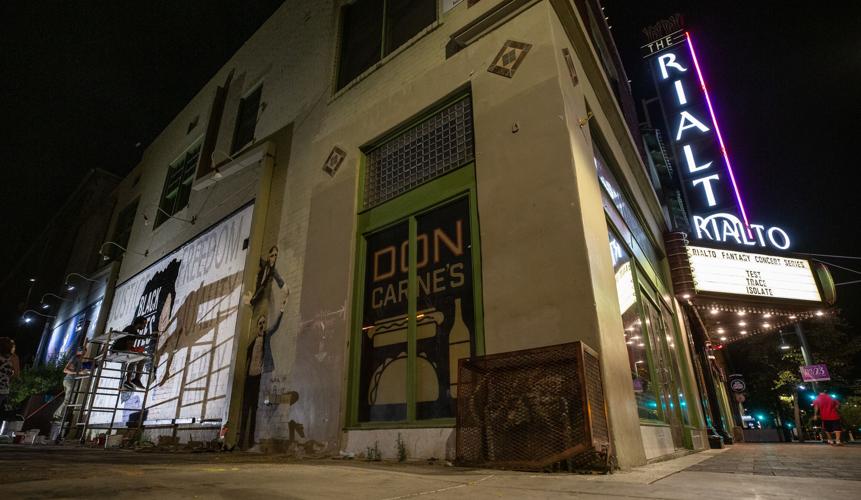
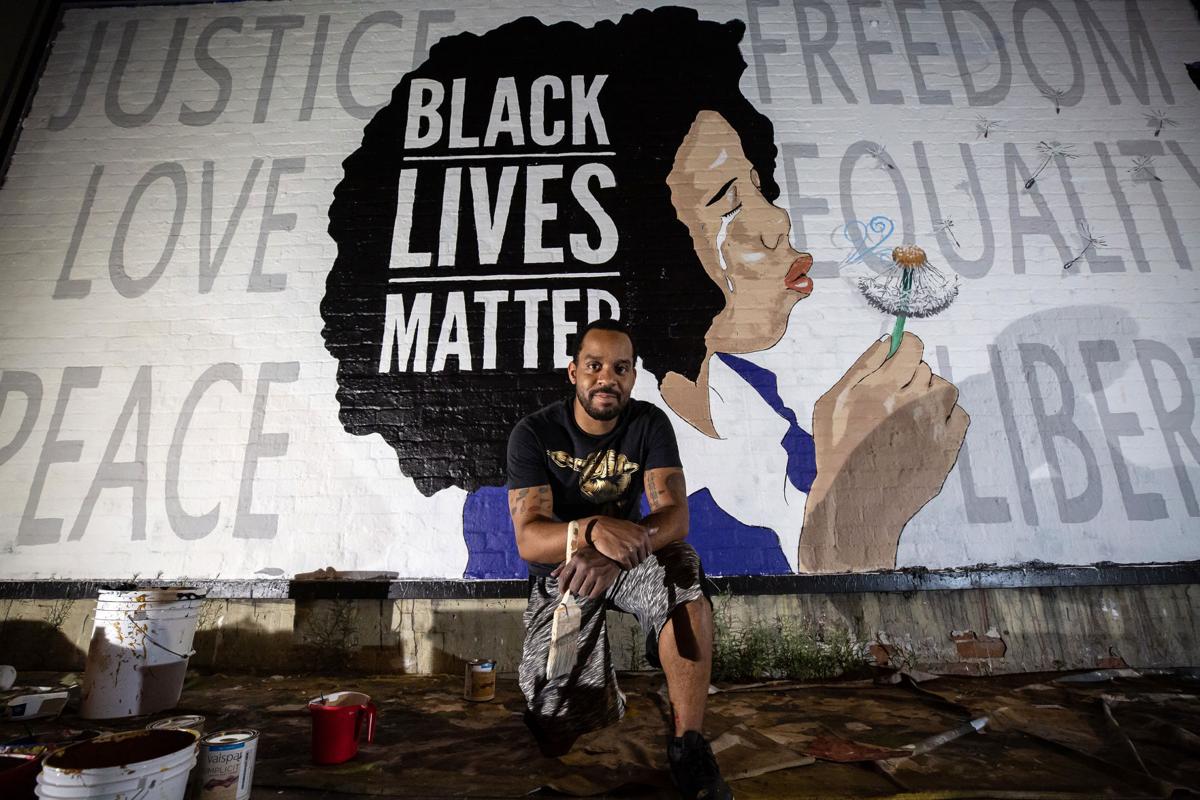
Robbie Lee Harris hopes his mural, on the side of the Rialto Theatre, will help launch conversations about the treatment of people of color in the United States.
So he put a call out for local black artists, secured the wall space, bought the paint and offered his assistance in any way he could.
But the work would be all theirs. Harris, Jamille and Wolf signed on to paint murals, and Pagac is expecting two more.)
“This is not a Pagac mural project,” he said. “Basically, I’m the guy in the shadows. I’ve told everyone, ‘you can do as much or as little as you like; I’m here to assist you.’”
Neither Pagac nor any of the artists is being compensated for the work or the materials.
The murals will be temporary; Pagac says all the walls have other purposes lined up. But, he said, “It’s the perfect time to get them up, to get artistic voices out there, and to keep the momentum going. It’s important, and hopefully will help make change.”
Harris took over a wall at Tucson’s Rialto Theatre Thursday night.
He wanted to do something uplifting.
Robbie Lee Harris hopes his mural, on the side of the Rialto Theatre, will help launch conversations about the treatment of people of color in the United States.
“It’s a young African American lady holding and blowing on a dandelion,” Harris said of his mural. “Written on the mural are the words justice, love, peace, freedom, equality and liberty.”
He also wanted to do something that was hopeful and could help launch conversations about the treatment of people of color in this country.
“When you see a big art piece, you get lost in that moment,” he said. “It hones you into whatever the message is. My idea is when someone turns the corner and sees the mural, they see that it portrays the innocence that the girl is wishing for. At the end of the day, I hope it triggers the conversation that needs to happen amongst everyone.”
Jamille and Wolf will share a mural space at the MSA Annex. They will be painting there this weekend.
Jamille has a baby at home and can’t get out to join protests, so she jumped at the chance to do a mural.(t)
The image will be colorful and graphic, and show African Americans experiencing the everyday joys of life.

The Black Lives Matter mural project seeks to break down racial barriers in Tucson and send a message in a big way.
“I am focusing on the hope and the love I feel for black people,” she said. “It will have imagery that touches on our history while looking to the future, ready to move forward.”
What it won’t contain are the painful images so often associated with black people — slavery, beatings, injustice.
“The black experience is so much more than that,” Jamille said. “I want to focus on the ways we are all the same. When you see the ways we are similar, it helps to break down barriers. ... When we start to see black people as whole human beings, it will change how others interact with us.”
Wolf, who already has a number of murals around town, will incorporate her calling card: ravens.
“There will be images of faces with my signature birds on them,” she said. “They represent the flight of imagination that we need in order to think and dream of a different place. Ravens are symbols of wisdom, and delving into the imagination.”
When Pagac first put out a call for African American artists, a number of people sent him to Wolf, and she was anxious to lend her art.
And while Pagac is known in Tucson and around the country for his murals, Wolf said his stepping aside to give center stage to black artists is important.
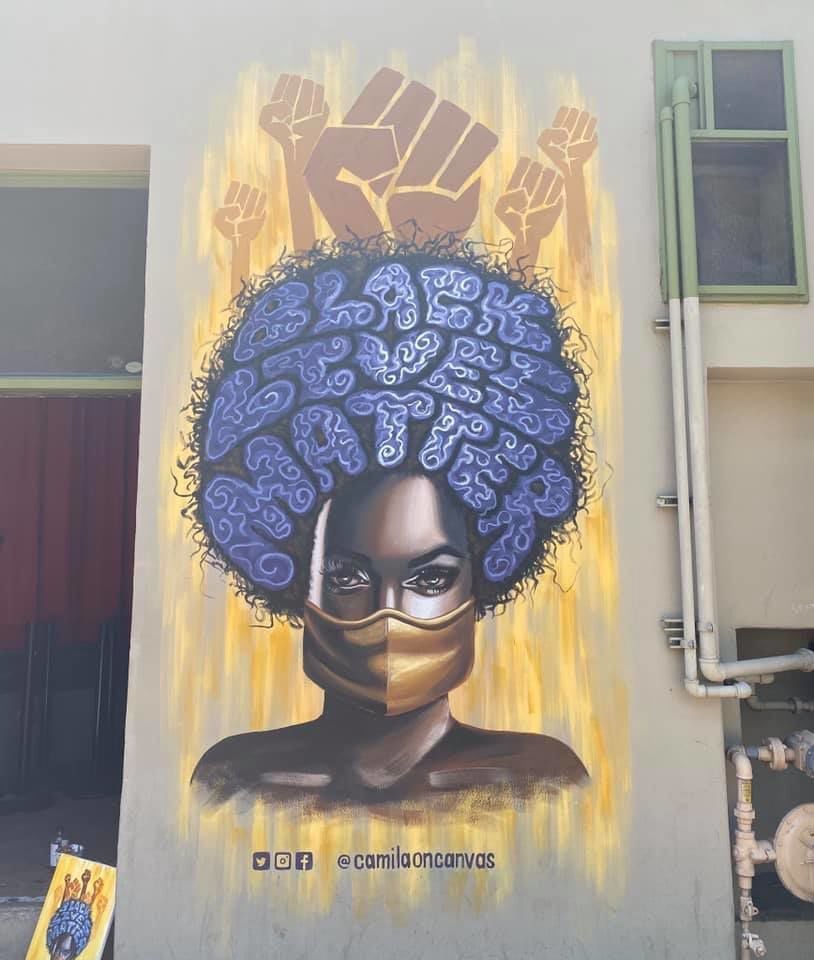
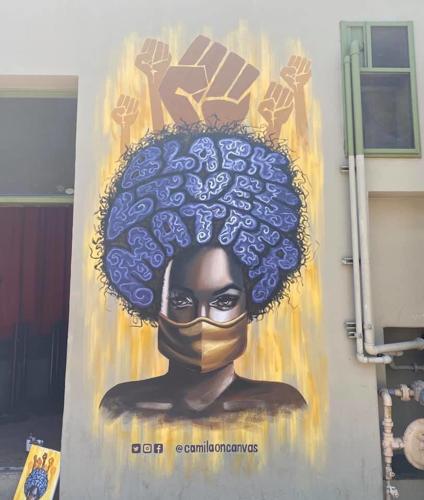
Camila Ibarra painted this Black Lives Matter mural on the side of Hotel Congress in solidarity with African Americans fighting police brutality and racial oppression.
“At times like this, it’s an act that’s appropriate,” she said. “It also addresses what needs to happen — if you are going to be an ally, you sometimes have to step back and let people of color stand out front. ... Representation matters. It absolutely matters.”
Photos: Sunshine Mile (Broadway) in Tucson
Sunshine Mile in Tucson
Updated
Hirsh’s Shoes was built in 1954 and is one of 29 buildings in the district designed by architect Bernard Friedman’s firm.
Sunshine Mile in Tucson
Updated
Hirsh's Shoes, 1954, on the Sunshine Mile (Broadway Road) in Tucson.
Sunshine Mile in Tucson
Updated
Hirsh’s Shoes at 2934 E. Broadway, in Tucson, circa late 1950s (courtesy Hirsh’s Shoes) and in 2016 (Mike Christy / Arizona Daily Star).
Sunshine Mile in Tucson
Updated
The distinctive Chase Bank at Broadway and Country Club was once a Valley National Bank. It was designed by Don Smith of Friedman and Jobusch Architects in 1971.
Sunshine Mile in Tucson
Updated
Construction workers build the Valley National Bank on the northwest corner of East Broadway Boulevard and North Country Club, on March 18, 1971.
Sunshine Mile in Tucson
Updated
Valley National Bank, 1973, on the Sunshine Mile (Broadway Road) in Tucson.
Sunshine Mile in Tucson
Updated
The Welcome Diner, built in 1964 as Sambo’s Pancake House, is on the western end of Tucson’s historic Sunshine Mile.
Sunshine Mile in Tucson
Updated
Solot Plaza on the Sunshine Mile (Broadway Road) in Tucson.
Sunshine Mile in Tucson
Updated
Kelly Building, built in 1964-65, on the Sunshine Mile (Broadway Road) in Tucson. Architect: Nicholas Sakellar
Sunshine Mile in Tucson
Updated
View from Country Club Road on the Sunshine Mile (Broadway Road) in Tucson.
Sunshine Mile in Tucson
Updated
Store in the Solot Plaza, built in 1958, on the Sunshine Mile (Broadway Road) in Tucson. Architect: Nicholas Sakellar
Sunshine Mile in Tucson
Updated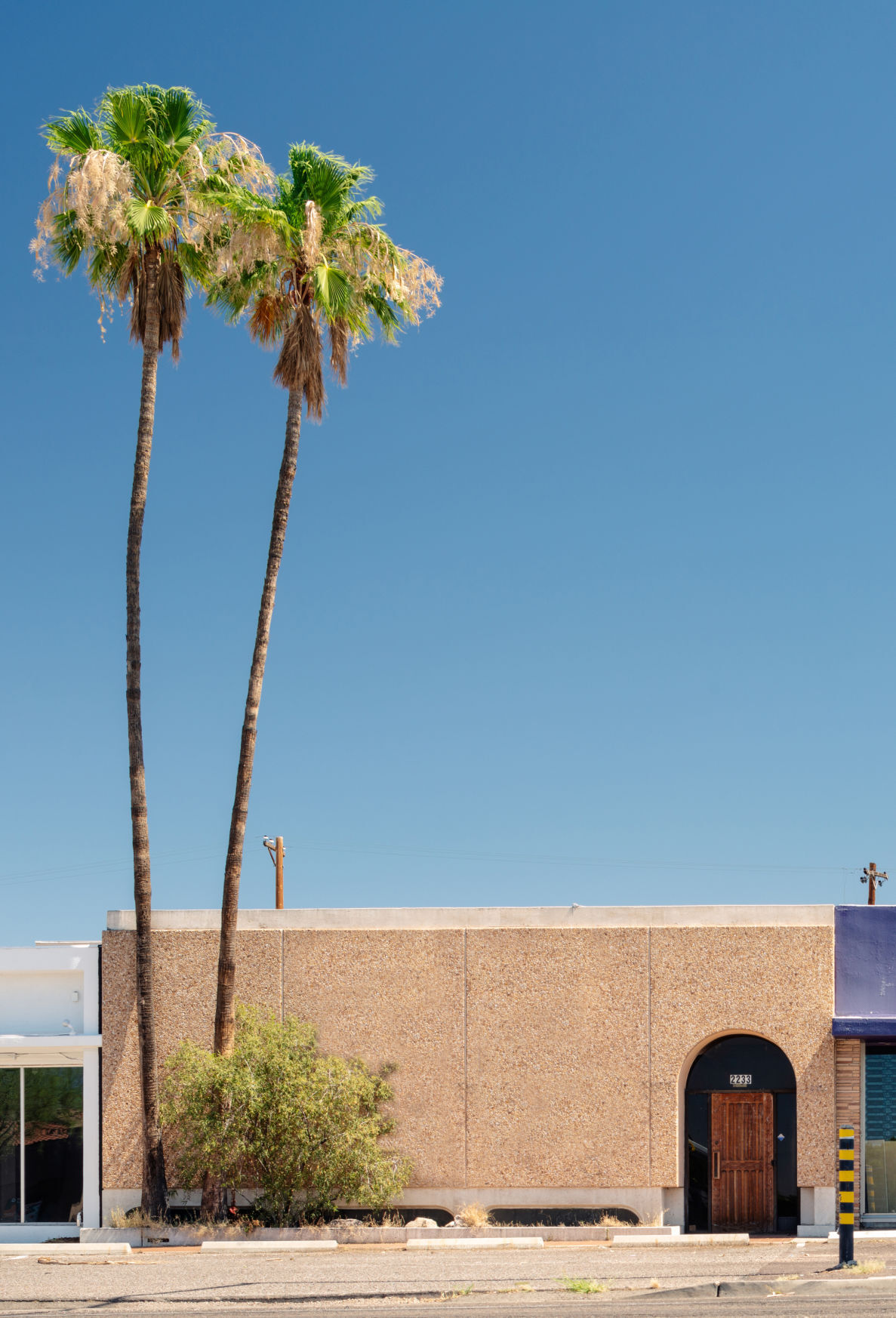
Friedman and Jobusch Office, built in 1950, on the Sunshine Mile (Broadway Road) in Tucson. Architects: Friedman and Jobusch
Sunshine Mile in Tucson
Updated
Old Pueblo Medical Group, built in 1965, on the Sunshine Mile (Broadway Road) in Tucson. Architect: Cain, Nelson and Ware
Sunshine Mile in Tucson
Updated
American Evangelical Lutheran Church, built in 1954, on the Sunshine Mile (Broadway Road) in Tucson. Architects: Jaastad and Knipe
Sunshine Mile in Tucson
Updated
Arizona Auto Refrigeration, built in 1951, on the Sunshine Mile (Broadway Road) in Tucson.
Sunshine Mile in Tucson
Updated
Old Tucson Jewish Community Center, built in 1953, on the Sunshine Mile (Broadway Road) in Tucson. Architect: Bernard Friedman
Sunshine Mile in Tucson
Updated
Anne Rysdale was Arizona’s only female registered architect when she developed and built the Haas Building in 1957.
Sunshine Mile in Tucson
Updated
A public workshop will be held May 18 from 9 a.m. to noon at First Assembly of God church, 1749 E. Broadway, to gather public reaction to a report on transforming the Broadway corridor into a public space as the city widens a portion of the street to six lanes.
Sunshine Mile in Tucson
Updated
The Chase Bank at 3033 E. Broadway Blvd. is one of several architectural distinctive buildings along the Sunshine Mile.

