


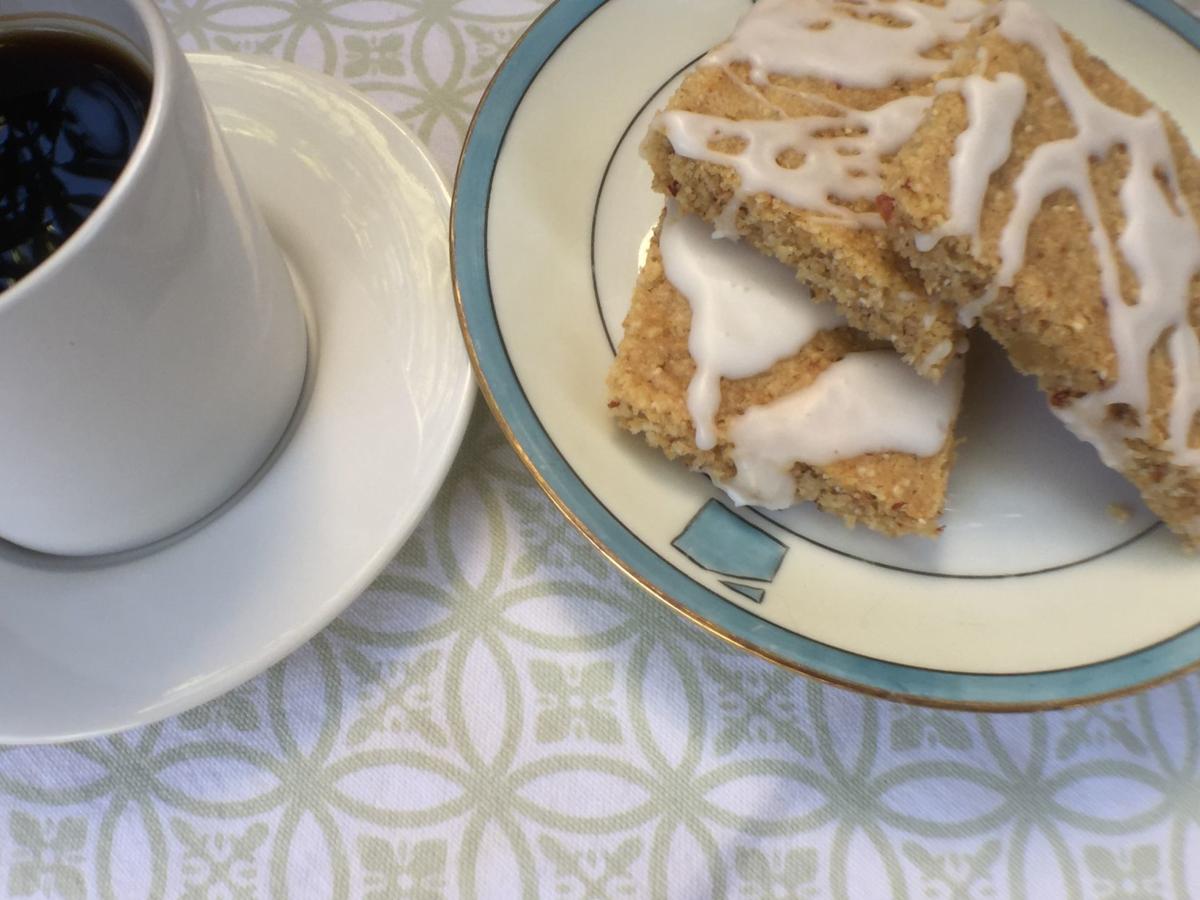
‘Tis the season for sugary treats to contribute to potlucks and church suppers, to give to friends and acquaintances, to set out to welcome guests to your home.
While there are plenty of lovely cookies appropriate for these occasions, I’m especially partial to these crunchy, surprising shortbread cookies. They’re a good companion to a cup of coffee or espresso, and they match well with a glass of milk. Whenever I serve them, happy eaters reach for seconds and say, “I’ve never had anything like this before!”
I’m so fond of these shortbread cookies that regular shortbread seems uninspiring to my palate now. Traditional shortbread is made using only butter, sugar and flour; its texture palls quickly, and its flavor seems boring to me. So I’ve been making variations on this shortbread for years now. Inits newest iteration, my lemon-ginger shortbread features Meyer lemon juice — a little sweeter and less sharp than regular lemons — together with the finely grated zest of those lemons.
Meyer lemons are just beginning their season here and will be around through the end of the year, if not a little longer. When they’re in season, I often pick up a passel and freeze some of their juice for use during the long months when they’re unavailable.
I also used some of Ramona Farms’ polenta, about which I wrote a while back, in this go-round. Its rough grittiness prevents the cookies from being boring, and — dare I say it? — even adds a wee bit of nutritional value. After all, shortbread is largely butter and sugar, so we’re not talking about a lot of nutrition. But people don’t eat cookies because they’re looking for healthy treats, do they?
And speaking of nutrition, let’s talk about what you can — and can’t — alter in this recipe. I haven’t made these using a gluten-free baking mix, but I think that substitution should work. It’s pointless to substitute margarine for the butter, because the flavor won’t be right and the simple recipe relies on real butter in its baking chemistry. By the same token, sugar substitutes won’t work, because the sugar plays a structural role in these unusual cookies.
Using lime zest and juice would be a delightful change. I use the standard rule of thumb that says a medium lemon will give you about a quarter-cup of juice, so plan to use the juice of two limes, together with their zest, if you want to try this variation. An orange zest and juice version would also work, I think; you’d need the juice of half of a large orange.
Although these cookies will be kept in a tightly lidded container for up to two weeks, you can also freeze them for longer storage. I often make a batch and freeze the pieces individually before putting them in a storage container. That way, I can pull out just a couple if I need a pick-me-up to go alongside that afternoon tea or espresso.
They’re sturdy enough to ship if they’re packed tightly before packaging to mail, but I think other cookies are better for shipping.
Sugary shortbread Cookies
Makes about a dozen pieces
Rich and surprising, these pretty shortbread cookies make a fine addition to a holiday cookie platter. The cornmeal — use polenta if you have it handy — contributes interesting texture, while the crystalized ginger adds a little zip. Make the superfine sugar needed here by whizzing granulated sugar in a food processor or blender for two to three minutes.
Ingredients
1 cup (two sticks) salted butter, at room temperature
½ cup superfine sugar
2 cups all-purpose flour
½ cup coarse cornmeal
¼ cup crystallized ginger, finely chopped
Juice and zest of 1 lemon
1 cup confectioners sugar
1 to 2 tablespoons heavy cream or half-and-half
Preparation
Preheat the oven to 325 degrees. Grease an 8-by-8 baking pan well and set aside.
In a stand mixer, beat the butter and sugar together for 10 minutes, no less. The mixture should be very white.
Use a rubber spatula to mix in the flour, cornmeal, ginger, and lemon juice and zest. Spread the mixture into the prepared baking pan, leveling the top with the spatula.
Bake for 30 to 40 minutes, or until slightly golden. The dough will puff up, then sink, while it’s baking. Remove from the oven and allow the shortbread to cool for 30 minutes before cutting into 12 pieces. If you have a bench knife or dough scraper, you can cut the cookies right in their baking pan. Otherwise, you may find it easiest to gently tip the baked slab onto a cutting board and go from there. Prepare the icing by combining the confectioners sugar with a tablespoon of cream or half-and-half. If the icing is too thick to drizzle, add more cream or half-and-half, one tablespoon at a time, until it reaches a drizzling consistency.
Place the shortbread pieces on a wire rack and use a whisk to drizzle the icing randomly over the pieces. Allow icing to harden before layering the shortbread pieces. They will be kept in a tightly lidded container for up to two weeks.

