



You know what you find in the middle of the road, right?
Roadkill.
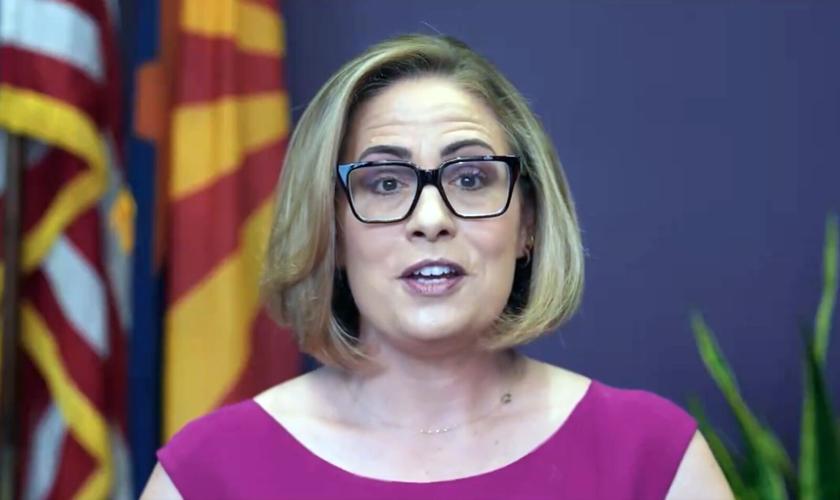
That old political saying came to mind Tuesday as Sen. Kyrsten Sinema announced her decision to step down at the end of this year when her term is over.
Sinema tried to position herself as a centrist dealmaker, sticking to the middle of the road, but she didn’t end up standing for much, other than the ideal of bipartisanship and her increasingly unusual self.
What will be left when she departs Hart Senate Office Building will be an air of disappointment and a faint, diminishing echo of her constant refrain “bipartisan … bipartisan … bipartisan.”
To be fair, this was her promise when she ran for Senate in 2018 and defeated appointed U.S. Sen. Martha McSally, a Republican. Sinema positioned herself as a nonpartisan, barely even a Democrat, allowing her to defeat the Trump-aligned McSally.
And she acted that way in the Senate, eventually leaving the Democratic Party altogether to serve as an independent.
But the implication that non-partisanship meant pragmatism — getting things done — has rarely played out in her term. Sometimes partisanship is pragmatic, as when Sinema voted with the Democrats and against all the Republicans, helping pass the American Rescue Plan 50-49.
The demise of her senatorial career is not just the fault of the polarized political system, as she suggested in her announcement Tuesday. It’s her fault, too.
Sign of self-involvement
The first sign I noticed of something unusual about Sinema the senator came a couple of months into her term. She took off for a week in the middle of Senate sessions to go to New Zealand. She was participating in a triathlon.
Being a triathlete is cool, but taking a week off during session two months into her first year was not. It was foreshadowing of Sinema’s self-defeating self-involvement.
As time went on, it became clear that Sinema liked to take advantage of the good life that her position in the U.S. Senate afforded. In summer 2020, she spent time as an “intern” at a winery in California, owned by private-equity interests, then held a fundraiser there.
As years went by, her financial filings revealed persistent spending on luxuries. In May 2023, an anti-Sinema group filed a complaint against her with the Federal Election Commission, alleging excessive spending of political donations on personal indulgences. Among the items:
- $35,702 on luxury hotels such as the Le Roch in Paris and the Waldorf-Astoria in Park City, Utah
- More than $20,000 on wine, most of it at wineries in California and Oregon
- $45,000 on chauffeured car and limousine services
In January this year, the Daily Beast, which has broken many stories on Sinema’s activities, revealed that since 2020 she has spent about $210,000 of her Senate budget — not campaign donations — on private plane flights. Most of that, about $116,000 worth of flights, occurred in 2023, including a flight from Washington D.C. to Arizona.
And Slate revealed in December 2022 that Sinema had a side-hustle of selling lightly used, high-end clothing and gear on Facebook Marketplace.
The senator who famously spent part of her childhood in an abandoned Florida gas station seemed to have found the antidote for her early-life privations.
Protecting a tax break
None of that would matter if she consistently produced for the everyday people of Arizona. She had some wins: By far the most important was the $1.2 trillion bipartisan infrastructure bill, which was a victory for her vision of slow, steady negotiation.
But she also started sticking her neck out for big money. She singlehandedly ensured that the carried-interest tax break, which benefits wealthy private-equity managers, remained in place. She had a repeal of that tax break removed from the Inflation Reduction Act, and she won financial-industry donations.
In her more arduous efforts, Sinema wasn’t helped by her obstinance on a crucial issue of Senate procedure — the filibuster.
Democrats pressured her, when she was still one of them, to eliminate or change the Senate rule that requires 60 out of 100 votes to advance most bills. She refused, saying that the traditional filibuster forces bipartisanship.
What I could never understand is her refusal to push for any type of reform to the filibuster. Consider that, in the past, a senator actually had to make a sacrifice to filibuster a bill. He would have to hold the floor and speak for hours, for example, but now senators simply send an email to block a bill. There’s no sacrifice required.
Sinema said she would consider reforms, but she didn’t pursue them. Some of the ideas were, for example, to again force a senator onto the floor to carry out a filibuster; or to get 41 votes in favor of a filibuster; or to gradually ratchet down the number of votes required to get a bill passed, from 60 to, say, 57, then to 55, over a period of weeks or months.
Such reforms could have incentivized further negotiation, but Sinema stuck with the outdated, painless filibuster that still prevails today.
Admirable, doomed efforts
And so she failed, repeatedly, most disappointingly in February, to pass the kind of bill she poured her effort into — a border-security bill. Her effort on this year’s border bill and other similar attempts was admirable, but they were doomed, not just by partisanship but also by her own refusal to reform the rules.
And so, as she decries the partisanship that she says is driving her from the Senate, I can’t help but conclude it’s largely her own fault. I think of her fanciful thumbs-down vote on a minimum-wage increase in 2021, a gesture that echoed John McCain’s 2018 thumbs-down vote that saved the Affordable Care Act. It was an unnecessary thumb in the eye of those who had supported her and favored a minimum-wage increase.
Worse was the photo she posted online in the aftermath, which showed her wearing a costume-jewelry ring. The ring formed words that you could make out in the photo: “F--- off.” Of course, the F word was fully spelled out on the ring.
In the end, it wasn’t just partisanship, but Sinema’s own performance that doomed her re-election.

