


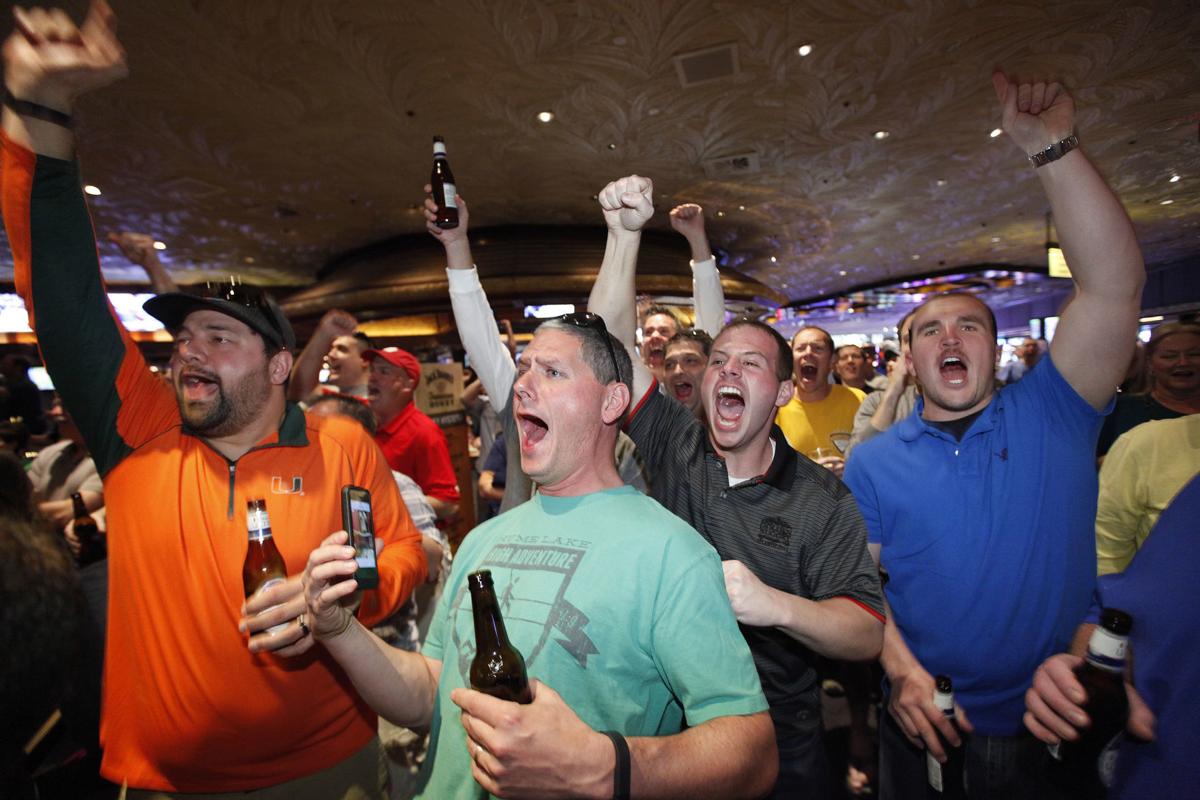
A ruling Monday by the U.S. Supreme Court could open the door to Arizonans legally betting for — or against — the Diamondbacks, Cardinals and even the Wildcats, Sun Devils and Lumberjacks.
It could also mean more money for the state.
In a 6-3 decision, the justices struck down a 1992 federal law which dictated that most states cannot allow such wagering. The majority concluded that the Professional and Amateur Sports Protection Act is an unconstitutional move by Congress to tell states what they can and cannot legalize.
“This is positive news,” Gov. Doug Ducey said on hearing the court struck down the law, which until now has prohibited most states from authorizing their residents to place legal bets on the outcome of professional and amateur sports.
The high court ruling said Congress is free to outlaw sports betting under federal law, but cannot tell states what they can and cannot make legal under their own laws.
In some ways, the timing of the ruling could not have been better.
It comes as Ducey already is negotiating with tribes to “modernize” the gaming compacts that Arizona voters authorized in 2002. These give the tribes the exclusive right to operate certain forms of casino gambling in exchange for the state getting a share of the profits.
Those compacts begin to expire after 2022. Ducey has made no secret he thinks there’s a better deal to be had in which the state would get more cash.
“This ruling gives Arizona options that could benefit our citizens and our general fund,” the Republican governor said.
Ducey spokesman Daniel Scarpinato said that specifically includes a possible trade-off: The tribes would get the exclusive right to take bets on sports and the state would reap a bigger share of the overall take.
The governor has not been opposed to the idea of expanding gaming to help balance the state budget. His original proposal to fund teacher raises included allowing the Arizona Lottery to start a keno game, a plan that was subsequently scrapped.
Odds are the tribes see opportunities, too.
“I think the Navajo Nation is very interested in sports betting and in finding ways to expand their casino offerings,” said attorney Steven Hart, who represents the state’s largest tribe.
That’s also the position of Stephen Roe Lewis, chairman of the Gila River Indian Community.
“We are looking forward to discussing with the state how we can go about working together on developing this opportunity, which could be a win-win for the state of Arizona and Arizona tribes,” he said in a prepared statement.
But not everyone thinks that if there is to be wagering on sports, the exclusive rights should go to the tribes.
“I don’t know why we would be left out,” said Vince Francia, general manager of Turf Paradise, who said there’s no reason to exclude the tracks. “We already bet on horse racing, which is one sport.”
Arizona Attorney General Mark Brnovich, who had sided with New Jersey in its challenge of the federal law, called Monday’s ruling a significant victory for states’ rights.
Sports betting remains a violation of state law, and the voter-approved compacts with the tribes limit the kinds of gaming that can take place at their casinos.
But the ruling opens the door to changes.
Brnovich said that is a decision for the governor and lawmakers. But as a former state gaming director and federal prosecutor, Brnovich said he is not terribly concerned that a change in Arizona law would lead to a massive increase in sports gambling.
“The reality is, it’s already going on,” Brnovich said. “We know during last year’s NCAA basketball tournament, so-called ‘March Madness,’ that of the money that was wagered, only about 3 percent of it was legally wagered,” that being in Nevada, which has an exception under the federal law.
The American Gaming Association produced a similar statistic for this year’s Super Bowl, saying that 97 percent of total wagers, equaling more than $4.6 billion, was expected to be bet illegally.
But Maricopa County Attorney Bill Montgomery is taking a more cautious approach to what lawmakers should do now.
“Arizona gaming policy to this point has been measured, regardless of the now-defunct federal legislation,” he said. Montgomery warned against seeing Monday’s ruling as an easy way to generate more cash for the state budget.
“Arizona should not rush into further gaming opportunities as a quick revenue generator,” he said. “Calculating costs requires careful review in order to fully weigh policy options.”
One factor behind the federal law was the claim by professional and amateur sports leagues that legalized wagering on the outcome of games will lead to a greater prospect of cheating. Players or coaches could be paid to “shave” points to, if not lose the game, win by a smaller margin than the point-spread line on wagering, they argued.
But Brnovich said that ignores the fact that billions of dollars already are being wagered, albeit illegally.
“So if someone’s going to compromise the integrity of an athletic contest, they, quite frankly, can already do that,” Brnovich said.
Conversely, he said, there may be benefits to having more of the sports wagering done through legitimate outlets.
“The reality is, you bring up the point shaving scandal from the 1990s that was uncovered as a result of the legal sports books in Las Vegas noticing aberrations in betting patterns,” Brnovich said.
“You could make a strong argument, I think, that if it’s regulated and people are on top of it, whether it’s the professional gamblers or it’s the professional sports books, that they will be able to detect anomalies and irregular betting patterns much better than some rookie in a back alley who has ties to organized crime,” he said.

