



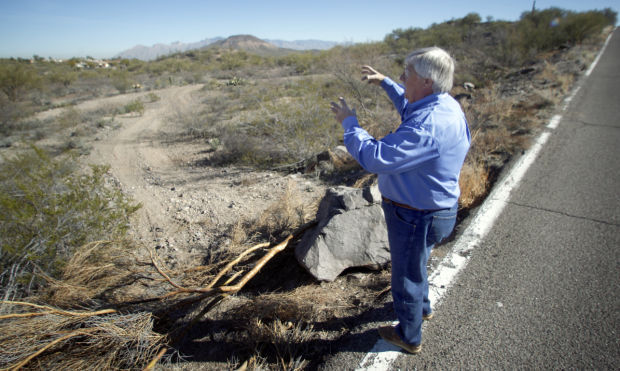

Pima County parks official Kerry Baldwin remembers the phone call all too clearly.
“The caller told me he had taken it upon himself to build several miles of mountain bike trails on public land in the Tortolita Mountains” northwest of Tucson, said Baldwin, natural resources division manager for the county. “He was extremely proud. But what he did was extremely inappropriate, destructive and illegal.”
That “build your own trail” incident is just one example of widespread problems with unauthorized trails on Pima County park lands around Tucson.
“We estimate that there are about 70 to 80 miles of trails in the core of Tucson Mountain Park” west of the city, Baldwin said this week on a visit to a popular park trailhead. “We designated and built only about 35 miles of those trails,” with many of the rest being poorly sited and difficult to maintain.
Other county park lands — including the Sweetwater Preserve northwest of Tucson — include poorly constructed trails from decades ago that are deeply rutted by erosion.
Officials are gradually closing unauthorized trails on county lands — replacing them with routes designed by trained trail builders.
HODGEPODGE OF TRAILS
The trails that weren’t built by the county — sometimes known as social trails or wildcat trails — are a combination of old roads to homesteads, jeep trails, routes beaten in over the years by free-ranging hikers, bikers, equestrians and quad vehicle drivers, and a few trails built intentionally and illegally by private citizens.
“There’s a segment of the population that sees public land as their own, and they build trails just thinking of their own interests,” Baldwin said.
The main problem with the unauthorized trails: They’re usually built by people without technical trail-building expertise — and that results in lots of problems.
Steve Anderson, a trails expert with Pima County Natural Resources, Parks and Recreation, said rogue trail builders often fail to take into consideration topography, impacts on wildlife, cultural resources and other factors.
“The trails we don’t like to see are trails, and especially jeep roads, that are sited on the fall line, which means the trail goes opposite of the sustainable line — for instance straight up a hill,” Anderson said. “That trail will erode, and it’ll be a mess after a few rains.”
Such trails, he said, require lots of maintenance and can have negative environmental impacts.
“That’s why we want everyone that wants a trail in a specific spot and is going to build it themselves to contact us to talk about what they want and where they want it,” Anderson said. “If we don’t want to put a trail where they do, we can usually specify an alternative that will work for them.”
Anderson noted that illegal trail builders are violating a park rule that prohibits destruction, damage or removal of county property. It’s a Class 2 misdemeanor, but information wasn’t readily available on whether violators have been cited for trail building.
HEAVILY IMPACTED SITES
One area where randomly beaten-in trails and illegal use by quad drivers have marred the landscape is county park land near a trailhead at the western end of 36th Street.
“This trailhead for decades and decades was a party place,” said Baldwin. “We’re trying to break that, but it’s been a real challenge. ... There are all kinds of different trail alignments — old roads and trails that have had lots of bike traffic and quad traffic.”
He showed sites where county crews have placed boulders at rogue trail entry points to keep out all-terrain vehicles that are prohibited on Tucson Mountain Park trails.
Some other trails in the area, used by hikers and mountain bikers, eventually will be closed after well-designed replacement trails are in place.
“This trail, for example,” Baldwin said, pointing out a narrow curving path, “follows the contours of the land. It was designed by us in 2008 and 2009 to limit damage to vegetation and avoid erosion.”
Another popular trail area with routes in need of work is the Sweetwater Preserve, on Tortolita Road south of West El Camino del Cerro.
“Here is another example of an old road that is used for a trail, but it is absolutely unsustainable,” said Baldwin, pointing out deep ruts caused by erosion on the preserve trail.
That trail is eventually to be replaced with one that contours across the hillside in a way that limits erosion.
ONGOING SOLUTIONS
Plans call for building new environment-friendly trails, or upgrading existing ones, and then closing and revegetating unauthorized trails as funding permits, Baldwin said.
“It will take some time and effort, but we’ll end up with sustainable trails,” he said.
OTHER PUBLIC LANDS
The Coronado National Forest of Southeastern Arizona has had limited problems with unofficial trails.
“Unauthorized trails do exist on the Coronado, but it is not a common problem,” said Heidi Schewel, spokeswoman for the forest. “Problems include erosion and the potential for hikers to become lost or disoriented.”
A spokeswoman for Saguaro National Park said unauthorized trails have created a “management problem” at times.
“Back in 2009, the park undertook a huge planning effort to locate, add, eliminate and improve trails as part of a comprehensive trails plan and environmental assessment,” spokeswoman Andy Fisher said.
“Since then, we have been systematically working through our trails plan, identifying priorities for improvement based on visitor use and condition,” Fisher said. “It has also allowed us to rehabilitate former unauthorized trails, many of which were redundant to official ones. There are a few areas in the park where new damage tends to occur as people want to access their parklands.”

