




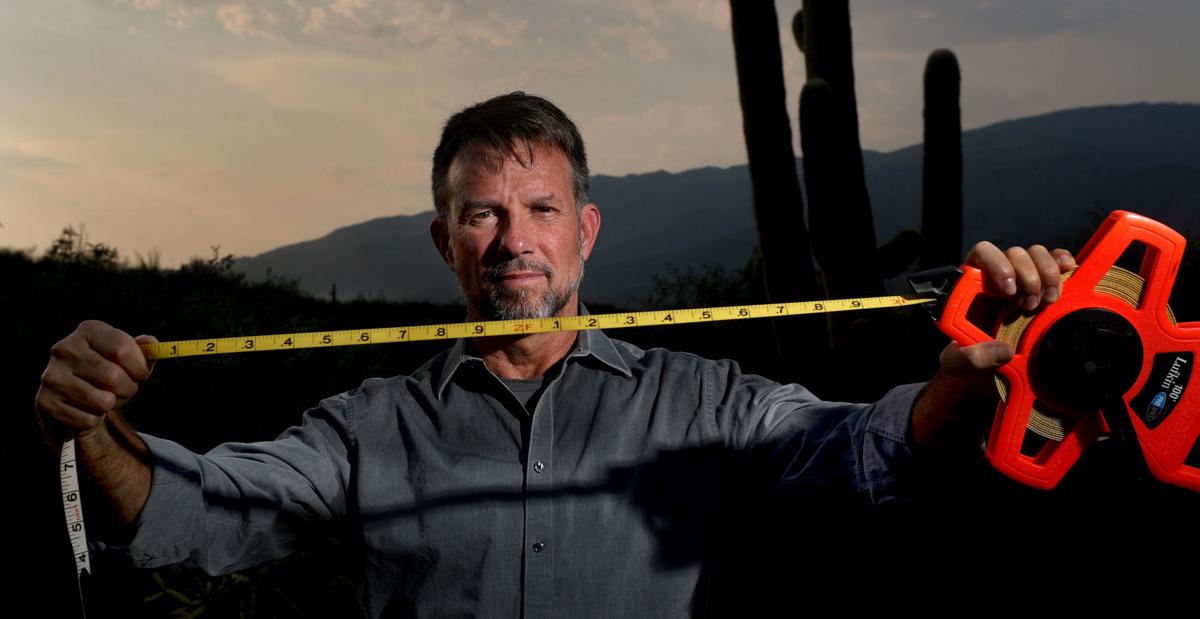
America has one too many feet, so the federal government is about to lop one of them off with the help of a surveyor from Southern Arizona.
Michael Dennis, who lives in Vail, is leading an effort by the National Geodetic Survey to eliminate an obscure, decades-old unit of measurement known as the U.S. survey foot.
Favored by American surveyors and almost no one else, the survey foot is ever so slightly longer than the more common international foot.
The difference between the two is two parts per million — or about one-tenth of an inch per mile — just enough to cause complications for major construction projects and large-scale surveys.
“They’re almost identical. But this is a real problem with real costs,” said Dennis. “I saw the chaos. I experienced it firsthand. I decided I wanted to do something about it.”
Good time to kill it off
The U.S. survey foot dates back to 1893, when the federal government officially defined its length as 1200/3937 — or approximately 0.30480061 of a meter.
An international standardization effort in the 1950s produced the second, slightly shorter foot, this one exactly 0.3048 of a meter.
The difference between the two is so small that it reveals itself only over great distances.
One place it frequently shows up is in measurements based on the state plane coordinate system, a government-issued mapping tool that divides the country into several hundred zones and allows land surveyors to plot locations and calculate distances without having to account for the curvature of the Earth.
Simply put, Dennis said, the system “makes it possible for surveyors to pretend the world is flat.”
The trade-off is one of scale. Measurements using the state plane coordinate system are based on a mathematical origin point that might be hundreds of miles away from a given survey site.
In the case of Pima County, the current “zero point” for state plane measurements is a spot in the Gulf of California, about 43 miles southwest of Puerto Penasco, Mexico. If you were to measure from there to the front steps of Old Main at the University of Arizona, you’d wind up with a 2 foot difference, depending on whether you used survey feet or international feet. If you measured from the zero point to the South Rim of the Grand Canyon, the difference grows to about 4 feet.
Dennis is currently supervising a major update of state plane coordinate systems nationwide. The yearslong effort, set for completion in 2022 at the earliest, could add hundreds of new zones and dramatically improve the accuracy of the system.
He figured what better time to finally kill off the survey foot once and for all.
“If we don’t do it now, we’re never going to get rid of this thing,” Dennis said.
An acre, plus or minus a cocktail napkin
His advice: Don’t think of it as an amputation. Think of it as America putting its best foot forward.
The change will improve the accuracy and uniformity of measurements while eliminating confusion and unnecessary costs, Dennis said.
“Even though it’s just surveyors, it actually impacts pretty much everyone, because surveyors do the measurements that we use to build infrastructure, to build buildings, to define property — all these things,” he said. “So people end up inheriting a certain version of the foot without even knowing it.”
His crusade recently landed him in the New York Times, which illustrated its story with a telling graphic showing just how little difference there is between America’s two feet.
The illustration, by the Times’ Eleanor Lutz, gradually zooms in on two side-by-side rulers that look identical at 10-times and even 100-times magnification. It’s not until you reach 1,000-times magnification that a difference in their lengths becomes visible.
On an acre of land, Dennis said, the difference between the two feet amounts to about 25 square inches — roughly the size of a cocktail napkin. A typical property survey isn’t accurate enough to even notice a variance that small.
“If the same surveyor measures the same parcel twice with the same equipment, they will not get the same distance or area within two parts per million. It doesn’t matter if the parcel is 1 acre or a thousand acres,” he said.
A society built on shared scales
Getting rid of the survey foot is actually a joint effort by the National Geodetic Survey, which is part of the National Oceanic and Atmospheric Administration, and the National Institute of Standards and Technology. Both are Commerce Department agencies, but it’s the institute that is tasked by Congress to maintain the nation’s system of weights and measures.
NIST, formerly known as the National Bureau of Standards, even keeps the official time for America, using an atomic clock at its laboratories in Boulder, Colorado.
The federal government has been in charge of maintaining our system of measurements from the very beginning.
The authority is enshrined in Article I of the Constitution, and President George Washington called it “an object of great importance” during the first State of the Union address in U.S. history on Jan. 8, 1790.
The quest for a shared set of standardized scales is far older than that — nearly as old as humanity itself, said Chris Lukinbeal, director of Geographic Information System Technology Programs at the UA.
“Scholars on the history of measurements would tell you that measurements create society,” he said. “The history of measures is part of the history of civilization.”
And like civilizations, measurements tend to grow more refined as technology advances, even while retaining fingerprints from simpler times.
Just consider the meter, the base unit of the metric system. It was originally defined in 1793 as “one- ten-millionth of the distance from the equator to the North Pole on a straight line running through Paris, France,” Lukinbeal said with obvious delight.
Today, the precise length of a meter is calculated using the speed of light.
“constant vigilance costs money”
Federal officials tried to phase out the U.S. survey foot in the 1980s, but the change never took.
Arizona is one of just six states to have legally adopted the international foot, though many American Indian tribes and federal agencies operating here don’t use it.
Dennis said the situation is reversed in Hawaii, where the state uses the survey foot, but military bases on the islands measure things in international feet.
“Then there are situations where the international foot is used horizontally, but the U.S. survey foot is used vertically,” he said. “So you’ve got this patchwork. You’ve got this whole mess.”
This is only a problem, of course, if one foot gets mistaken for the other. It’s one more thing for surveyors and engineers to worry about, Dennis said, and “constant vigilance costs money.”
“Everyone has a story”
Since he started working on the problem, he said a number of surveyors have told him stories about the screw-ups they’ve been involved in — or had to correct — because of the slightly different units of measurement.
Those cautionary tales are usually presented to him with key details left out.
“Everyone has a story,” he said, but no one wants to name names because of the expense and potential liability involved.
In one case, a high-speed-rail project in California was delayed because of a foot-related surveying error. In another, the top floor of a building had to be taken out of the plans after a corrected measurement placed the site in an airport flight path with strict height limits.
Dennis said he first encountered the foot issue about 25 years ago, when he was just starting out as a surveyor in Northern Arizona. He’s been dealing with the problem ever since.
The Ph.D. geodesist has even made some money off of it, before he went to work for the federal government in 2010. Dennis recalled one consulting job near Jerome, where he was paid about $2,000 to diagnose a nagging discrepancy in measurements for some sort of mining development.
“It turned out to be the foot thing,” he said.
“Revolution” needed for change
An actual amputation might be simpler. It would certainly take less time.
Dennis said it’s taken years of meetings and reports and legal notices to get to where they are now, and they’re still not finished.
The next nail in the coffin for the survey foot will come later this month when a final notice about the change is due to be published in the Federal Register.
In accordance with that notice, the government will officially declare the measurement unit obsolete on Dec. 31, 2022.
After that, a foot will be a foot, though surveyors will still occasionally refer to it as an international foot to distinguish it from that other, soon-to-be-discontinued one.
Eventually, Dennis expects the “international” term to fade from use as well, as the U.S. survey foot recedes into history.
Not everyone shares his confidence.
Rudy Stricklan is a long-time registered land surveyor in Arizona. He said Dennis is well-liked and well-respected in the industry, but surveyors can be stubborn and resistant to change, especially when it forces them to recalibrate their equipment.
“(Michael) is trying to simplify things, and objectively, he’s correct. There is no one saying, ‘This is crazy, and let me tell you why scientifically,’” Stricklan said. “But it’s kind of tough to dislodge some people. This is going to take another revolution.”
OK to mess with Texas this time
Stricklan’s prediction: Surveyors will simply ignore the government’s directive and keep on using the foot they’re used to the way they always have.
“Not in my lifetime — and probably not in your lifetime — is this going to go away,” said Stricklan, a former state chairman for the Arizona Professional Land Surveyors Association. “But it’s going to be an interesting battle.”
Dennis remains hopeful.
He said two states, Kentucky and Washington, have already written the change into statute.
He also expects support from people in Texas, considering how much they love to brag about the size of their state. When you measure it in international feet, Texas gets about eight feet “bigger,” Dennis said with a laugh.
“The idea here is not to torture people,” he said. “It really is to make things better.”

