



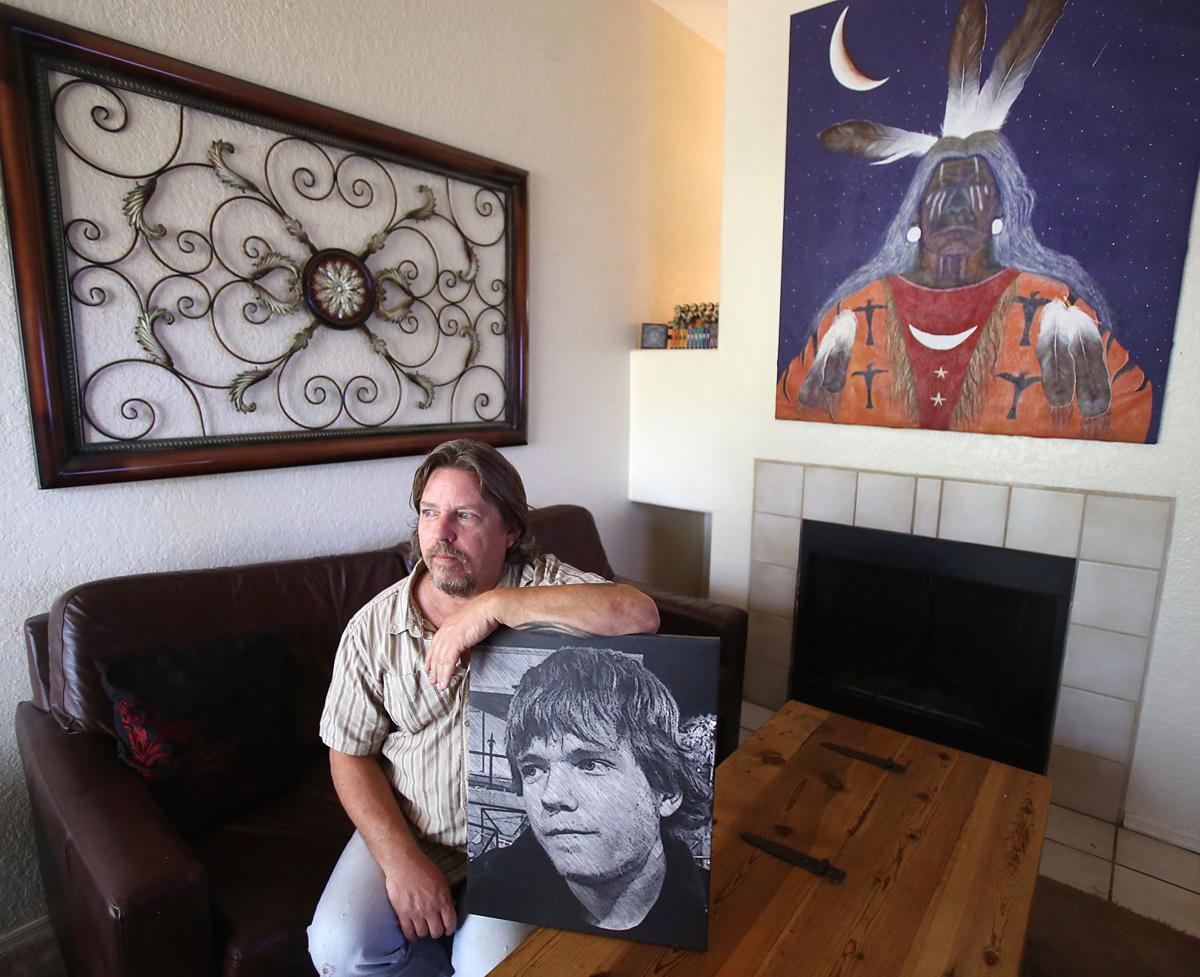
David Walker longs for what was — family camping trips, SpongeBob SquarePants and the life his son had before the voices began.
“He lives in a reality where there are snipers on rooftops, people’s heads are being lit on fire, of being stabbed and feeling the pain but no injury,” Walker said. “Life for him has literally been like living a nightmare since his early teens.”
Walker’s own nightmare includes images of his child dying alone in some garbage-strewn underpass. He’s haunted by the possibility that his 22-year-old son will unwittingly hurt himself or someone else.
Unlike many who successfully manage their mental-health diagnoses, Walker’s son resists or refuses help for the paranoia and auditory hallucinations common to schizophrenia.
The problem is compounded, Walker said, by the mental-health system’s growing tendency to encourage people to manage their own treatment — without enough supervision given to those unwilling or incapable of doing so. Walker, who tries to advocate for his son, said he keeps repeating the same requests and wonders sometimes if his son is remembered from one visit to the next.
“We’re stuck in this position of not having anything to do,” said Walker, an ecotoxicologist at the University of Arizona. “You can’t kidnap somebody, and I totally get that. At the same time, if it’s in society’s and that person’s best interest to require treatment, why is it so difficult?”
The hamster wheel
During the last few years, two things have helped Walker’s son. The first was being stabilized during a three-month stay at a facility in Washington state, where he landed after being imprisoned in Canada for illegal entry. Walker said his son, then 20, came back to Tucson determined to work and, for the first time, held a job for a few months.
The second followed, some months later, when his son started to regress and was court-ordered to follow a treatment plan that included injections of anti-psychotic medication. Walker said his son — who declined an interview request and is not being named to protect his privacy — stuck with that plan for a few months before deciding he didn’t need the shots.
“If your world is driven by conspiracy and fear,” Walker said, “of course you’re not going to like injections.”
Over the last couple of years, if he hasn’t wandered off to another state, the young man has cycled endlessly around what Walker calls the hamster wheel: He acts out, gets picked up by law enforcement and is evaluated before being released.
Then a new cycle begins.
“He’s been kicked out and then caught within an hour doing the very same thing he was doing in the first place,” he said.
Walker said his son has been taken in for psychiatric help at Banner-University Medical Center South or the county’s Crisis Response Center eight times this year, either after a run-in with law enforcement or by a concerned family member.
Employees with the Pima County Sheriff’s Department have grown familiar with the family.
“It’s an extremely sad situation and very frustrating for the father,” said sheriff’s detective Maria Stengel, who works in her agency’s mental-health unit. “We all agree with the dad that something more needs to be done.”
The young man’s infractions in recent years include pushing a shopping cart down the shoulder of Interstate 10, harassing and chasing a security guard, and pointing his fingers like guns to pretend he’s shooting passing motorists.
There have been a couple of domestic violence calls, including one in which he warned his father about what the voices were telling him to do. Walker said that while all the auditory hallucinations and imagined atrocities have seemed so real to his son, he’s never hurt anyone.
“I can’t deny he’s displayed frightening behavior at times, but he’s always pulled back or walked away,” Walker said. “I’ve never been really afraid, but I know when I need to back off.”
Court-ordered treatment
As one of the few exceptions to a person’s constitutional right to refuse health care, a judge can force someone to receive mental health treatment. That only happens, however, if the person is found to be a danger to himself or herself, a danger to others or is gravely or persistently disabled.
While many people are able to manage their illnesses without court supervision, a small percentage need more oversight, either through hospitalization or as an outpatient, said Deputy County Attorney Paula Perrera, who heads the health-law unit at the County Attorney’s Office.
Even then, it’s far from easy.
“Frankly, we don’t have a lot of resources out in the community that provide the wrap-around and intensity of services for those individuals who struggle to stay in treatment,” she said. “There’s not a lot of placements and programming for them.”
The number of people brought in to hospitals or the Crisis Response Center because they might need a court-ordered mental health evaluation has not changed much in recent years, averaging just about 2,000 annually. However, the number of people actually receiving those evaluations has dropped from a high of 43 percent between Jan. 1, 2013, and Aug. 1, 2013, to 34 percent last year, and then to 28 percent during the same period this year.
As a result, the number of people who go on to be court-ordered to receive treatment has also dropped, from 356 during those seven months in 2013 to 205 this year, county data show.
Part of the reason for that decrease is likely due to more patients being taken first to the Crisis Response Center. About 65 percent are released after they have been stabilized, usually to community treatment, detox or an outpatient provider. The rest are voluntarily or involuntarily hospitalized for a court-ordered evaluation.
“Before, there were too many people locked up and treatment was too coercive,” said Dr. Margie Balfour, chief clinical officer at the Crisis Response Center. “For the vast majority of people, the move toward self-determination is a good thing, but there are always outliers.”
What’s needed isn’t there
David Walker and Judy V. Kowalick have never met, but they have some important things in common.
Like Walker, Kowalick knows what it’s like trying to help a family member whose sense of reality is disturbed by paranoia and hallucinations. Her son is troubled by the same things.
And as coordinator of Tucson’s Family-to-Family program for the National Alliance on Mental Illness, she said she often hears from others with the same plight.
“There are a lot of family members who ask how to get their loved one court-ordered or into a hospitalized setting so they can be stabilized,” she said. “Family members can’t figure out why they can’t be kept in the hospital longer. But it’s not set up that way now and so what some people need is not available to them.”
Kowalick’s son, who is 36 and diagnosed with schizoaffective disorder, has been in the Arizona State Hospital for the last 10 years. He needs 24-hour supervision, she said, and still thinks people are tampering with his medication and want him dead.
“He still has severe delusions that people are out to harm him,” she said. “When he stops taking his medication, he can get really aggressive.”
While Kowalick is not advocating commitment to a hospital for anyone else, she said limiting that option should mean more resources in the community, including more supervised living facilities.
“We need better options,” she said, “and we need more of them.”
Walker can’t understand why his son doesn’t fall under the category of chronically disabled since he has repeatedly cycled through the mental health system.
“They don’t care about his history, what they care about is how he presents today,” Walker said, explaining his son “presents well” when he needs to. “Then, while we’re walking out the door, he’ll start talking about people’s heads being lit on fire.”
The young man’s caseworker and a psychiatrist who recently worked with him did not respond to interview requests.
Karl Sachs, a Tucson psychologist who got to know the family when Walker’s son was a teenager, said he fears cases like this are a “potential tragedy waiting to happen.”
Walker’s son, he said, “shares a profile of criteria seen in many if not most recent mass killings: young adult male, paranoid ideation, substance abuse and a history of violence including repeated involvement with law enforcement.”
Lucifer, rooftop snipers
Walker said his son won’t use a computer or cellphone now, fearing someone — particularly the government — could control him that way. But a couple of years back, he kept a blog. It’s filled with musings on his own immortality, references to heaven and hell and some violent imagery about blood-soaked floors and people conspiring to harm him or kill him.
In one post he reflected on meeting Jesus at the Juvenile Court Center — a wonderful experience that left him with deep feelings of peace, until Lucifer took over and started using his body.
He wrote that he was afraid of nothing because of his own divine powers, and had walked in traffic to prove it. He said he knew half of Tucson was trying to kill him, including people on rooftops pointing sniper rifles at him.
He wrote about a former girlfriend he believed was trying to kill him — and so, he reasoned, if he killed her first, it would be justified.
In late spring of this year, Walker said his son was doing a bit better. After a brief stay at Sonora Behavioral Health, he was living in housing provided by CODAC and appeared to be taking his medication. But by mid-July, like so many times before, he’d stopped taking his medications.
No one could force him because the treatment was not court-ordered.
A short time later, he was gone. He’s called his father a few times from New Mexico but says he isn’t ready to return home. They’ve been here before, with calls from Colorado, Oregon, Canada and Washington D.C., where the young man went in search of some time with President Obama.
He’s been hospitalized and jailed in several states, his father said. He’s also been assaulted. He arrives home needing food and a bath.
“It is only by sheer luck,” Walker said, “that he’s lived long enough to get to this point.”

