

It’s no surprise that bureaucracies consume reams upon reams of paper, perhaps none more so than the courts do.
“There’s not a week that goes by that we don’t have several hundred documents to read,” said Pima County Superior Court Judge Charles Harrington.
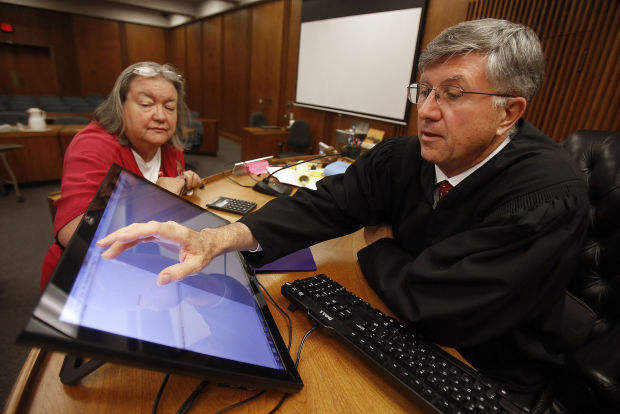
In an effort to streamline the courtroom and limit paper consumption, the county’s Superior Court has begun a pilot program for a new paperless courtroom system.
Called eBench, the new system allows judges to access entire case files electronically from the bench in the courtroom or in their chambers, minimizing the need to print case documents.
Judges can use the system to search case files for keywords or terms. The system allows them to attach notes to documents for later reference and share documents with staff members.
“In the past, it was all paper copies of everything,” Harrington said.
He’s one of three judges in Pima County to use the system in the beta format; the others are Judges Scott Rash and Jeffrey Bergin. The judges went live with eBench a week ago.
As judges and their staffers become more accustomed to the new system, Harrington said it later could be implemented across the entire civil bench in Pima County Superior Court.
Another long-term goal would be to have attorneys go paperless as well, at least in filing documents.
Harrington said the move toward a paperless courtroom was long overdue.
“When I came on to the bench, I had clients who had gone paperless,” he said, noting he was first appointed 15 years ago.
Other courts in the state have used paperless technologies outside the courtroom for many years.
The Arizona Court of Appeals first implemented an electronic document filing system for attorneys in 2001.
Since 2012, Division I of the Appeals Court and the Arizona Supreme Court have required attorneys to file certain court documents electronically.
A recent Arizona Supreme Court administrative order mandates all attorneys in the Appeals Court Division II, which includes Pima County, file all case documents through its electronic portal by Oct. 1.
Colorado-based Mentis Technologies developed the eBench system for the Arizona Supreme Court beginning in 2013. The court paid $275,575 for the system. The company also has developed similar paperless courtroom systems in Florida.

