

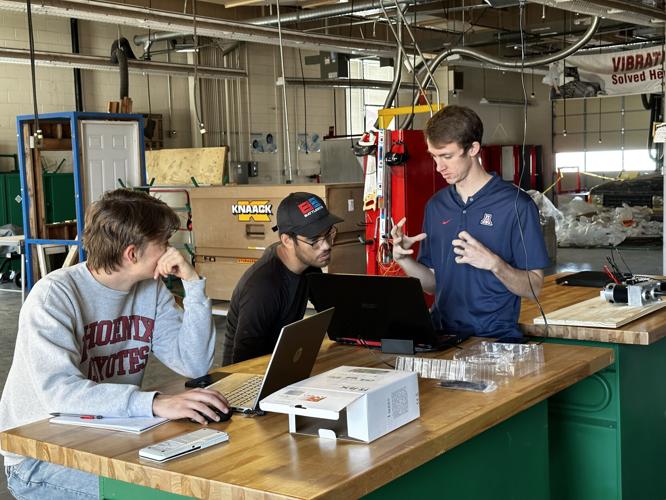


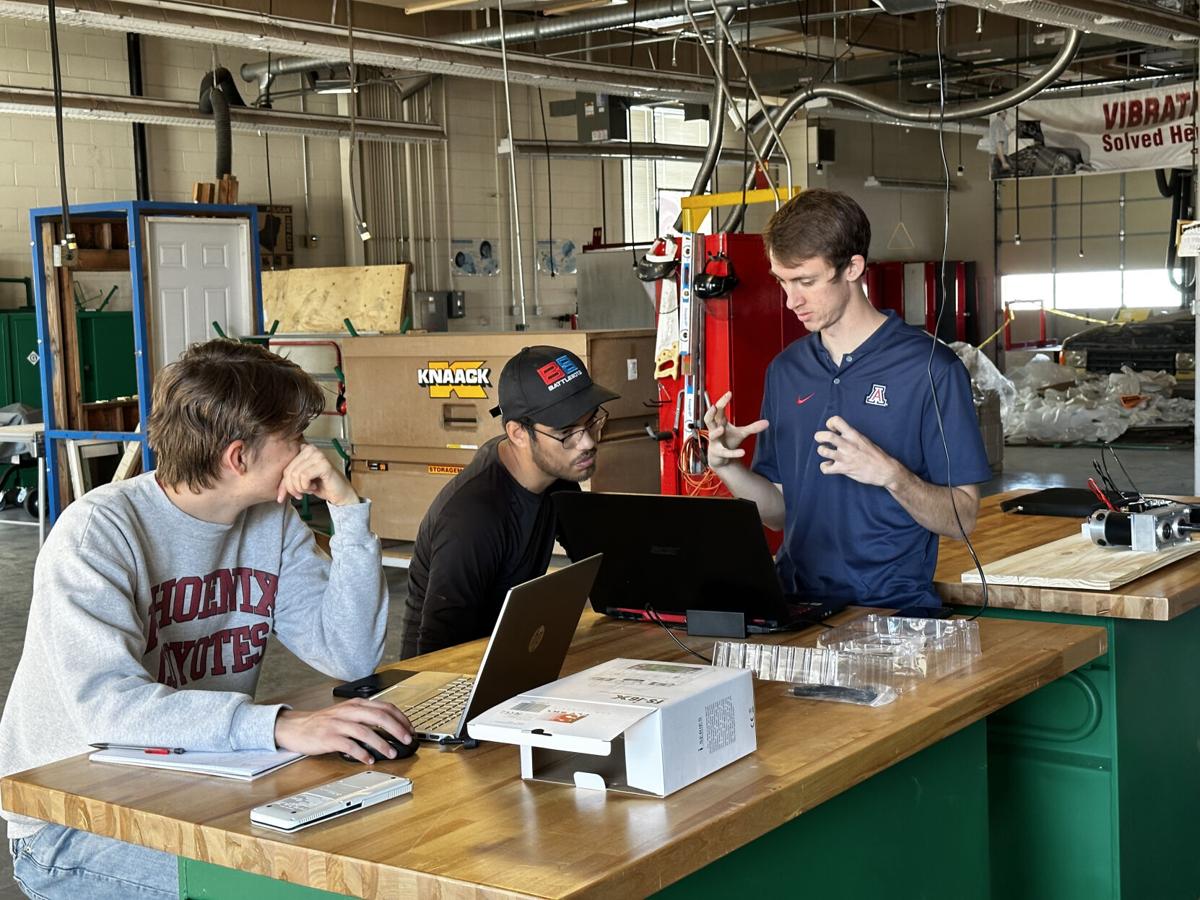
Nick Sivertson groaned as he set the cardboard box on the workshop desk.
The box cradled two 20-pound slabs of ballistic steel, sturdy enough to stop a bullet in its tracks.
Beside the box, wires weaved in between motors and batteries laid out on a strip of wood. A transmitter, which looks somewhat like a video game controller, accompanied the array on the table.
As the team gathered their materials on a Saturday morning, their grins only grew brighter.
Some of them had always dreamed of building a battle robot capable of pure devastation.
A palpable aura of excitement emanates from around the workshop table. Sivertson and the five other University of Arizona seniors laugh and joke about the Herculean task before them.
After 19 design iterations in computer-aided design software, or CAD, they are finally ready to bring their dream to life.
Their eyes are set on the biggest global arena in robotics: “Battlebots.”
The six UA College of Engineering students are constructing a 250-pound battle robot to compete on the “Battlebots” television show as a part of their senior capstone project.
The “Battlebots” competition features one-on-one bouts between massive, complex robots capable of causing serious destruction. The robots clash wheel-to-wheel inside the Battlebox, a perilous arena replete with automated hammers, spinning saws and powerful pinball-esque paddles, centered in Caesars Entertainment Studios in Las Vegas.
Given three minutes in the ring, two Battlebots operated by opposing teams try to cause as much damage as possible to their competitor. The bots feature weapons systems that they use to impair their opponents, with some of the more popular weapon types including flippers, flamethrowers and horizontal or vertical spinners that can rotate at hundreds of miles per hour.
Sivertson said that he and two other team members, Al Hurworth and Mathias Ramirez, birthed the idea in response to a lack of variety in past senior design assignments. As former members of the Baja SAE team, a design project where engineering students construct a Baja-style off-road racing car, the three decided they wanted to do something new and unique for their project.
“I think we all wanted to build something that was different than what we’ve done before,” Sivertson said. “So when the opportunity came up to build a robot, and build a robot of this scale, too, I was all in on it.”
After pitching their idea to the dean, they received an enthusiastic approval, allowing them to begin working on their idea.
The “Battlebots” competition is no stranger to college students entering the ring; the show has featured robots from student robotics teams at the University of California at Berkeley, MIT and the Rochester Institute of Technology, among others.
The UA Battlebot team’s six members include Sivertson as the project lead, Hurworth helping with leadership and project guidance, Ramirez overseeing the CAD design and robotics process, Yousuf Choudhary as the software lead, Karson Knudson as the safety and electrical systems lead, and Alex Wait as the weapons lead.

Materials for the build of the Sting “Battlebot” sit on a workshop table at the Pima Community College manufacturing lab.
The team’s bot is named Sting, and its creative design reflects that of a mechanical stingray. Sivertson said when he was around 7 years old, he was feeding stingrays in the Bahamas when one sucked his arm all the way up to his shoulder; he said he thinks the stingray mistook his thumb for a shrimp.
“It didn’t hurt, it just felt like a vacuum,” Sivertson said. “I’ve always kind of kept that lowkey, but that’s why I’ve always loved the design because I have that fond memory.”
The design of the Sting bot has changed many times throughout the team’s months-long process, with almost 20 design iterations so far. One early build of the bot came in at 380 pounds and had to be scrapped to fit the Battlebots heavyweight division requirement of 250 pounds.
The team’s current design of Sting meets the weight requirement and features a vertical spinner weapon. Sivertson said Sting’s vertical spinner tip speed is estimated to travel at 250 mph, capable of inflicting devastating damage to any opposing bots.
“That’s what everybody wants to watch,” Hurworth said. “When they’re watching ‘Battlebots,’ they don’t want to watch like a grabber or something. We want to make sure that we’re putting on a show, too.”
Making their mark
To connect with the senior design project idea, Hurworth spearheaded the creation of the Robotics Club at the UA during the fall. The club sponsors smaller Battlebot projects in addition to the heavyweight senior project, with two bots in the creation process: Gila and Buzzkill at 12 pounds and 3 pounds, respectively.
“One of the big things about the project is that we wanted to build a Battlebot, but at the same time, we wanted to leave a lasting thing at the university,” Hurworth said. “I really wanted to make sure that other students coming in that are interested in robotics have the opportunity to learn and grow.”
Each team member’s role is integral to the success of the bot’s design, and for acceptance into Battlebots, every single component must be up to code. Submitting a bot to the competition requires a full CAD design, as well as passing rigorous safety standards.
Ramirez heads the 3D modeling process in CAD, and also directs a lot of the robotics work as a whole. Ramirez has the most experience in robotics out of the team, even starting the VEX Robotics Club when he attended Empire High School in Tucson’s Vail School District.
Ramirez ensures that all of the sketches the team creates are able to be designed effectively in CAD, and said that a big challenge is modeling everything to be at the correct scale.
As an inveterate “Battlebots” fan, Ramirez said he is excited at the opportunity to participate in a competition that has been so important to him.
“It’s really a dream come true to have the support to build a Battlebot as a part of a class that I have to do anyway,” Ramirez said. “It feels a little bit like a cheat code to work with friends on something that you want to do anyways. It’s a lot of fun.”
Knudson, who majors in electrical computer engineering, statistics and data science, oversees both the electrical systems and safety standards of the Sting bot.

The Sting "Battlebot" design rendering in CAD.
“There’s many different layers of making sure that when this bot is not supposed to have power and not supposed to be moving, then it doesn’t have it,” Knudson said.
Choudhary, the software systems lead for the project, works on coding the telemetry system for Sting. The telemetry system allows the team to analyze Sting’s motor speeds and temperatures in real-time, so they can make quick strategic adjustments during a fight.
Choudhary also handles the programming for a drone robot, currently named Jellyfish, that will fly above the arena to track and follow the opposing bot and provide a bird’s eye view feed of the fight. Choudhary said having this extra layer of real-time reconnaissance can allow the Sting team to better predict what their competitor might do next inside the ring during a match.
In addition to being the weapons lead, Wait, a mechanical engineering major, also is in charge of fundraising and ordering materials. The trio raised more than $45,000 for the project from sponsors to cover the costs of building several bots and developing the Robotics Club.
The project has received money from various company sponsors, which help finance the project in exchange for advertising placement on the robot. Some company sponsors have also offered discounted prices to the team for using their products in the build model of Sting.
After completing their application to the “Battlebots” show in February, Hurworth said the team was contacted by one of the producers in March. Hurworth said the producer liked their application, but asked that they add a flamethrower to their design. Hurworth also said the producer invited the team to compete in an exhibition match during the “Battlebots Destruct-A-Thon” series in Las Vegas during May.
With their CAD design complete, and a working build of Sting expected to be completed by the end of March, the team intends to unveil their battle robot to fellow engineering students at the College of Engineering’s Craig M. Berge Design Day on May 1. After they fight in the “Destruct-A-Thon,” they hope Sting will be accepted to compete in the Battlebots World Championship VIII season taking place this summer.
“It’s our dream, and we’re going to go and make it happen together,” Choudhary said. “And it’s going to be very exciting to see.”
Fun facts
In the span of a three-minute Battlebots match at peak power, the Sting bot’s drive operates at about 100 amps – equivalent to powering five households.
The Sting bot is designed to travel at around 20 mph, but its vertical spinner’s tip speed is estimated to be around 250 mph.
The University of Arizona Robotics club is open to everyone, and any students interested in building “Battlebots” can join. The club hopes to build more robots and host fights at the UA, making it into a popular sporting event among the student population.
This might not look like much, but it could be the future of surgery and cancer treatment. This is what its designers call F3DB, a 3D bioprinter that uses bio-ink to repair the body’s organs, but it can do so from inside the body. Conventional bioprinting must first be done outside the body, then relying on invasive surgery to get whatever has been printed to where it needs to go. This method involves long recovery times, blood loss, chance for infection, you name it.
Photos: University of Arizona – Then and Now – Part 3
University of Arizona: Football stadium
Updated
The horseshoe-shaped University of Arizona football stadium is clearly visible on campus on September 10, 1968 in Tucson.
University of Arizona: Football stadium
Updated
The Meinel Optical Sciences Building at the University of Arizona in Tucson on July 23, 2018. It was originally built in 1970 and with the expansion of the west wing in 2006 has evolved into a four story structure above ground with three levels below. There is a 100-foot vertical test tower; laser beam, glass technology and solar energy laboratories; offices and classrooms.
University of Arizona: Adminstration
Updated
A couple of students walk along the University of Arizona Mall in front of the new Administration building being erected on January 3, 1966.
University of Arizona: Adminstration
Updated
Constructed in 1966, the University of Arizona Administration Building is not only occupied by the provost and vice presidents it is also used by student services and business offices including financial aid, the registrar's office and graduate college in Tucson on July 16, 2018.
University of Arizona: Mall
Updated
University of Arizona students enjoy a warm fall morning on the mall in Tucson, on October 1, 1968.
University of Arizona: Mall
Updated
Huge trees surround parts of Old Main, the original building at the University of Arizona in Tucson, including the balcony that overlooks the Mall on July 23, 2018.
University of Arizona: Mall at Campbell
Updated
A worker uses heavy equipment to place a palm tree along North Campbell Avenue near the easternmost side of campus at the University of Arizona, in Tucson on August 13, 1968. Some of the palm trees were transplanted from different parts of campus.
University of Arizona: Mall at Campbell
Updated
Cyclists ride along the entrance to the Mall at the University of Arizona in Tucson on July 25, 2018. The "Curving Arches (Homage to Bernini), right, was designed by Athena Tacha and is inspired by the work of Gian Lorenzo Bernini's St. Peter's Square. It was installed in September, 1981.
University of Arizona: McKale Center exterior
Updated
The new McKale Center is starting to take shape as construction continues at the University of Arizona in Tucson on August 4, 1972. The health and physical education complex, which will include a 15,000-seat basketball facility. McKale, named after legendary coach James "Pop" McKale Center, will replace the aging Bear Down Gym and is expected to be ready for the upcoming 1972-73 basketball season.
University of Arizona: McKale Center exterior
Updated
The McKale Memorial Center at the University of Arizona is the home of the Department of Intercollegiate Athletics in Tucson on July 16, 2018. Named in honor of James "Pop" McKale, the former athletic and Arizona coach, it has a 14,000 seat arena and now houses a 10,000 square foot strength and condition facility and heritage center. In addition of being the venue for the basketball, volleyball and gymnastics teams it is also where past commencement ceremonies have taken place.
University of Arizona: Dorms
Updated
Trees and spacious parking is available for football fans and for residents of Santa Cruz Hall, middle, and Apache Halls, far right, at the University of Arizona on East Sixth Street, in Tucson on September 11, 1966. The new look for the school is part of a decade of planning to provide as much open space as possible.
University of Arizona: Dorms
Updated
A large eucalyptus tree provides plenty of shade on the southwest corner of Arizona Stadium and partially obscures Likins Residence Hall at the University of Arizona in Tucson on July 16, 2018. Built in 2011 the four to six story hall was designed around a hacienda-style interior courtyard. It is named for former UA President Emeritus Peter Likens.
University of Arizona: Coronado Dorm
Updated
Coronado, the 10-story women's dorm, is one of the latest structures built on the campus of the University of Arizona on September 11, 1966.
University of Arizona: Coronado Dorm
Updated
The Arbol de la Vida, middle, is the largest and newest honors hall at the University of Arizona in Tucson on July 16, 2018. The six-story hall is home for more than 700 residents and features striking architecture including sky bridges connecting five buildings.
University of Arizona: Physics, Math and Meteorology
Updated
One of the newer structures on the campus of the University of Arizona, in Tucson, is the Physics, Math and Meteorology building on the southern part of the school near East Sixth Street on January 3, 1966.
University of Arizona: Physics, Math and Meteorology
Updated
Once called the Physics, Math and Meteorology Building, it is now the Physics and Atmospheric Sciences Building at the University of Arizona in Tucson on July 16, 2018.
University of Arizona: Math building
Updated
Work is still ongoing at the new Math Building at the University of Arizona in Tucson on April 4, 1968.
University of Arizona: Math building
Updated
Built in 1968, the Mathematics Building at the University of Arizona, in Tucson, is located on the southern portion of the campus on July 16, 2018. The department has a long tradition of doing outreach to local schools with programs that support high school teachers and provide a research center focusing on improving the math education of low-income Hispanic students. The department makes major contributions to the overall mission of the UA and Tucson.
University of Arizona: Administration and Mall
Updated
The walkway and steps that lead up to the nearly finished University of Arizona Administration building on campus on September 11, 1966.
University of Arizona: Administration and Mall
Updated
Students take a short cut as they walk in front of the University of Arizona Administration Building on their way to the Student Union in Tucson on July 16, 2018.
University of Arizona: Steward Observatory
Updated
A photo of the Steward Observatory on the campus of the University of Arizona in March 1930. R.B. Streets, UA Department of Plant Pathology / UA Special Collections.
University of Arizona: Steward Observatory
Updated
The old Steward Observatory at the University of Arizona in Tucson on July 16, 2018. The first telescope and building were dedicated on April 23, 1923. The observatory is near the Education Building, left, and Modern Sciences Building. When constructed it was located on an isolated piece of university land that was once an ostrich farm.
University of Arizona: Homecoming parade
Updated
The University of Arizona Marching Band performs during the Homecoming Parade as they walk south along North Stone Avenue in October 1955.
University of Arizona: Homecoming parade
Updated
Pedestrians cross North Stone Avenue near West Council Street at the Pima County Public Service Center in Tucson on July 16, 2018.
University of Arizona: Mall and Old Main
Updated
The Student Union bell tower looms over the campus mall at the University of Arizona in Tucson, on October 1, 1968.
University of Arizona: Mall and Old Main
Updated
The Mall at the University of Arizona looking west in Tucson on July 16, 2018.
University of Arizona: Bear Down Gym
Updated
In the early spring of 1926 the metal framework for the new men's gymnasium at the University of Arizona is beginning to take shape. The structure is where the Wildcats are expected to play their basketball games, the first maybe as early as January, 1927. It is located east of the Old Main, the original building on campus.
University of Arizona: Bear Down Gym
Updated
Bear Down Gymnasium is still in use at the University of Arizona in Tucson on July 16, 2018. Constructed in 1926 as the men's gym it has served a number of different functions throughout its history. It was the main basketball venue until the McKale Center was built and during World War II it was made into a barracks for cadets in the Naval Training School. The Department of Campus Recreation uses the basement for activity classes, the main floor currently houses the Office of International Admissions, College of Letters, Arts and Science Academic Advising Center and the THINK TANK.
University of Arizona: Optical Sciences
Updated
The huge hole in the ground on the eastside of campus at the University of Arizona is going to be the new Optical Science Building on September 10, 1968, in Tucson.
University of Arizona: Optical Sciences
Updated
The Meinel Optical Sciences Building at the University of Arizona in Tucson on July 23, 2018. It was originally built in 1970 and with the expansion of the west wing in 2006 has evolved into a four story structure above ground with three levels below. There is a 100-foot vertical test tower; laser beam, glass technology and solar energy laboratories; offices and classrooms.
University of Arizona: McKale Center
Updated
Interior of the new McKale Center is starting to take shape as construction continues at the University of Arizona in Tucson on August 4, 1972. The health and physical education complex, which will include a 15,000-seat basketball facility. McKale, named after legendary coach James "Pop" McKale Center, will replace the aging Bear Down Gym and is expected to be ready for the upcoming 1972-73 basketball season.
University of Arizona: McKale Center
Updated
Participants in coach David Rubio's volleyball camp break out into groups at the University of Arizona McKale Center in Tucson on July 16, 2018.
University of Arizona: South of Bear Down Gym
Updated
A paid parking gate is located not far from the mall at the University of Arizona on September 11, 1966. The new look for the school is part of a decade of planning to provide as much open space as possible.
University of Arizona: South of Bear Down Gym
Updated
Likins Residence Hall at the University of Arizona, in Tucson, was built in 2011 and is next to Arizona Stadium on July 16, 2018. The four to six story hall was designed around a hacienda-style interior courtyard. It is named for former UA President Emeritus Peter Likins.
University of Arizona: Mall looking East
Updated
University of Arizona students enjoy a warm fall morning on the mall in Tucson, on October 1, 1968.
University of Arizona: Mall looking East
Updated
The Mall at the University of Arizona as seen from Old Main in Tucson on July 23, 2018. It is now the site of the USS Arizona Mall Memorial featuring medallions bearing the names of the 1,177 sailors and US Marines killed in board the ship on December 7, 1941.
University of Arizona: Football stadium
Updated
There is a new, open look at the football stadium, just east of the building where the baseball field is being developed on Sixth Street, on September 11, 1966. The new look for the entire school is part of a decade of planning to provide as much open space as possible. Moving the baseball field from Bear Down Gym is helping to create the open mall look that will be extended all the way to North Cherry Avenue. The university's aggressive building program amounted to about $8 million which includes the new administration building, the Space Sciences building and a new women's dorm.
University of Arizona: Football stadium
Updated
Construction of the Intercollegiate Athletics Indoor Sports Center at the University of Arizona continues in Tucson on July 16, 2018. Once the site of Sancet Field, the baseball complex has made way for the Arizona football team facility after moving to Hi Corbett Field. The $15 million indoor sports center which is expected to be completed in December 2018, includes a 90-yard field with a 10-yard end zone and full width, climate-controlled area for training and conditioning.
University of Arizona: Steward Observatory
Updated
A circa 1921 copy photo of the Steward Observatory at the University of Arizona in Tucson.
University of Arizona: Steward Observatory
Updated
at the University of Arizona in Tucson on July 16, 2018.

