



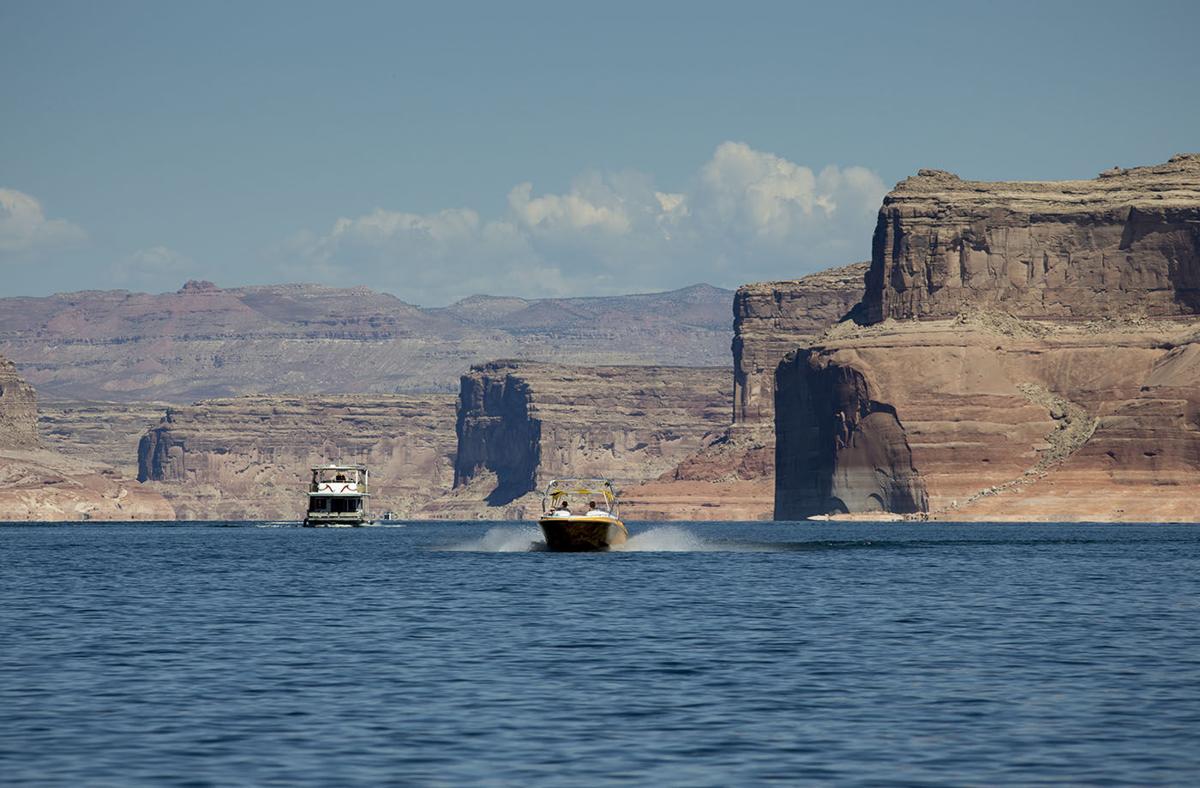
Arizona and five other Colorado River Basin states are challenging a proposed pipeline that would divert to a booming Utah community almost as much river water as Tucson uses every year.
Six of the seven river basin states — all but Utah — wrote to the U.S. Bureau of Reclamation on Tuesday, seeking a delay in publishing a final environmental review, and in making a final decision, on the Lake Powell pipeline. They want time for states to “reach consensus regarding outstanding legal and operational concerns.”
It’s a highly unusual move. The basin states have in recent years resolved various issues about management of the over-allocated river without breaking out into public disputes. The letter mentions that history as one reason for delay on this pipeline.
“The Colorado River Basin states face daunting challenges as populations continue to grow, water demands increase, and supplies diminish,” the letter says.
So far, the states have managed to stave off crippling shortages on the river through a series of collaborative efforts, their letter says.
But if federal officials approve this pipeline soon, “we believe the probability of multiyear litigation ... is high,” the letter continues. Certain legal questions best left to the states to resolve are likely to be raised in such lawsuits, it says.
“That is not a recipe for creating the kind of meaningful and positive change needed to sustain the Colorado River in the coming decades,” it says.
The bureau had no comment on the letter, which was signed by Arizona Department of Water Resources Director Tom Buschatzke and officials of New Mexico, California, Nevada, Colorado and Wyoming.Utah’s Division of Water Resources will use the next several months to address other states’ concerns, said its director, Todd Adams.
“As Colorado River Basin states, we’ve resolved complex challenges and concerns before, and we will do the same now,” Adams said. “We remain committed to working with the other basin states to mitigate their legal and operational concerns raised by Utah’s intent to use a portion of its Colorado River allotment to provide water to Washington County.”
The pipeline has been a major source of contention for many years between environmentalists, tribal interests and state officials. The 140-mile pipeline would deliver 86,000 acre-feet of water annually for expected future growth in the St. George area of Washington County, one of the fastest growing counties in the United States.
The Utah Division of Water Resources estimates the project’s cost at $1.1 billion to $1.9 billion. In 2019, Utah’s legislative auditor general pegged the likely cost at $2.4 billion, due to inflation resulting from lengthy construction delays that are expected.
The pipeline would take water from the Colorado River that Arizona and the other basin states are using via previously approved projects such as the $4 billion Central Arizona Project that delivers river water to Phoenix and Tucson. Tucson uses about 90,000 acre-feet of CAP water annually and recharges another 50,000 or so acre-feet into the aquifer every year. An acre-foot is enough to serve four Tucson households for a year.
The Bureau of Reclamation published its draft environmental impact statement on the Utah pipeline in June. It is scheduled to publish a final statement on Nov. 21 and to issue a decision in January.
It has sped this review as part of a broader Trump administration effort to quicken reviews of a host of large projects.
The Lake Powell pipeline is needed to satisfy expected growth in the county from 186,000 people today to 468,000 in 2060, county officials say. In its draft environmental impact statement, the reclamation agency says existing local water supplies aren’t nearly enough for that many people, setting the stage for major water shortages by 2060.
“More than 20 years of planning have gone into the Lake Powell pipeline to meet the needs of Washington County’s growing population and to diversify the area’s water supply. Without the project, the county’s economic viability and water security will be harmed,” Utah water director Adams said.
This slideshow recounts the creation of Lake of the Ozarks and the subsequent tourism that followed years later.
“Wildly out of touch”
Opponents have called the pipeline a wasteful, overpriced boondoggle, diverting water from a river whose supply has already fallen close to 20% since 2000, in part due to human-caused climate change. The opponents say more intensive water conservation efforts could satisfy the St. George area’s water needs without it. They point to the county’s per person water use of 305 gallons daily — far higher than for most Arizona cities. Washington County officials say they’ve shaved 1 million gallons a year off their water use since 2000.
“These letters of opposition from outside Utah demonstrate how wildly out of touch the Utah Division of Water Resources has been on this dinosaur water project,” said Zachary Frankel, director of the Utah Rivers Council. “The Lake Powell pipeline needs to die and we need new leadership in Utah that understands what the 21st century means for the West.”
In separate comments on the draft federal environmental report, Nevada water officials questioned the need for the project.
Utah officials have incorrectly characterized as impractical the use of conservation techniques such as converting turf to desert landscaping and creating water conservation incentives that are used effectively in many other communities, the Southern Nevada Water Authority said.
California officials raised concerns the environmental report didn’t adequately analyze combined impacts of the pipeline and two other planned Utah water projects that would take a total of about 240,000 acre-feet out of the Colorado.
“A quarter of a million acre-feet is decent sized. We need to take a look at the impacts of this. We’re managing for endangered species and habitat alongside the river, and that’s enough of a size that we need to take a hard look,” said Jeff Kightlinger, general manager of the Los Angeles-based Metropolitan Water District.
Joel Williams, an assistant director for the Utah water agency, defended the bureau’s work on this issue, saying its computer modeling “includes all the aforementioned water uses and more. Environmental impacts due to the pipeline were analyzed and the (environmental statement) adequately addresses the cumulative impacts.”
The basin states’ letter focuses on more abstract legal issues. The proposed diversion raises “significant questions” concerning the 1922, seven-state Colorado River compact, and the 1948 Upper Colorado River Basin compact, which covers the four Upper Basin states, it says.
Because the pipeline takes water from the Upper Basin’s share of the Colorado, “our view is that it doesn’t necessarily change what’s available for the Lower Basin,” Kightlinger said.
“But it pushes the two basins more toward conflict if we have to start measuring, are we getting our appropriate share of water?”
Photos: 2020 going down as a year of climate disasters
Climate Disasters
Updated
FILE - In this Aug. 27, 2020, file photo, buildings and homes are flooded in the aftermath of Hurricane Laura near Lake Charles, La. Climate-connected disasters seem everywhere in the crazy year 2020. But scientists Wednesday, Sept. 9, say it'll get worse. (AP Photo/David J. Phillip, File)
Climate Disasters
Updated
FILE - In this Sept. 7, 2020, file photo, a firefighter battles the Creek Fire as it threatens homes in the Cascadel Woods neighborhood of Madera County, Calif. Climate-connected disasters seem everywhere in the crazy year 2020. But scientists Wednesday, Sept. 9, say it'll get worse. (AP Photo/Noah Berger, File)
Climate Disasters
Updated
FILE - In this Aug. 17, 2020, file photo, Steve Krofchik cools off with a bottle of ice water on his head in Death Valley National Park, Calif. Climate-connected disasters seem everywhere in the crazy year 2020. But scientists Wednesday, Sept. 9, say it'll get worse. (AP Photo/John Locher, File)
Climate Disasters
Updated
FILE - This Sept. 6, 2020, file satellite image released by NASA Worldview, Earth Observing System Data and Information System (EOSDIS) shows Typhoon Haishen barreling toward the main southwestern island of Kyushu. The second powerful typhoon to slam Japan in a week has unleashed fierce winds and rain on southern islands, blowing off rooftops and leaving homes without power as it edged northward into an area vulnerable to flooding and mudslides. (NASA via AP, File)
Climate Disasters
Updated
FILE - In this Aug. 23, 2020, file photo, fire consumes land recently deforested by cattle farmers near Novo Progresso, Para state, Brazil. Climate-connected disasters seem everywhere in the crazy year 2020. But scientists Wednesday, Sept. 9, say it'll get worse. (AP Photo/Andre Penner, File)
Climate Disasters
Updated
FILE - In this Sept. 9, 2020, file photo, firefighters watch the Bear Fire approach in Oroville, Calif. Climate-connected disasters seem everywhere in the crazy year 2020. But scientists Wednesday say it'll get worse. (AP Photo/Noah Berger, File)

