

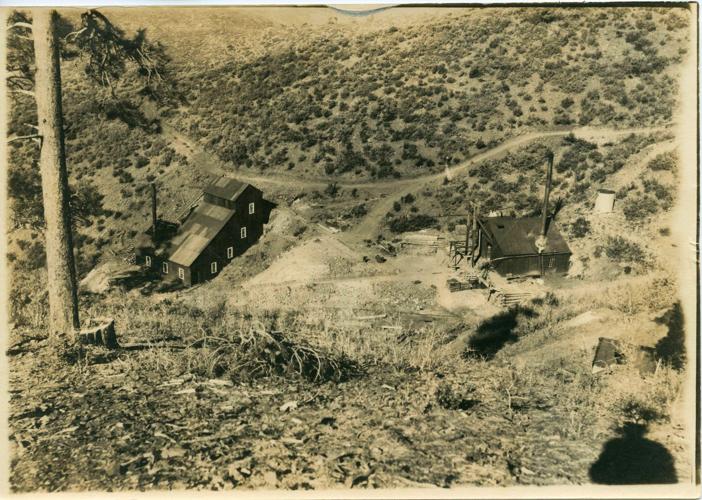
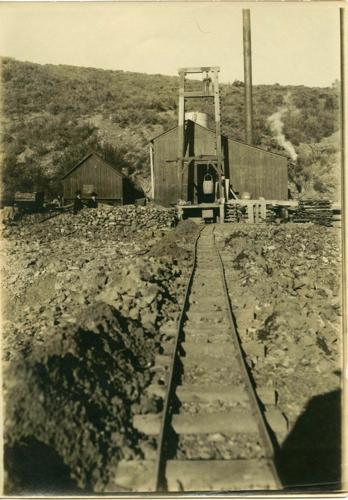
Located seven miles west from Prescott in the Thumb Butte Mining district in Yavapai County, the Derby — or Madizelle — Mine was active in the early 20th century.
The Derby Mining Co. comprised over 25 claims in the area with gold and silver as its primary products along with copper byproduct.
Development and production years varied between 1905 and 1937.
Prominent claims were the Madizelle, Puritan and Italian which by 1918, consisted of multiple tunnels ranging from 130 to 800 feet long and 5,000 feet of underground workings.
Operated by the Madizelle Mining Co. from 1905 to 1908, the property included a five stamp mill used to treat ores by amalgamation and concentration. An onsite shaft house included a boiler, automatic hoist and air compressor.
Derby Camp encompassed a bunk house, dining room and kitchen, store house and mine manager’s quarters.
The small operation averaged seven miners, and included a mine superintendent working the property.
A natural spring supplied potable water to the mining camp and milling operations.
Correspondence by Booth, Garrett & Blair in 1906 involving assessment work of the workings and improvements of the mine considered its value at $250,000.
Numerous outcroppings of gold bearing quartz trending in the same direction along with the presence of a large iron dyke nearby the general trend of the ore veins combined with a local placer deposit further confirmed that a great mass of gold bearing rock was located in the area.
Sample values of ore showed a minimum value of $30 per ton of gold.
The property was closed down in 1909 while still under development.
The Derby Mine was later owned and promoted by George U. Young, who also served as secretary of the Arizona Territory and mayor of Phoenix.
Young, originally from the Midwest, prospected around the area in 1900 and staked his first claim the following year.
Enticed by the mineralization which occurs as a vein deposit with a tabular ore body; Young bought out the Madizelle Mining Co. for $13,000.
The Santa Fe, Prescott and Phoenix Railroad, served as the nearest railhead with a siding at Prieta (formerly Summit Station) was located one and one half miles north of the mining camp.
Young had been employed by the Lantry Bros. helping construct the railroad which ran from Ashfork to Phoenix.
Young was also involved in multiple mining ventures in Arizona including in the Superstition Mountains and the Young or Mammoth property in the Goldfields district in Pinal County.
Young missed an opportunity to invest in the Little Daisy Mine when offered by surveyor John J. Fisher in 1908. That mining venture eventually acquired by James S. Douglas in 1912 would become a copper bonanza worth over $125 million, producing until 1938.
Young passed away at the mine site on Thanksgiving Day in 1926. The property reverted to family members.
Young had reported to Fred Smith, the mine’s caretaker since 1912, that he lost $250,000 in mining ventures around Prescott. That included $30,000 of debt from developing the Derby Mine.
Excess flow of subsurface water hindered the mine’s operation, making it unprofitable.
Around 1960, the area was classified as a real estate development known as Highland Pines with over 57 homes built. The main mine shaft that was more than 350 feet deep served as a water source for the subdivision.
A report from the State Department of Mineral Resources reasoned that if the pump were lowered to the bottom of the shaft, it would be completely un-watered and reveal potential ore deposits.
Although the mine itself is credited with little or no production, much of the abandoned equipment — including a hoist engine, crusher, and ore feeder found around the Puritan Shaft — was later salvaged and sent to the Sharlot Hall Museum for display.
Today the mine site sits within the Prescott National Forest.

