

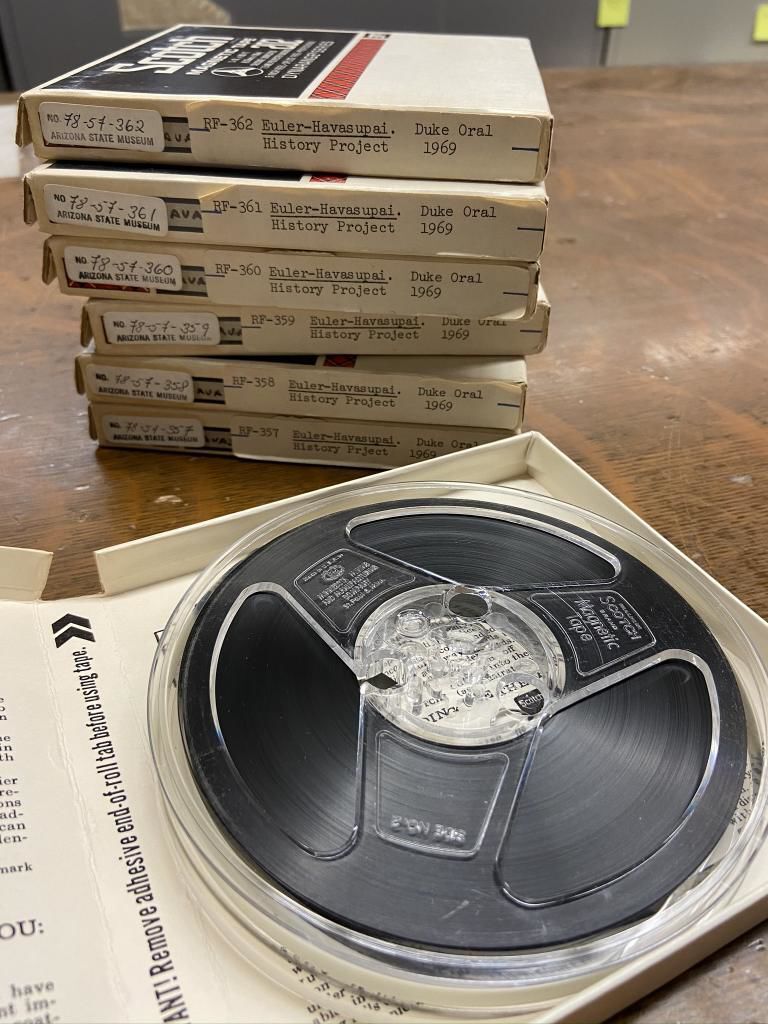

More than $1.6 million will be used to digitize the oral histories of Native Americans collected during the 1960s and 1970s to make them more accessible to the communities they come from.
The Doris Duke Charitable Foundation, established in 1996 in honor of the late daughter of the founder of the American Tobacco Co., is launching the Doris Duke Native Oral History Revitalization Project to ultimately increase access to the stories collected more than five decades ago.
Seven universities, including the University of Arizona, will collaborate to “translate and index recordings and materials spanning 150 Indigenous cultures,” the foundation said. The collection will be made more accessible to Native communities, tribal colleges and the wider public.
“Those interviewed were asked to reflect on their experiences living on reservations and attending Native schools, and for their knowledge on Native traditions,” the foundation said. “By 2010, more than 6,500 recordings were collected and archived at the participating universities.”
The Association of Tribal Archives, Libraries and Museums, an international agency whose mission is to preserve and advance history and culture of indigenous peoples, will use $300,000 over two years to serve as national coordinator over the project. They’ll coordinate creation of a website that will be the central site for visitors to access the materials.
The foundation’s expectations are for the project to “expand the collections to include contemporary voices and develop related curriculums and educational resources for students and visitors.”
The Arizona State Museum at the UA is the repository for over 800 sound recordings made between 1938 and 1987, primarily focusing on the culture of Native American groups. The primary geographical focus, the museum said, is of the peoples living in the southwestern United States and northern Mexico.
Among this collection, 60% of it is comprised of university’s portion of the Duke foundation’s project.
The university researchers completed most of the work between 1966 and 1972 with the goal of “encouraging native peoples to record their own culture from their own viewpoint,” the museum said.
However, only 25% of the site’s collection has been transcribed.
The universities will use $1.35 million collectively from the foundation to complete the work.
Duke — described as a lifelong philanthropist by the foundation — started the project in 1966 when she began awarding grants to different universities.
The mission: to enlist university researchers to collect “a robust collection of oral histories from Native leaders and culture bearers around the country and to return these stories to the tribes and communities that provided them,” the foundation said.
Upon Duke’s death, her property and collections of art would be given to a foundation created in her name to build upon the work.
Photos: Students return to Tucson for spring semester at the University of Arizona
UA Campus
Updated
Alex Brezovsky, a freshman at the University of Arizona, works on his laptop outside the Admissions Building near the University Mall, on Jan. 14, 2021.
UA Campus
Updated
A digital announcement sign reminds students, visitors and staff to social distance at the Student Union Memorial Center on the University of Arizona, on Jan. 14, 2021.
UA Campus
Updated
(From left to right) Nathan Rindlisbacher, Batya Salomonon and Andrea Shay who all work on the Covid Ambassador Team (CAT) sit outside the Student Union Memorial Center where they handout masks, on Jan. 14, 2021.
UA Campus
Updated
A couple walks through the Student Union Memorial Center on the University of Arizona, on Jan. 14, 2021.
UA Campus
Updated
People walk near the Tree Ring Building on the University of Arizona, on Jan. 14, 2021.
UA Campus
Updated
A sign reminding students, staff and visitors to wear a mask near Old Main on the University of Arizona, on Jan. 14, 2021.
UA campus
Updated
Tuition and fees will be increasing for some students at the University of Arizona for the 2021-22 school year. Incoming freshman from Arizona will not see a tuition increase in the fall.
UA Campus
Updated
A person walks through the Student Union Memorial Center on the University of Arizona, on Jan. 14, 2021.
UA Campus
Updated
Alex Brezovsky, a freshman at the University of Arizona, works on his laptop outside the Admissions Building near the University Mall, on Jan. 14, 2021.
UA Campus
Updated
People walk between the Centennial Building and Arizona Street Museum South on the University of Arizona, on Jan. 14, 2021.

