

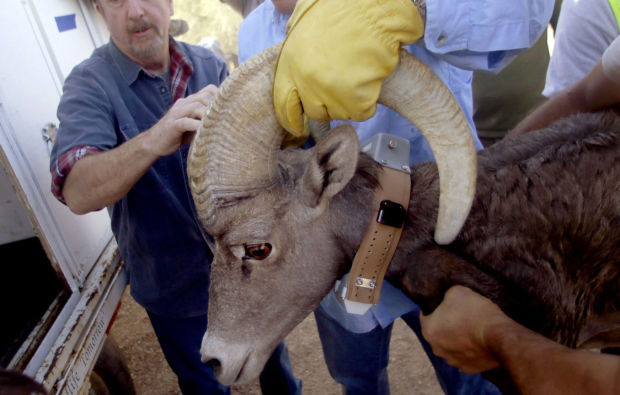

Additional bighorn sheep will be brought to the Catalina Mountains north of Tucson next month in a continuing — and controversial — effort to rebuild a herd there, state wildlife officials confirmed Wednesday.
“We’re in this for the long haul,” said Mark Hart, spokesman for the Arizona Game and Fish Department.
Only 13 bighorns are known to have survived of 31 sheep reintroduced in the Catalinas last November, but Hart said the lack of recent bighorn deaths “makes us confident that we should go forward. It has been more than six months since a known bighorn mortality in the Catalinas.”
An opponent of the reintroduction effort called it an “insane project with its heavy-handed wildlife mismanagement and wilderness violations.”
Hart said plans call for capturing about 30 bighorns next month — some from sites in the Tonto National Forest northeast of Phoenix and others, if needed, from a U.S. Bureau of Land Management site near Quartzsite in Western Arizona. A tentative date for the capture is the third week of November, he said.
The animals will be captured using net guns fired from helicopters, Hart said. After examinations, they will be brought to the Catalinas in trucks for release there.
“If we are able to go into wilderness areas of the Tonto Forest (pending approval of a permit), we could get 30 sheep from there because the population is sufficient” to withstand the removal of that many animals, Hart said. “If we have to go outside wilderness areas of the Tonto, the most we could take would be 15 or 20 sheep. Then we would get the remaining sheep from the BLM lands near Quartzsite.”
Hart said the exact sheep release sites in the Catalinas will not be disclosed to the public in advance in an effort to minimize impact on the animals.
“We want to put the sheep as close to the existing population as possible,” he said. “The sooner they can join up with the sheep on the mountain, the better. We want to give them ample opportunity to do that.”
PROBLEMS, SUCCESSES
The reintroduction project — aimed at rebuilding a bighorn herd that disappeared from the Catalinas in the 1990s — got off to a rocky start when more than half of the first group of 31 sheep died in the first few months. Most of them were victims of mountain lions, and three lions were killed for preying on sheep.
But since then, the surviving animals “have been occupying good escape terrain” and avoiding predation by lions, Hart said.
Another positive sign: “We have seen five lambs” that were born to pregnant ewes following the initial reintroduction, Hart said. “And there could be more up there.”
ADVISORY panel VIEW
A member of a citizens advisory committee, which is working with the Game and Fish Department on the project, said the recent developments bode well for continuing with additional bighorn reintroductions next month.
“It seems that the sheep have found themselves in the terrain that they have historically used, and they are doing pretty well at this point,” said Mike Quigley of The Wilderness Society, who serves on the committee.
“We’re optimistic moving forward with the planned second release based on the events of the last six or seven months,” Quigley said.
AN OPPONENT’S VIEW
Ben Pachano, a member of a group called Friends of Wild Animals, said the reintroduction program has been poorly conceived, and he called for an end to additional sheep releases and mountain lion killings.
“It’s disappointing that the environmental groups on the advisory committee decided to continue rubber- stamping this insane project with its heavy-handed wildlife mismanagement and wilderness violations,” Pachano said.
He said Game and Fish Department officials “claim they want to restore native species to the historic range. They don’t support that with species like the jaguar — but with trophy hunting species like bighorn sheep. And that’s even though the science suggests that the habitat quality for sheep has gotten worse since they disappeared in the 1990s.”

