

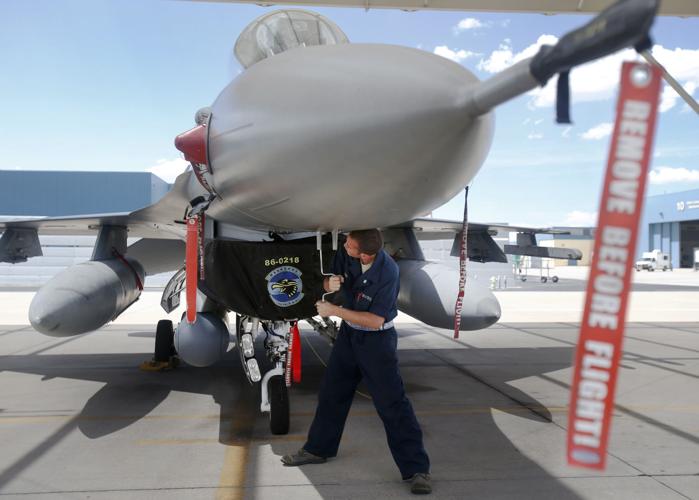
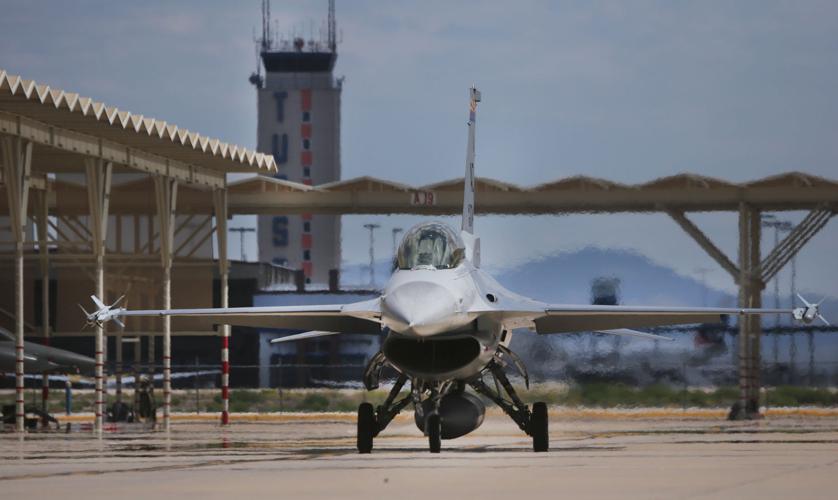

One by one, four F-16 Fighting Falcons of the Arizona Air National Guard 162nd Wing rumble down a taxiway at Tucson International Airport. Their engines howl as they pass canopied F-16s marked on their tails with U.S., Dutch and Iraqi flags.
It’s a daily scenario at the Air Guard’s biggest base, and it’s expected to continue for years to come.
The 162nd is the nation’s main training facility for F-16 pilots from allied nations, with about 30 partner countries sending pilots to train here since the 1990s.
It’s also an important economic engine — with more than 70 aircraft and nearly 1,900 Guard members and civilian workers, the 162nd has an estimated economic impact of more than $250 million.
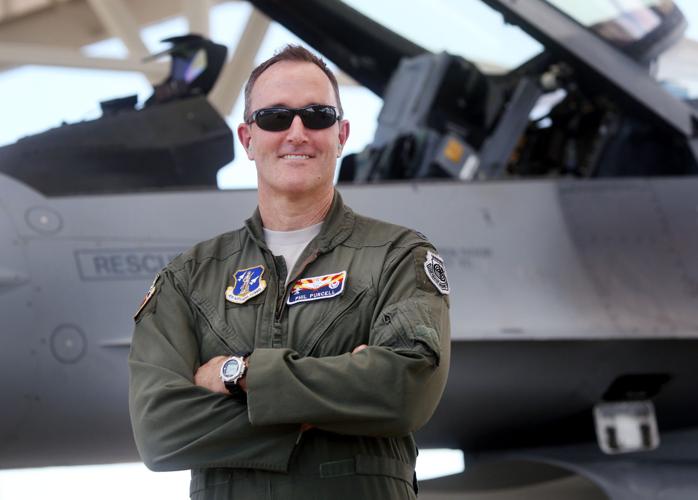
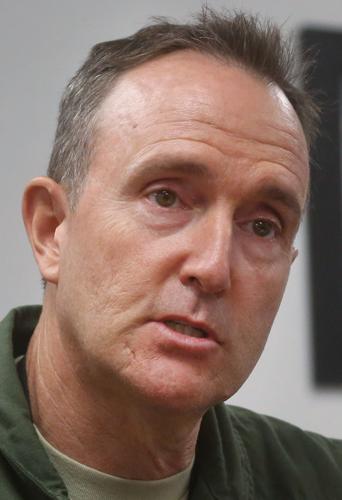
In a wide-ranging interview, the Star recently talked with 162nd Wing commander Col. Phil Purcell about the wing’s varied missions, the future for the base and recent news events, including the fatal crash in June of an Iraqi F-16 training here.
Purcell, 51, was named commander of the 162nd Wing in November 2013 after serving as vice commander of the Virginia Air National Guard. He’s on extended leave from his other job, as a captain with JetBlue Airways.
He expects to stay in command of the 162nd perhaps a few more years. Soon, that could be as a brigadier general — Purcell’s promotion to the one-star rank is pending in the U.S. Senate.
Q: The 162nd has been training F-16 pilots since 1985, and since 1992 it has been a center of F-16 training for pilots from allied nations. Can you talk about the importance of that mission?
A: We feel we have an excellent niche in training here. We feel we do it the best in the world, and we end up having to turn countries away because of their desire to be here and our ability to service everybody.
We’re not only training people in the F-16, but it’s building partnerships, which is a U.S. strategy ... We enjoy being ambassadors, we enjoy making the relationships that we make that are long-lasting. It’s important that we don’t always stand by ourselves. It’s important that the people we stand with for whatever reason, we have a common ground and we are able to work closer together for whatever desired endpoint. It’s important that when a country has an issue, they are able to possibly take on that issue without us going over there. It’s a team event, and you want your teammates to be as capable as possible, and that’s what we do.
Q: What makes Tucson a great place for fighter training?
A: For a true air-to-air training environment at the advanced level, you need a significant amount of space and you need the ability to go supersonic, and use chaff and flares (missile countermeasures). And not only does it have to expand across the countryside, it has to have a fairly good vertical space as well.
I’m from the East Coast, and there we fly a lot over water, but to actually have that over the ground is a true asset that you can only find in maybe five places in the U.S. Not onny do you have the air-to-air (warfare) piece, but the air-to-ground also, and you can do it in the same place. Here, I can see ridgelines, and I can see intersections, and I can hide behind a ridgeline or a mountain, which is a valid tactic. Over water, you don’t have that. The range space here is fantastic.
Q: What’s the future look like for F-16 and other fighter training at the 162nd?
A: I expect, and this is my opinion only, that we’ll be doing F-16 training for quite a while. You can see that Iraq just bought brand new F-16s. Lockheed continues to sell brand new F-16s to many countries — it’s a great aircraft. So our F-16 training for international partners is going to continue, and we’ll more than likely be one of the last U.S. units to fly the F-16 as we progress. And I’m talking about 2025 and past that.
Q: The 162nd Wing commands the 214th Reconnaissance Group at Davis-Monthan, which flies MQ-1 Predator drones over Afghanistan and is getting the newer MQ-9 Reaper, as well as a small F-16 homeland-security alert detachment based at D-M. What’s the importance and future for those missions?
A: (At the 214th) they’re in the fight every day; they are truly at the tip of the spear, doing fantastic work. We’ve just built the LRE (Launch and Recovery Element, a facility to practice takeoffs and landings) at Fort Huachuca, one of five in the nation for the Guard. It’s a huge enabler for us, not only to allow our guys and people from other states to train on how to launch and recover the MQ-1s or MQ-9s — because obviously those teams will go over to Afghanistan, to Africa, and do the same thing there ... We’re very likely to be mobilized for a second CAP (combat air patrol), a second orbit, and we like that. ... The RPA (remotely piloted aircraft) business, the demand for it from commanders in the field is never-ending, and we really like to be in this mission because it’s right on the tip of the spear and our guys are great at it.
The alert detachment of the 162nd is at D-M, but it’s totally mine. They’re on 24/7 continuous alert for whatever security event. Obviously, we’re very close to a border, so that’s a big deal. They are controlled by NORAD (the North American Aerospace Defense Command), and there are two F-16s on alert all the time, plus spares. They recently had a NORAD inspection, and they are consistently at the top and a benchmark for other units to strive for.
Q: The 162nd has been passed over so far as an Air Guard base for the F-35A Joint Strike Fighter, the nation’s next-generation stealth fighter. In Tucson and elsewhere, the F-35 has been the target of public opposition because of its high noise levels. Do you think the 162nd will eventually get F-35s?
A: We realize that only a few Guard bases are going to get it, but I firmly believe we are in the running for the F-35 sometime in the future.
It is the future aircraft for the United States, and the training that we will do will not only benefit the U.S. guys, but eventually many of our countries are going to be buying it. … Our niche of both U.S. and partner training could easily expand in the F-35.
Q: Though support for the military is strong in Tucson and Southern Arizona, some residents complain about the jet noise from the 162nd’s operations. What are some of the things you’ve done to mitigate noise issues with nearby neighborhoods?
A: This is not a Tucson-unique thing; it happens everywhere there’s an airport, not just military. We like to take off to the south. We’re probably the loudest when we’re taking off, and so that is our primary way to go, and geographically it works great for us. And obviously, the expansion and growth of Tucson in the south is not as dense as the north. I understand growth, and I understand there is a relationship to be built with the community to make sure everyone is as happy as possible. ...
When we take off to the north, we have noise-abatement procedures where we climb at a slower speed with less power to get up to a certain altitude before we make our turns. Luckily, most of our turns are almost immediately to the south or to the east or west, and we are basically away from most of the community hopefully. Coming home, once again, most of our airspace funnels away from most population, and as we descend to the base it’s usually at less of a noise level. ...
Here, while we have had some noise complaints on the periphery, we’re not the same focal point that Davis-Monthan is for people who are concerned about noise. ... So it’s just partnering and working through the details, because obviously the military is a huge asset for the community.
Q: Some residents have opposed the basing of the F-35 (as well as the F-16) at TIA for safety reasons, citing the increased likelihood of crashes with single-engine jets. For some, those fears have been heightened by the recent crash near Douglas of an Iraqi pilot training at the 162nd. How do you respond to that?
A: Before the Iraqi aircraft (crashed) it was 17-plus years since we’ve had anything significant like that. (In 1994, a Dutch F-16 pilot flying from TIA died in a crash in a remote area of Greenlee County. Fighter jets from D-M were involved in crashes in Tucson that included civilian fatalities in 1967 and 1978.) There’s a level of risk in this line of work, it’s undeniable. ... Because at the end of the day, when you get into combat, you want to have that training that’s relative for what you’re trying to do.
There’s always going to be some risk; we are very cognizant of that. We try very hard to minimize that as much as possible — an amazing amount of training. ... You would hope you don’t have accidents, but most of our aggressive maneuvering is certainly not done here near the base. When we come back here, it’s fairly benign. Like you have in general aviation we take off and land.
The investigation is ongoing; unfortunately, I am unable to talk about it. I can tell you, the community responded very well and had great support for us when we went through a very challenging time.
Q: Your military duties have taken you all over the country, starting as a young pilot at the former Williams Air Force and Luke Air Force Base in the Phoenix area, and including stints as a test pilot and a decade at the Virginia Air National Guard. What’s your overall impression of Tucson as a community and how it supports the local military installations?
A: It’s been fantastic. Coming from Richmond-Langley (Va.) area from my other Guard experience, it was not as finely meshed as what we have here.
We get incredible support from the entire community; it’s strong. Obviously, there are always pockets — and you can find this at any military base — those who want something different, for whatever reason.
But I have never seen the level of support we get or the intense support we are able to give back out, and the relationship has been incredible.
… A lot of my guys grew up here, went to Sunnyside (schools). A lot have brothers here, sons here, they have grandfathers that worked here. We feel like a family, and we enjoy our ties with the community. … I absolutely feel like an Arizonan now, even though most of my time has been on the East Coast.

