



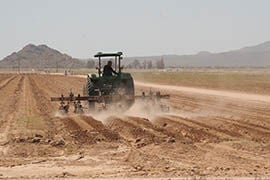

To save the Colorado River and keep Western farming going at the same time, urban dwellers will have to pay.
That’s the conclusion of an expert who helped lead a new federal study on what to do about the Colorado. The river, whose supply is threatened by drought and overuse, today serves most of Tucson’s drinking water and supplies water for a total of 35 million to 40 million people living in seven states.
Over the next five to 10 years, urban dwellers in the cities served by the Colorado could see the rates they pay for Central Arizona Project water and other river supplies rise sharply, perhaps double, says Reagan Waskom, a Colorado State University researcher who led much of the new study’s work on agricultural water conservation.
The money would be spent to invest in technology and equipment to make farmers more water-efficient, so the farmers will have water they don’t need that can be sold to cities, Waskom says. That means more costs for the cities to build canals and pay the pumping costs to bring in the farms’ water.
“The era of cheap water in the Southwest is over,” Waskom said in an interview last week. “It’s realistic to think of water rates doubling in a decade. It depends on how serious the crisis is and it depends on how we plan it. Tons of money will go to build canals to get the water to us from the farms.”
Farming uses around 70 percent of the Colorado River’s supply. As the river’s flow has diminished in the past decade, and Lake Mead at the Nevada border continues to drop, fears have grown that in five to 10 years, the river and its system of nine reservoirs won’t have enough water to supply everything that cities and farms are legally entitled to.
The prevailing assumption among many experts has been that as Tucson, Phoenix, Las Vegas and other cities keep growing, they’ll buy farmers’ river water rights, putting cropland figuratively out to pasture, as a way to prop up urban water supplies. The thinking behind that theory is that cities —their manufacturers, stores, offices and urban residents — contain much more wealth and contribute much more to the region’s economy than does agriculture. So the water will flow naturally to the top dollar.
Today, however, a backlash has sprung up against that practice, which Waskom disses as “buy and dry.” Waskom, director of Colorado State’s Water Center, was the co-chair of the group of experts who wrote the agriculture chapter for the federal report.
Many people, including some environmentalists, want to preserve the rural atmosphere and economic base created by farming. Others want to preserve big vegetable-growing centers such as the Yuma area for the sake of consumers — although many economists and environmentalists are less enthused about the large amounts of water applied to alfalfa crops across the basin.
An alternative to draining the farms of their water would be to make farms’ water use more efficient so more water will be left for the river — and to serve thirsty cities whose own supplies are at risk. But “it is likely that future water use efficiency actions will become increasingly more expensive and difficult as the least expensive and easier actions are implemented,” the new federal report on the river concludes.
But it wouldn’t have to be that much water — only a fraction of the current amont of water used in agriculture would have to be saved, Waskom said. “A 10 percent savings is a lot of water” in the short term.
While the state and federal goverment could pick up some of the tab, Waskom says the bigger share will be felt by cities who would get the extra river water.
Two board members of the Central Arizona Project, Sharon Megdal of Tucson and Jim Holway of Phoenix, say they agree that water rates will have to rise to bring more water in from outside sources. They declined to be more specific, but Megdal said, “I do not expect the overall costs to be low.”
“All water users, regardless of the sector and state, will need to make more investments in conservation to benefit the water delivery system that we all share,” said Chuck Cullom, the CAP’s assistant general manager for Colorado River programs.
Megdal and Holway emphasized that any water transfers through efficiency from Arizona farms to cities would most likely come from farmers along the Colorado River, including those in Yuma, Parker and across the river in Blythe, California. Those farmers have senior water rights with high priorities during Colorado River shortages, higher than those of Phoenix and Tucson.
By contrast, Central Arizona farmers with CAP water in Pima, Pinal and Maricopa counties will be the first to get cut off in a CAP shortage, so “they don’t have any water to sell” cities, said Holway, a former Arizona State University professor, assistant director of the Arizona Department of Water Resources and official with the Sonoran Institute, a Tucson-based conservation group.
Any transfer of water use from the river-based farms to cities will depend on the willingness of farmers to enter into voluntary arrangements, added Megdal, director of the University of Arizona’s Water Resources Research Center. “It may take some time to work through these. There is much work to be done in understanding the impacts of the different types of arrangements and the factors influencing decision-making.”
Here are some questions and answers about the issue with Waskom, a professor of soil and crop sciences:
Q. Why should those in the cities be tapped to save farms?
A. They are the ones who want to move the water — to bring the water from farms to our taps. Water bills are going to go up to pay for the mechanism to bring in clean water.
Q. What are some of the reasons for the higher costs? And what will that mean for our energy use for water?
A. One of the things that I think gets left out in the conversation about water efficiency is that in inefficient irrigation systems, in surface flood irrigation systems, the water is gravity fed. It flows downhill. There is no pumping or pressurization.
When we go to a more efficient water system, you have to substitute carbon. You have to pump, to pressurize systems to get the water through microsprinklers onto the crops. That takes energy, as opposed to gravity.
Q. What’s the bottom line for farmers?
A. Ag producers make decisions on irrigation systems based on their crops. We want them to become more efficient. The money has to come from somewhere, and from the ag point of view it should come from the folks who want the water.
Q. What’s on farmers’ minds about whether to sell water or grow more efficient?
A. It’s not a simple picture. Nobody in agriculture wants to buy and dry. But each producer wants to reserve their own right to capitalize on the land and water that they own. Everyone knows we need a certain critical mass of farmers as an industry to make things work. But individuals also want the right to make their critical mass work.
Q. So farmers want to be kept in business, and keep their options open.
A. It makes sense. With the human condition, no one wants to be the last person to man the irrigation ditch. You bear all the costs, you get what water is left. It doesn’t work. Each farmer is having to look at their family, their assets and market pressures on their water, and having to make good generational decisions.
Q. Your new report says that in the past few decades, they’ve gotten 25 percent more efficient, but the water savings go to planting more crops, not back to the river. How do you change that?
A. We can go further with efficiency, no doubt. The question is, does efficiency yield transferable water? That’s where it becomes a lot more complicated. Can the water be made more available for other uses?
Q. What do you mean? The nonprofit Pacific Institute, a conservation-research group, has estimated that if farms in the Colorado River Basin can reduce their water use by 6 percent, that would free up enough water to serve all of Las Vegas’ needs.
A. Making the water available for industrial, municipal or environmental uses — efficiency alone doesn’t get you there. In a lot of fields, by implementing efficiency measures, in some cases you can increase a crop’s total consumptive use (the amount of water that is actually taken in by a crop as opposed to what runs off down a field after being applied). I think this is what folks don’t understand.
Q. How does that happen?
A. On a surface-irrigated field (such as conventional flood irrigation), often, the bottom half of the field is underirrigated and the top half is over-irrigated. If you go from surface to sprinkler irrigation, it’s more efficient, and you get better uniformity of irrigation. But it can increase the bottom half’s use of water because it’s being more effectively irrigated.
The individual producer incentive to divert less water in many cases is not there. In most years, they may have adequate supplies. Producers always have that dry year in their minds. In a dry year they will need every bit of that water. They don’t want to do anything that might foreclose getting through those dry years.
I don’t want to make it sound like we can’t make farming more efficient. I just want to say it’s complicated, both at the (river) basin scale and the individual producer scale.
Q. So what’s a solution to this dilemma?
A. Up here in the Upper Basin (in Colorado), a lot of agriculture water goes into relatively low value uses — grass, hay, grazing land, forages. The things we’re looking at are whether temporary fallowing or deficit irrigation can work. (Deficit irrigation is a practice in which water supply is reduced below maximum levels and mild stress is allowed, hopefully with minimal effects on crop yields.)
Q. What else?
A: You can go to cool season crops or shorter season crops. The really important thing is there are no free lunches for any of those. Each of those will cost (crop) yield. It will be disruptive to the operation. What we’re trying to figure out is what is the best business deal that works for both parties, the city and the farm — money for water. We keep the farm but the farmer gets to take a vacation or grows less. They’re compensated.

