


Are you dying to stare at the sun during the April 8 eclipse, but you don’t want to permanently damage your eyes?
Flandrau has you covered.
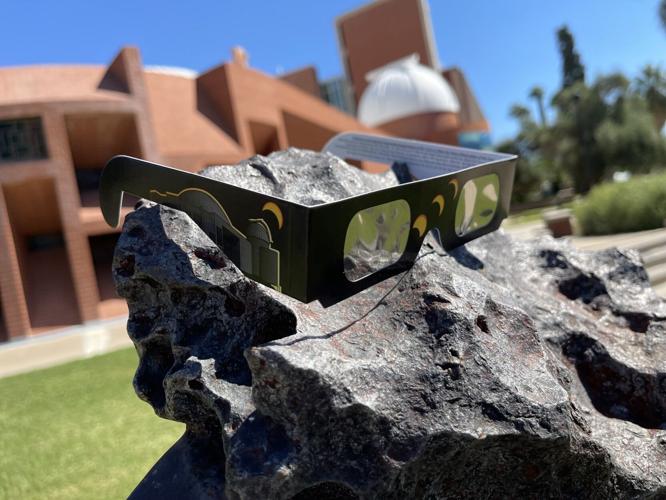
The University of Arizona’s Science Center and Planetarium is selling commemorative — and, more importantly, certified — solar glasses for safe viewing.
The glasses, decorated with a drawing of Flandrau’s historic building on the U of A Mall, can be purchased at the planetarium for $2 each or $1 each when you buy 20 or more.
“They’re ISO certified, and they support our science programming,” said Nick Letson, marketing and communications manager for the planetarium.
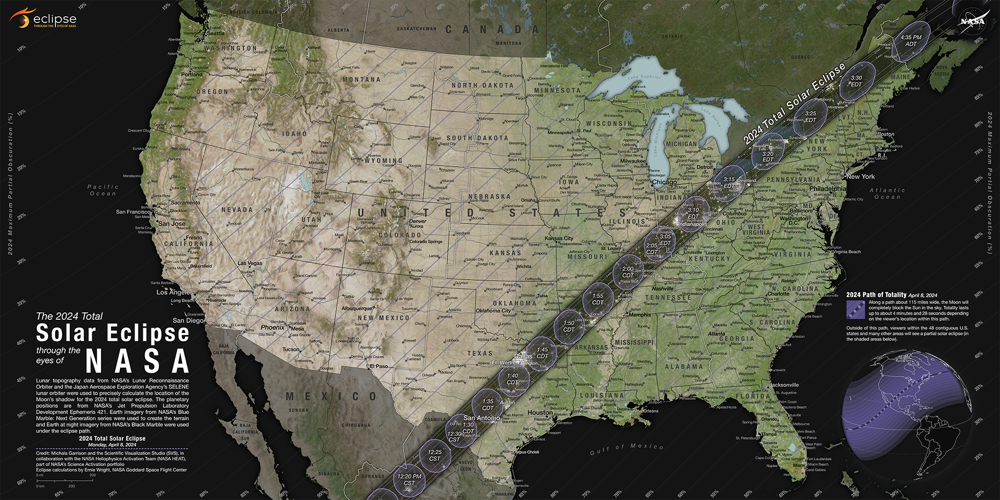
A swath of Mexico and the U.S. from Mazatlan through Maine will experience a total eclipse, but in Tucson the moon will cover roughly 75% of the sun when the event peaks at 11:19 a.m. local time Monday.

Flandrau Science Center and Planetarium is selling these special viewing glasses ahead of the April 8 partial solar eclipse over Tucson.
It is never safe to look directly at the sun during an eclipse without specialized eye protection designed for solar viewing. Flandrau will be selling its special glasses right up until — and even during — the event on April 8, when the planetarium will host a viewing party set to begin shortly before the eclipse does at 10:06 a.m.
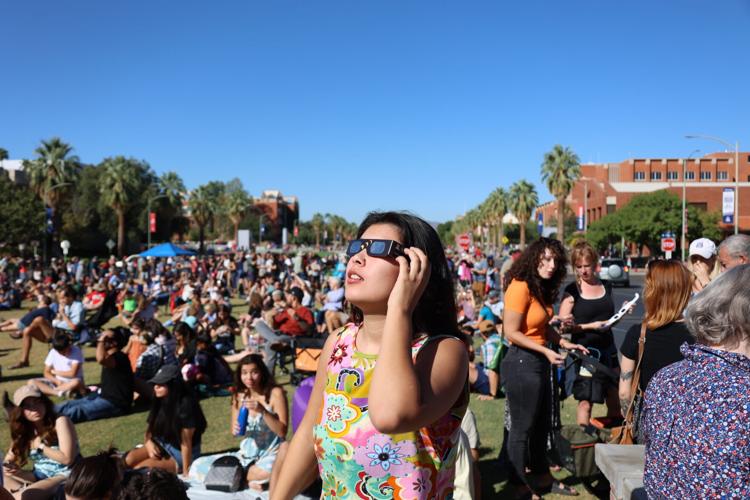
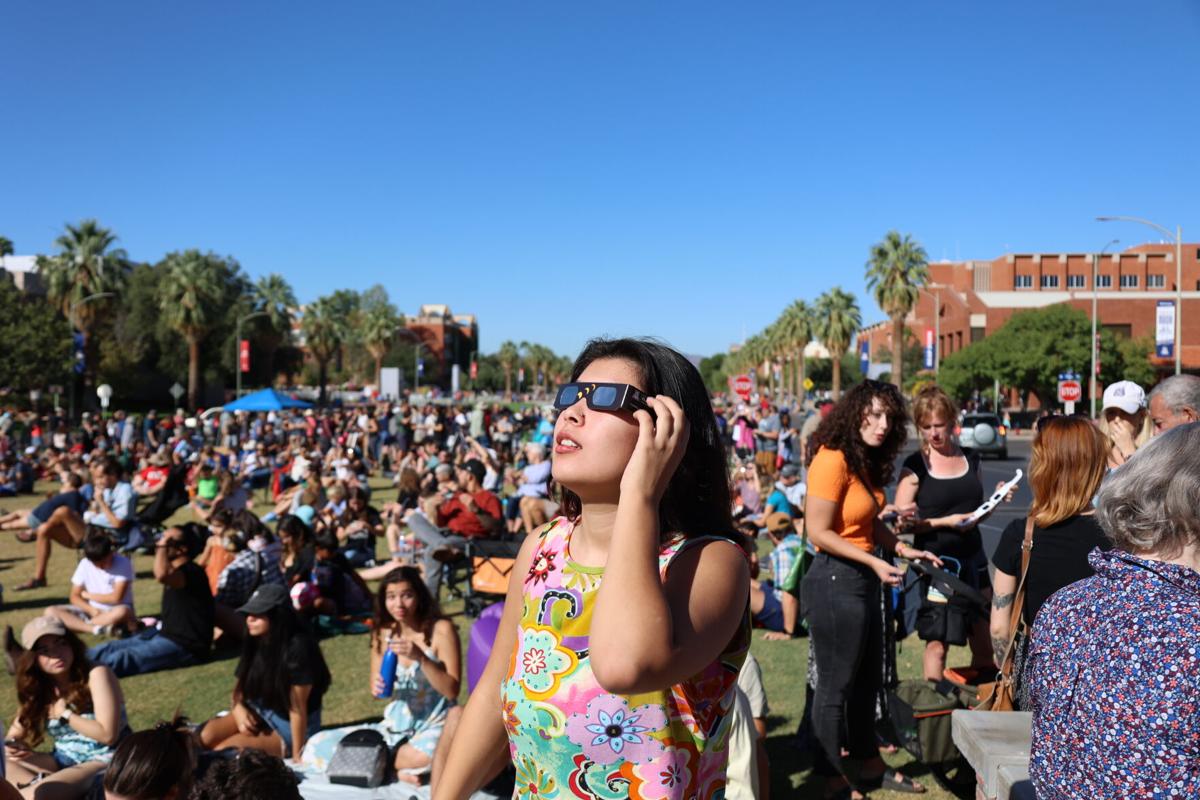
This will be the first solar eclipse visible from Tucson since the annular eclipse that covered 83% of the sun here on Oct. 14. More than a thousand people gathered in front of the planetarium to watch that show.
The Old Pueblo hasn’t found itself directly in the path of a solar eclipse since another annular event, also known as a “ring of fire eclipse,” on Aug. 27, 1821.
During next week’s eclipse, several major cities will find themselves in the so-called path of totality, including Dallas, Indianapolis, Cleveland and Buffalo.
A total solar eclipse won’t cross the lower 48 states again until Aug. 12, 2045, when the moon will blot out the sun along a path stretching from Northern California to Florida but just missing Arizona.
During the free April 8 event at Flandrau, on the U of A Mall at the corner of Cherry Avenue and University Boulevard, visitors will be able to view the eclipse through solar telescopes provided by the Tucson Amateur Astronomy Association.

The total solar eclipse will be visible along a narrow track stretching from Texas to Maine on April 8. A partial eclipse will be visible throughout all 48 contiguous U.S. states.
A live stream of the eclipse from locations along the path of totality will be broadcast inside the planetarium, Letson said, so people can watch the show as it unfolds elsewhere and witness it in person outside until it ends here at 12:36 p.m.
Flandrau will also offer a discounted admission rate of $5 per person for its science exhibits from 10 a.m. to 2 p.m. and for an educational planetarium show about solar eclipses called “Totality!” after the live stream of the actual eclipse is over.
More information can be found online at flandrau.org.
Meanwhile, Kitt Peak National Observatory is inviting visitors to watch the partial eclipse while strolling among the mountain-top telescopes on the Tohono O’odham Nation, about 50 miles southwest of Tucson.
The event will last from 9 a.m. to 1 p.m. and include telescope viewing, a light meal and a free set of eclipse glasses with the cost of admission, which ranges from $60-$75 per person plus fees.
Tickets can be purchased through the observatory’s website, kpno.noirlab.edu/news/announcements.
To get people primed for April 8, Flandrau will host “Science at Sunset: Eclipses & The Ring of Fire,” an evening of lectures, stargazing and planetarium shows from 5:30 to 10 p.m. Saturday, April 6.
Speakers include Nicole Kerrison from the U of A’s Lunar and Planetary Laboratory and astrophysicist Jenna Samra from Harvard and the Smithsonian’s Center for Astrophysics. Tickets are $25 each or $15 for Flandrau members.
And for those interested in reading more about the phenomenon, senior scientist Sanlyn Buxner from the Tucson-based Planetary Science Institute has assembled a collection of scholarly works, safety guides, educational resources and personal narratives about eclipses.
The compilation of 33 articles can be found for free in the Bulletin of the American Astronomical Society under the title “Celebrating the Wonder of Science in the Shadow.”
“We knew that the community wanted an outlet to share their experiences and resources and wanted an outlet that had credibility and reach to share,” said Buxner, the institute’s senior education and communication specialist. “We also knew we needed to get something out that let people share their October 2023 experience in time for the 2024 eclipse.”
Fellow senior scientist Pamela Gay served as co-editor for the volunteer project.
As for Flandrau’s eclipse glasses, Letson said they had “tens of thousands” of them made, so he doesn’t anticipate them selling out.
Just in case, though, he recommends picking up your pair before the big show on April 8, if only to avoid the long lines of last-minute eclipse shoppers.
On April 8, a total solar eclipse will cross over Mexico, the United States and Canada. A map developed from a variety of NASA sources shows the total eclipse path as a dark band, with purple lines outside of that to indicate how much of the sun will be covered by the moon during the partial eclipse.

