



A combination of gerrymandering of districts and packing the Supreme Court with jurists chosen by the conservative Federalist Society and Heritage Foundation have pushed U.S. policy “in a rightward direction that voters can’t even do much about,” says author David Daley.
Even when voters do effectively change policy, as Arizonans did in November by enshrining a right to abortion in the Constitution through the citizens’ initiative process, legislators immediately get to work trying to weaken, thwart or undo what the voters chose, says author Amanda Becker.
Political forces in effect today in the U.S. have been building for a long time — in the case of threats to free speech, ever since President John Adams used a Sedition Act to arrest political opponents, says author Jonathan Turley; in the demonizing of immigrants, throughout our history, notes author Juan Williams; and in conservatives’ modern influence on redistricting, the courts and other institutions, 50 years “of a very determined and orchestrated process,” Daley says.
The rapidly changing media landscape, the echo chambers we retreat to that reinforce what we already believe, and the “rhetorical battles” won or lost through political messaging can mean, as author Zeke Hernandez puts it, “the truth doesn’t prevail even when there is so much evidence.” Joe Rogan’s interview with Donald Trump during the 2024 campaign had 26 million views within 24 hours, author Paola Ramos notes, adding, “This election was won through feelings, not facts,” feelings including fear, anger and resentment.
And when we are afraid, angry or confused, we turn on each other, attack “the other,” “try to silence those we disagree with,” and “the villain image prevails,” Hernandez and Turley point out.
These are some of the themes that emerged in two discussions on current events by author panels Saturday at the Tucson Festival of Books, “Freedoms Under Fire” and “Race, Ethnicity and the Election,” both of them popular events for advance tickets, and both aired by CSPAN 2’s Book TV from the University of Arizona campus.
On their panel, Hernandez, Ramos and Williams analyzed why Trump, after pledging mass deportations, for example, got 45% of the Latino vote, or why one in four Black men voted for Trump, according to exit polling.
When Trump talked about immigrants being criminals, many Latino voters thought “He’s not talking about me,” said Ramos, a journalist who contributes to Telemundo News and MSNBC, was deputy director of Hispanic media for Hillary Clinton’s 2016 presidential campaign, a political appointee during the Obama administration, and is the author of “Defectors: The Rise of the Latino Far Right and What It Means for America.”

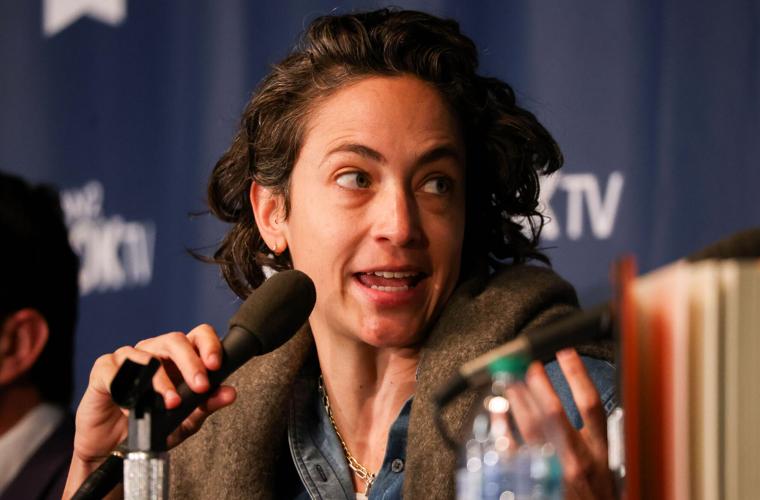
Paola Ramos, an author and Emmy Award-winning journalist, explains why she wrote “Defectors: The Rise of Latino Far Right and What It Means for America” as she addresses the panel “Race, Ethnicity and the Election” Saturday at the Tucson Festival of Books.
But now that they’re seeing Trump’s sweeping policies playing out, with family separations and the closing of legal pathways, more might be thinking, “Is he talking about you or not?” she said.
What voters hear is “so divorced from the facts,” said Hernandez, a professor at the Wharton School who studies how immigration affects the economy and is the author of “The Truth About Immigration: Why Successful Societies Welcome Newcomers.”
People are told one of two stories about immigrants, he said, that they are villains or victims, “needy outsiders who deserve your pity,” when in fact, they “positively contribute to everything you want to prosper in an economy,” he said.
Immigrants provide talent, investment, consumption, innovation and pay taxes, and “who doesn’t want those things?” Hernandez said.

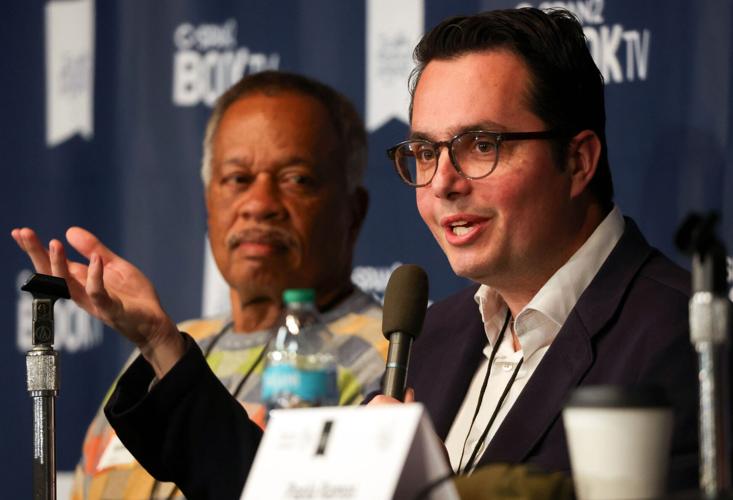
Zeke Hernandez, author of “The Truth About Immigration: Why Successful Societies Welcome Newcomers,” addresses a book festival audience Saturday at the UA.
Now, with Trump’s tariffs and “attempt to kick out 13.7 million undocumented people — workers, consumers, taxpayers” — local officials in both political parties are very worried about the effects on local economies, he said. For many people it’s a surprise to hear undocumented immigrants in the U.S. are taxpayers, he said, but “they pay an estimated $100 billion per year in taxes.”
Rather than “stealing your job” or holding down your wages, “it’s the opposite of that … they actually increase wages because they grow the economy,” Hernandez emphasized.
However, “because the villain message is winning in the court of public opinion, immigrants absorb that message, too,” he said. “But they believe there’s got to be ‘those others’ out there,” which “pits immigrants against immigrants.”
Ramos agreed, saying “no one is immune to xenophobia and racist beliefs,” and also pointing out that third-generation Latino Americans are the fastest-growing group, the majority of them native-born English speakers “who are feeling more and more removed from that original immigrant story.”
It’s part of the American experience to want to prove you belong here, she noted.
That resonated with Williams, too, the journalist and historian who wrote the civil rights history “Eyes on the Prize,” which accompanied a PBS series, and his new “New Prize for these Eyes.” Misinformation and caricatures are rampant, and “so many of the Trump administration’s initiatives target minorities,” he said.
He pointed to the long list of words that are being taken out of federal documents and politics under Trump, as reported by the New York Times and others, which include Black, women, race and ethnicity. "Blacks, gone. Women, gone. Wow, can you believe it, is this a joke, what's going on here?" Williams said.
“If you want to be accepted in America,” there’s a “bandwagon of grievance and finger-pointing” to join, he said.
“This is where the energy is” and it “drove a lot of the male attitude” in the electorate, he said, pointing to social media, Rogan and others he said celebrate masculinity by blaming women for a lot of issues. Young men of color wanted to be “part of the clubhouse, too,” he said, “and it’s a very toxic place.”

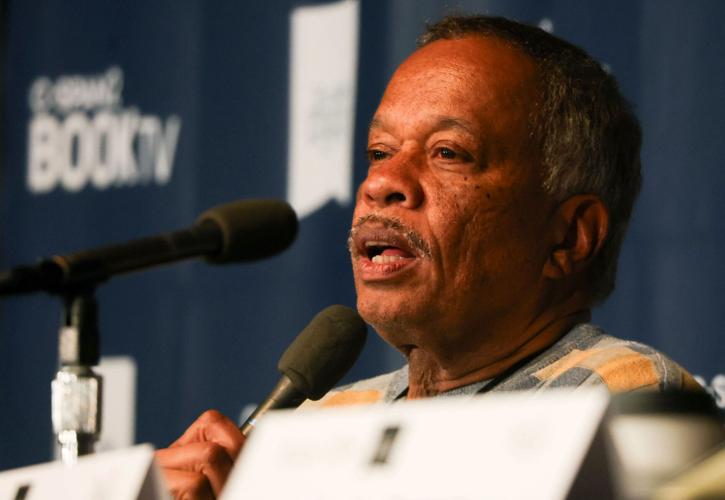
Juan Williams speaks Saturday at the book festival about his new book on civil rights movements, “New Prize for These Eyes.”
Added to this, Hernandez said of the 2024 presidential campaign, “The evidence goes against everything Trump says. But the Democrats did not have a message on immigration. And if they did, it was a terrible message, the pity message. Democrats need to have a soul-searching and a better message. … Stop with the pity, and appeal to self-interest” — that immigrants are a boon to the economy you depend on.
Ramos said the theory of the Clinton campaign in 2015 was that “in the face of someone like Donald Trump, Latinos would turn up in these unprecedented numbers.” When she and others would urge more outreach, they were told, “Nah, we’ve got it.” Then, less than 50% of Latino voters showed up at the polls.
That point was followed up by a similar one, in the next panel discussion, “Freedoms Under Fire,” when Daley said that with Barack Obama’s victory in 2008, “Democrats thought demographics are destiny,” and that a coalition had formed that would carry political strength into the future.
But while Democrats were concentrating on “how do we keep the White House,” conservatives behind the scenes were focused on “how do we control the levers of power?” said Daley, former editor-in-chief of Salon. His book “Antidemocratic” recounts what he calls “the 50-year campaign by the Republican right to roll back the Voting Rights Act of 1965.”
As a result of various machinations of those levers, he said the U.S. Supreme Court has become “the bastion of Republican political power.” Chief Justice John Roberts is “the most effective Republican politicians in many ways of the last 25 years,” Daley said, achieving big changes from 2005 to today on voting rights, reproductive rights, presidential immunity, and the regulatory state when it comes to the environment, health care and more, “pulling the U.S. in a direction that polls suggest could not have happened at the ballot box.”
Turley, speaking on the same panel, who said he testified on behalf of Neil Gorsuch’s nomination to the high court, countered that the justices “are just trying to get it it right” on issues and constitutional requirements.
A law professor at George Washington University, a television analyst for multiple networks (currently for Fox), and a litigator, Turley wrote the bestselling book “The Indispensible Right: Free Speech in an Age of Rage.”
A staunch proponent of free speech, Turley was asked for examples from the Biden and Trump administrations of threats to the First Amendment. He said “the censorship system grew” under the “anti-free-speech” Biden administration, as evidenced by “the Twitter files,” the select releases of 2022-2023 internal Twitter, Inc. documents, that show “government coordinating with social media and targeting groups.”
As for Trump, Turley said the recent arrest and detention with intent to deport Mahmoud Khalil for taking part in pro-Palestinian protests at Columbia University, who has not been charged with any crime at this point, is concerning. “You’re allowed to protest in this country, you’re allowed to be pro-Palestinian,” a right shared not just by citizens but by people legally residing in the country, as Khalil is, Turley said. “That is not a basis for deportation.”
On the other hand, Turley said he agrees with “every part” of what Vice President JD Vance said recently in Munich about “the robust censorship system” in Germany. While neo-Nazis are thriving there, one poll said only 17% of Germans felt they could speak out about their beliefs, Turley said. “They’re silencing the wrong people.”
“I believe the solution to bad speech is good speech,” he said.
Becker, who wrote “You Must Stand Up, The Fight for Abortion Rights,” which focused in part on Arizona’s policies and voter decisions, built on Daley’s points about gerrymandering, especially after 2010, and dilution of voting rights.
She also said that in Arizona, although the electorate is made of up roughly equal thirds of independents, Republicans and Democrats, the partisan primary election system means, “some candidates for statewide office are being nominated by less than 10 percent of the electorate.”
Add to that, she said, the efforts by the Republican-controlled Legislature to roll back voters’ decision in November on abortion rights, and also what she said is happening under the U.S. Justice Department — “which has stopped arguing for emergency medicine laws” and might go after the abortion pill.
Voters in Arizona cannot simply trust that the law they enacted is safe, Becker said.
Get your morning recap of today's local news and read the full stories here: tucne.ws/morning

