

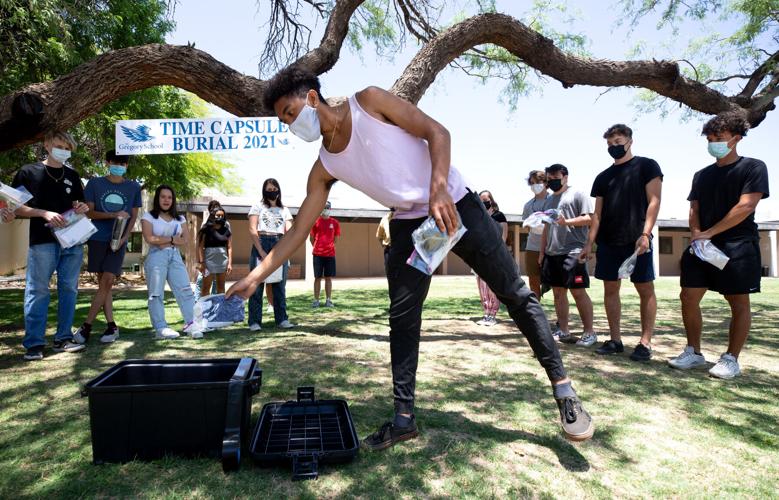

Lori Barnett, an English and psychology teacher at The Gregory School, asked her students to write personal essays to put in the time capsule they buried on May 17, to be unearthed in 2031.
The class of 2021 wrote the essays for the people they will be in 10 years, when they’re on the precipice of 30. Barnett asked the graduating seniors at the private school near River and Craycroft roads to compare themselves to a tree, the soil, the roots, the branches, the trunk, the leaves of their lives.
“You know, at 17 years old, they don’t have as many memories as I do. But I thought they’d get a kick out of it, even in 10 years. Going back and saying, ‘This is what I was like.’”
For Barnett, her roots are New York, where she grew up. Her trunk and her branches are the profession of teaching, which she has given 45 years to. And her leaves are all of her students over the years.
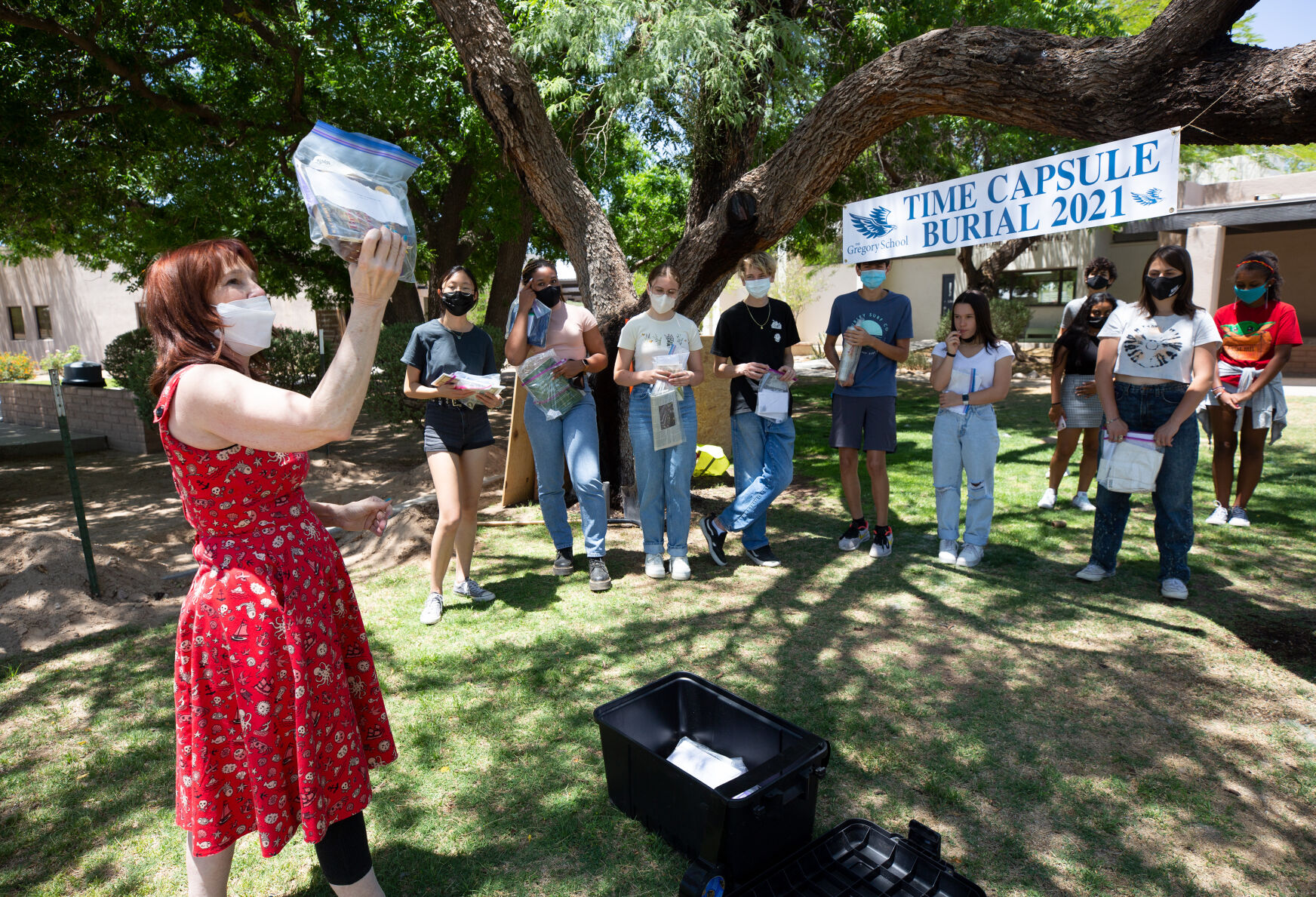
Teacher Lori Barnett holds up personal items she is putting in a time capsule at The Gregory School on May 17, 2021.
The longtime educator is vibrant in a bright red dress, just a shade brighter than her red hair. Her dress matches the excitement of the day — burying the capsule, a sunny day outside and being with her class in person.
Barnett wore that same dress three years earlier when unearthing the only other capsule she asked students to bury — the graduating class of 1993. She gathered that group of students in Ridgewood, New Jersey, to unearth the capsule 25 years later.
About 30 former students, by then in their mid-40s, showed up to the unearthing, some with children in tow. They were delighted to read letters they’d written themselves and to see how much they’d grown in 25 years.
Barnett thinks this time around, the capsule is even more important.

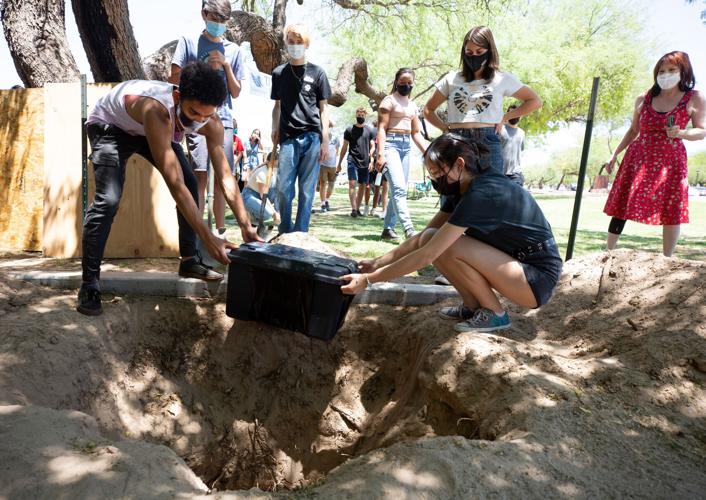
Students from Lori Barnett's class lower the time capsule into a hole. Barnett says the psychology of education during the pandemic "has been different from anything I have ever known as an educator."
“The psychology of education in COVID time has been different from anything I have ever known as an educator,” she said. “The lack of connection that we suffered through COVID was so hard. I think it’s going to mean much more to them.”
High school senior Michael Jansky made a playlist to put in the capsule, with input from his classmates. He put in a QR code to access the music digitally. Music is especially influential for teenagers, he says, and he thinks it will remind them what that time in their lives was like.
Deciding what to put in the capsule and writing the essay inspired him to do some reflecting on his life and this past year.
“It is important to know where you’re at,” he says. “Just reflecting at the time is important, just so you know what you’ve achieved up to this point, and it gives you a good idea of what you will do in the future.”

He says his roots are the Czech Republic where his family is from, and he thinks reading his essay in 10 years will remind him of the importance of his culture and heritage.
Jansky’s parents are both health-care workers and worked in a COVID-19 unit. He weathered that stress with them, and eventually his whole family got COVID. Jansky himself is an essential worker at a restaurant. Now he’s fully vaccinated.
Dylan Greenhill wrote a nine-page essay to her older self, comparing her previous struggles and who she is today to the roots, soil, leaves and flowers of a tree.
“It’s pretty reflective, so I feel like in 10 years when we read that it’s going to kind of bring us back to who we are and who we were when we were 18 years old,” she said. “Senior year is also a special year for that because we’re graduating high school. So it’s pretty monumental.”

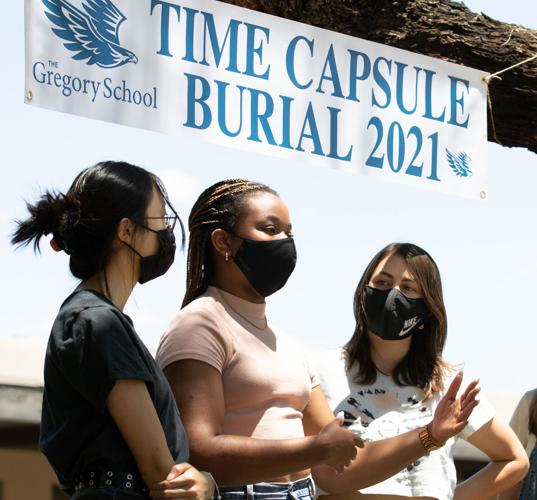
Students from Lori Barnett's class at The Gregory School talk about the time capsule. From left, Karen Jie, Ada Onuoha and Katie McColgin.
This year taught Greenhill not to take anything for granted, especially time with friends and family.
Karen Jie started a business during COVID, selling her art online. She’s putting an enamel pin she made into the capsule. COVID and starting her business helped her realize what’s really important to her.
“School is important, but it’s not my entire life,” she says. “There are some things in life that are more important than school. And if I want to work on my business, then I think that’s important to me.”
Ada Onuoha put a scrub top in the capsule that she used to wear around the hospital where her mother worked when she was little. Her mother’s colleagues called her mini-Dr. O. When Onuoha opens the capsule in 10 years, she plans on being the second Dr. O.
She says she is definitely coming back to unearth the capsule. It’s not so much about reuniting with her friends because she plans to keep in touch with them anyway. It’s important to her because of the opportunity to reflect back on who she is today.
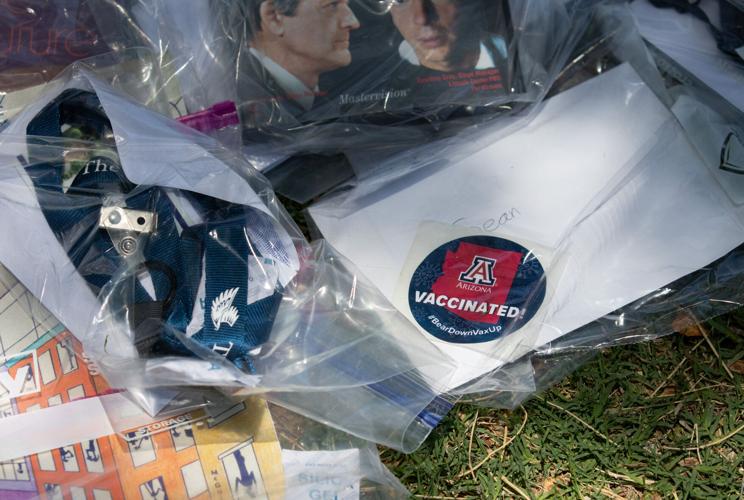
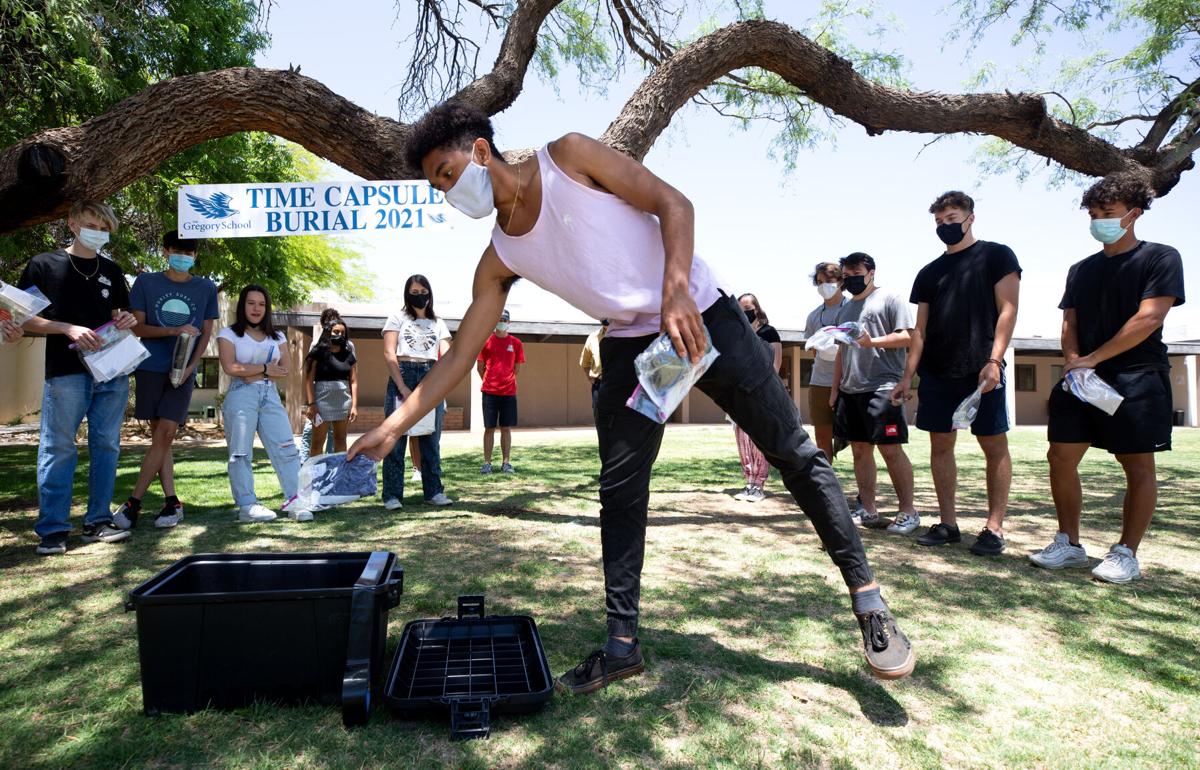
About a dozen students gathered in a circle around the black plastic storage container. Each one picked up a sealed bag with their essays and personal items — old phones, pandemic face masks, a student government T-shirt, homecoming shirts from years past, pandemic journals and well-loved books, “I got vaccinated” stickers, a Trader Joe’s work shirt covered in cleaning supplies and bleach.

Personal items including letters, journals and, to mark the pandemic, masks and vaccination stickers, were included in the time capsule buried Monday at the base of a tree at The Gregory School.
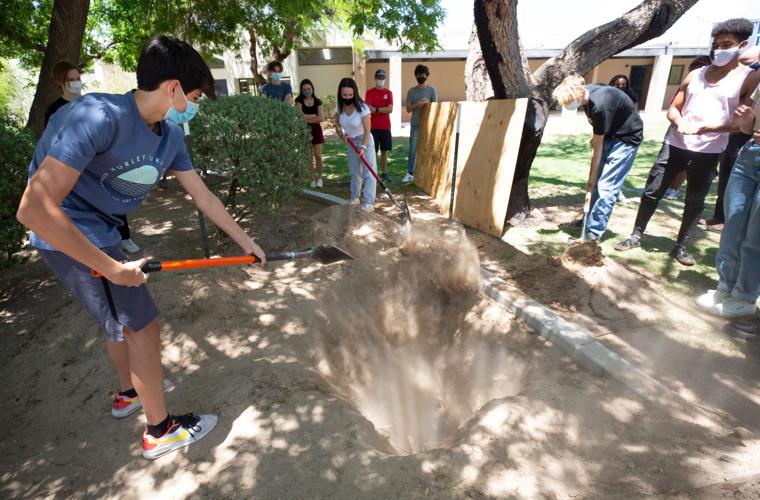
One by one they put them in the container. They also put in a piece of thick tree root pulled out of the ground when they dug the hole for the capsule, about 5 feet down at the base of the Chinese pistache in the school’s grassy courtyard.
While the last year was scary and tragic for many, Barnett saw resilience and acceptance in her students.
They were just angry that the pandemic robbed them of the last year of their childhood, but unlike many adults, they didn’t complain about wearing masks. They accepted the precautions and shutdowns, and they found new ways to connect.

Students bury a time capsule at The Gregory School on May 17, 2021.

