

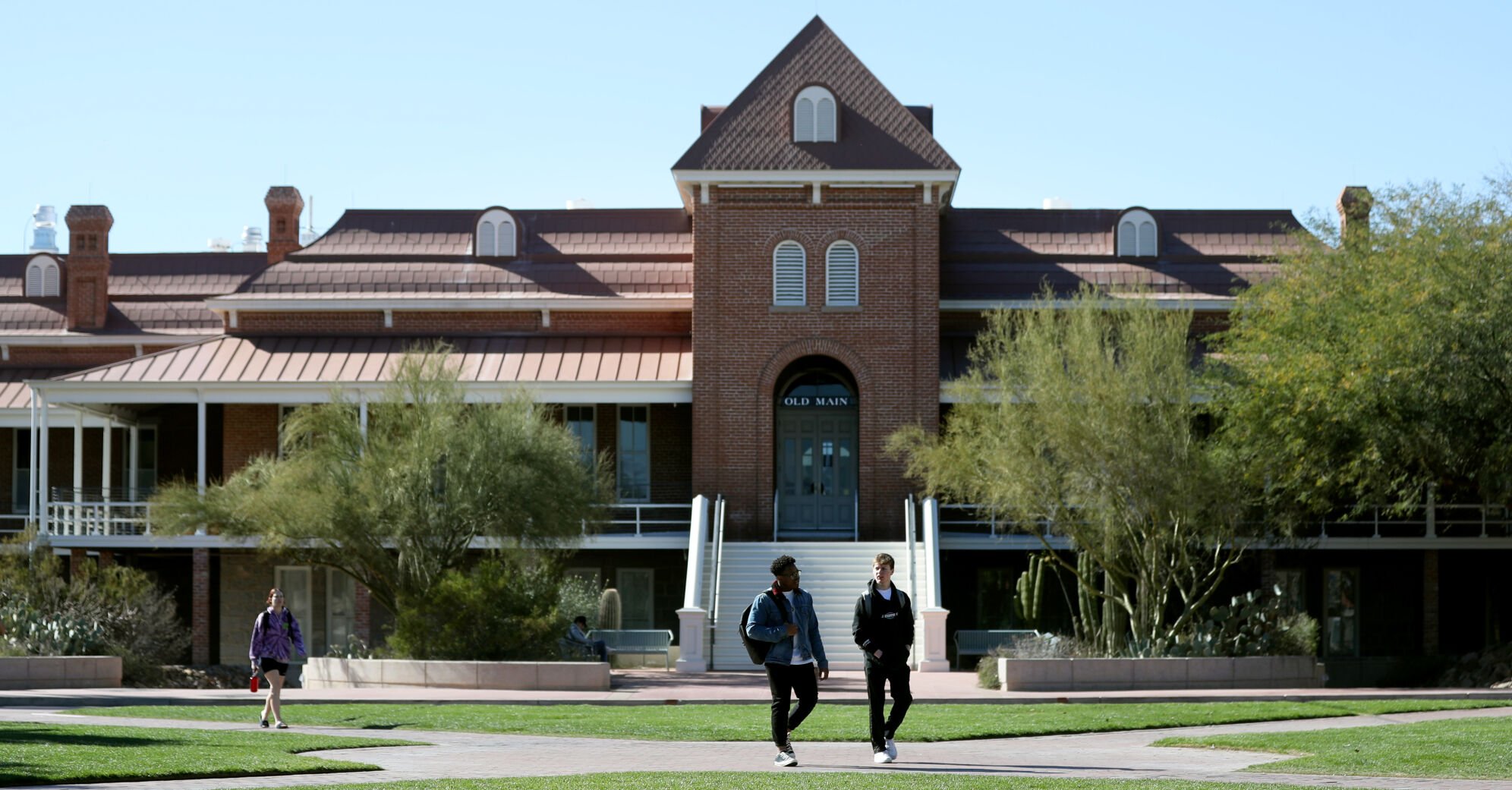
The University of Arizona is giving some high school teachers in Arizona the chance to take free no-credit humanities courses, which explore complicated questions like “Are the United States and China enemies or competitors?” and “What is the future of the Colorado River?”
The UA College of Humanities has offered the Humanities Seminar Program —which organizes a slate of flavorful classes taught by UA faculty members for public interest — for nearly 40 years. Retirees typically compose the majority of students in these courses, but that could be changing this year.
After Jacquelynn and Bennett Dorrance, two UA alumni, gifted the college $5.4 million in 2021, it used part of the money to create scholarships for local high school teachers to attend the Humanities Seminar Program. The program, which will also allow teachers to earn required professional development credits, launched last semester and is continuing this semester.
“Educators make a huge impact in our community and we want to bring this resource to them so they can be supported in their roles,” Micah Lunsford, director for the humanities seminar program, said. “Teachers don’t have a lot of time — they have a lot of demands on them — so it can be difficult for them to take these kinds of classes as often as they’d like. We want to remove every potential barrier from that process for them as possible.”
Last fall, the course list included such titles as “Representing the Other: Jews in German Texts from 1500 to Present,” “French Roots of North America” and “Chinese Poetry Then and Now.”
“These courses are kind of like academic entertainment,” Durand said. “It’s an opportunity for anyone out there in the community to take classes by some of our top professors on a variety of topics connected to the humanities.”
The courses range in length — some are a one-time lecture and others span 10 weeks — and cost anywhere from $10 to more than $250. Although these courses don’t count toward a degree, they are taught by some of the UA’s leading scholars, which can cost a degree-seeking student $500 to more than $1,300 for some graduate-level courses.
Historically taught in person and during mid-day, the pandemic pushed the seminar program online and now most of the classes are offered both online or in-person, with asynchronous participation options. The change in modalities allowed retirees who may live in another state for half the year more flexibility to take the classes they wanted.
“This gave us another idea to invest some of the money (from the Dorrances’ $5.4 million gift) to give high school teachers in Arizona access to any of these courses free of charge,” Durand said. “Our idea is for them to take whatever interests them — not just as part of their professional development credits, but to benefit from training by getting new ideas on how to approach.”
Last semester, about nine teachers took advantage of the scholarship and most took it online. This semester, the department has about 30 spots available for Arizona teachers interested in taking a course.
Courses start Jan. 13 and intermittently throughout the UA’s spring semester. The course list is as follows:
Lecture: Our Future in a Warming, Water-Stressed World
Astronomy and the Arts
The Erotic, Laughter, and Spirituality
The Colorado River: Past, Present, and Future
Enigmas of the Universe
Shakespeare’s First Folio (1623)
Haydn’s ‘Creation:’ Which Libretto, Which Language
US-China Relations in the Modern Era: Competitors or Enemies?
How America Became a Right-Wing Nation: Lessons from the 1970s
Lecture: Asteroids: Small Objects That Might Have a Big Impact
World War I and the US: Causes and Consequences
Between France and Morocco: Abdellah Taïa’s Stories of Migration
Writing … And Then Writing Again: Marie Darrieussecq Explores the Art of Storytelling
If you’re an educator who’d like to learn more about how you can take one of these classes on scholarship visit, https://hsp.arizona.edu/great-books.
With students back at UA for the fall semester, here's a look at the Tucson campus over the years compared to now.

