

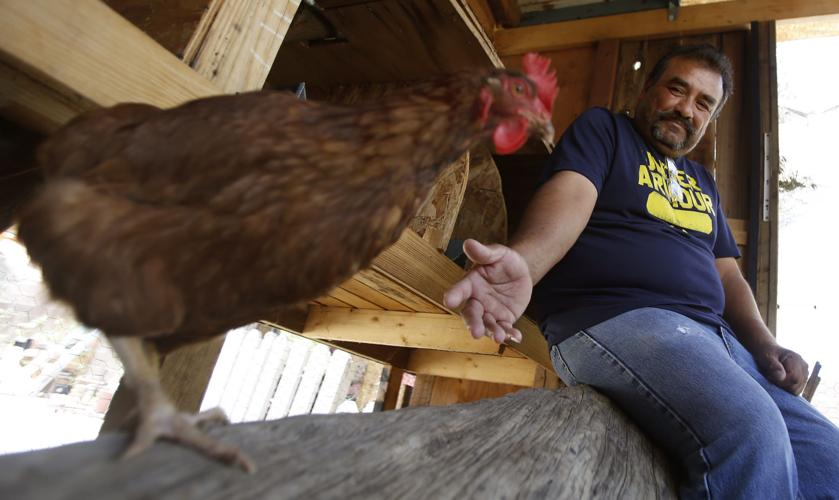

You can excuse Lorenzo Torres if he seems a tad obsessive.
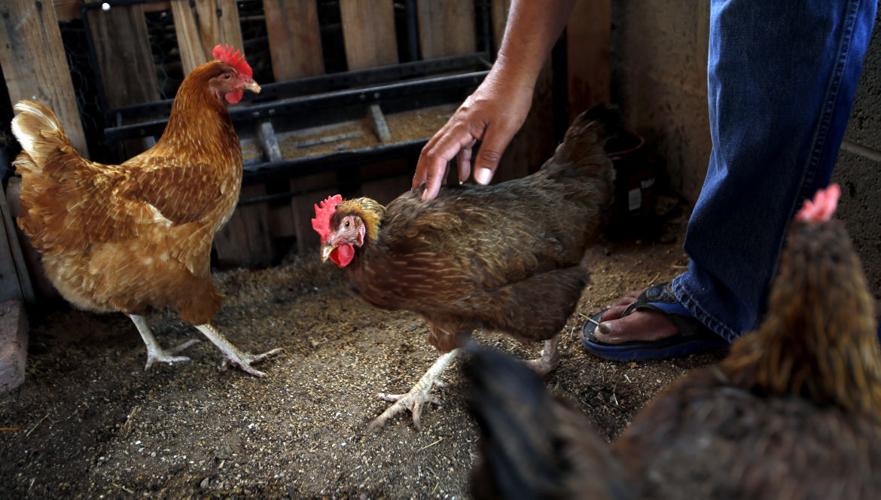
He gets up early every morning, makes a cup of joe and walks out into his backyard to say hello to his girls. He talks to them, feeds them and freshens up their water. He’ll let them out of their large enclosure to roam about his fallow garden.
Torres is crazy for his chickens.
“I always wanted chickens. Growing up in Mexico my grandmother raised chickens,” said Torres, a 52-year-old retired career U.S. airman.
Torres acquired his first three chickens from a neighbor in January. Now he has six: five Rhode Island reds and one white Leghorn. And if he has his way — which he probably will — Torres hopes to double his lovable flock.
He can’t stop talking about his girls and his family is amused.
His wife, Anita Torres, shrugs her shoulders. “These are his babies. I don’t deal with them.” His 14-year-old daughter, Lorenna Torres, a high school freshman, said, “I make fun of him.”
I feel him.
Since February I’ve gone chicken crazy, too. Like Torres and a growing cadre of urban chicken owners, I get up as the morning light arrives and I go outside to greet our four girls. They cluck and squawk in response. I give them clean water, scratch to eat and let them roam our backyard. Then it’s back to sleep.
Whether it’s to relive their childhood or engage in a more sustainable lifestyle or simply to have a new kind of pet, Tucsonans have gone hog wild over their chickens.
Alli Swanson knows the elation of having chickens.
“I wanted a third baby and didn’t think it could happen so I got chickens,” she told me over the phone.
That was late last year and, yes, after the chickens arrived so did her third child. She converted her garden shed into a coop where her five fluffy Silkies hold court.
She wanted chickens as pets and for eggs but they’ve become part of the family. The chickens are especially ideal for her two older children who have learned something about where their food comes from, Swanson added.
That’s one of the driving factors why city dwellers have turned to chickens and other fowls, said Megan Kimble, managing editor of Edible Baja Arizona, a Tucson magazine devoted to local culinary themes, and author of her just-released book, “Unprocessed: My City-Dwelling Year of Reclaiming Real Food.”
“People are getting into chickens for the same reason they’re gardening. They want to reclaim food cultivation,” she said.
Kimble doesn’t see backyard chickens as a fad. If anything, the movement will grow, she said. It is also relatively easy. While some chicken coops are elaborate, a simple coop of recycled material and wire is all that is needed. That was our first coop.
Kimble said the increasing interest in urban hens is seen, for example, on social media. Local chicken and fowl owners have a Facebook page named Tucson CLUCKS.
“It’s a permanent change,” said Kimble.
With this change also comes changes in city regulations. The city is considering altering zoning regulations regarding small farm animals in residential areas. The city currently requires a 50-foot setback for coops and shelters. And no roosters are allowed within the city.
The reality is that if a neighbor were to complain about my chickens and a city inspector were to visit our backyard, the law is on their side, not mine. Some chicken owners have lost their birds this way.
We don’t intend to lose our chickens, however. We’re part of a growing movement of urban farming which will ensure that Tucson residents will be able to keep a reasonable number of birds in our yards. As it is, my chickens, which we named Valentina, América, Daisy and Tropic Thunder, are less of an annoyance than loud barking dogs and feral cats in my west-side neighborhood.
Beyond the question of zoning regulations, having backyard chickens is just plain ol’ fun.
The girls have personalities. They have their cute habits. Fluttering their wings, they run up to greet you. They gobble up bugs and they eat all the leafy scraps from the kitchen. They are cheap entertainment. They lay eggs, enough to share with family and friends.

