


University of Arizona researcher Zachary Emberts knows what you’re thinking: Dressing up bugs in faux-leather armor and watching them fight? That sounds less like science and more like something dreamed up by a bored 9-year-old kid.
“I definitely can see that point of view,” Emberts said with a laugh.
But that’s pretty much how the postdoctoral fellow from the UA’s Department of Ecology and Evolutionary Biology spent his summer.
Two male giant mesquite bugs fight each other as part of a laboratory experimental study on the evolution of fighting and weapons in the animal kingdom. The slow-motion part shows how one of the bugs slams its leg spike into the wings of its opponent, causing permanent -- though not serious -- damage. Read more here. Video courtesy Zachary Emberts / University of Arizona
Emberts collected 300 giant mesquite bugs from the desert around Tucson and pitted them against each other in one-on-one glass-jar cage matches.
The effort resulted in two recently published studies by Emberts and UA ecology and biology professor John J. Wiens that help explain combative behavior of animals and the wide array of weapons they use.
Emberts said lots of animals fight amongst themselves over territory, food, shelter and mates. Some use claws and teeth, while others have evolved antlers or, in the case of his test subjects, prominent spikes on their legs.
“Evolution has found multiple solutions for inflicting damage in fights,” Emberts said. “We don’t fully understand what’s driving that diversity.”
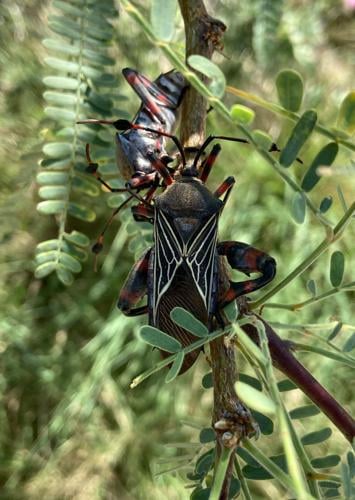
The giant mesquite bug is a common type of leaf-footed insect that grows to about 2 inches long and sports a pair of outsize, almost frog-like back legs. Each of those legs comes equipped with a sizable spike or two for the bugs to use in combat.
Their fights resemble wrestling matches, with one bug grabbing hold of the other and punching holes in its wings with the spikes on its legs.
The damage isn’t fatal but it is permanent, so researchers can chart the effects of fights on their test subjects and other leaf-footed bugs by checking their wings for telltale holes.
“It’s incredibly rare for fights between animals — any animals — to end in death,” said Emberts, lead author of the two studies.
He collected only male mesquite bugs, since they are the ones that fight each other for access to food and females.
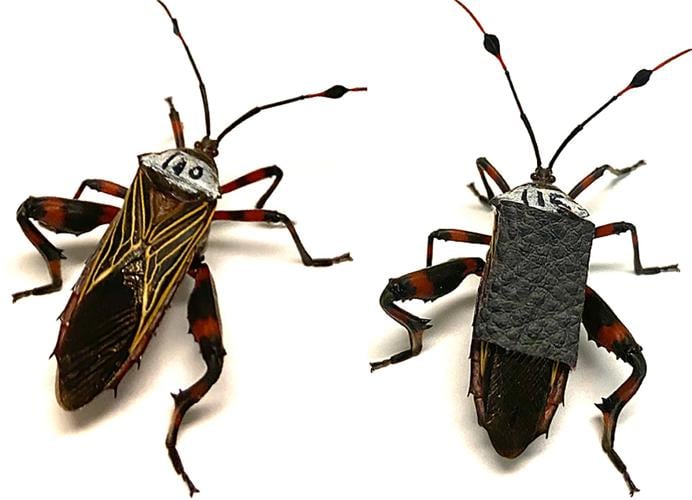
To tell them apart, the bugs were marked with a small spot of white-out with a number written over it.
Emberts and Wiens would place two of the insects in a jar together and give them a mesquite stick to fight over. “Or not fight over, if they didn’t want to,” Emberts explained. “They didn’t have to fight.”
There were no rematches. Win, lose or draw, each bug got to retire after its one and only time in the ring.
“This is natural behavior,” Emberts said, but “we definitely take ethics into consideration.”
In about 15% of cases, the two bugs basically ignored each other. The rest of the time, a brawl would ensue, sometimes lasting as long as 10 minutes until one of the fighters gave up the stick.
Predictably enough, the bug that sustained the most damage usually ended up losing.
“Biologists have generally assumed that the individual who inflicts more damage on their opponent will be more likely to win a given fight,” said Wiens in a written statement. “Surprisingly, this fundamental assumption had yet to be tested in an experimental study.”
That’s where the armor came in.
Emberts wanted to better understand the role of damage in deciding fights in the animal kingdom, so he decided to give some of his combatants an extra layer of protection.
After a trip to a craft store to check out different fabrics, he settled on tiny patches of faux leather, which he attached to 50 of the bugs with nontoxic Elmer’s Glue.
Emberts found that bugs with armor were almost two times more likely to triumph in their fights than those without it.
“This tells us that damage is important in who wins the fights,” he said. “This had previously been hypothesized, and it makes intuitive sense, but it had not been experimentally shown before.”
Because of the ongoing pandemic, Emberts avoided the lab and worked from home as much as he could.
“I actually did this on my patio,” he said of the bug fighting ring. “My landlord doesn’t know, but I’m sure they would be OK with it.”
Emberts swears he never staged any insect combat when he was a kid, “but I’ve been interested in animals for a long time,” he said.
With additional study — and more bug battles — he hopes to be able to determine the physiological and evolutionary price of fighting, particularly on those that lose.
“The puncture holes in their wings don’t heal up,” Emberts said. “It’s not severe damage, but there does seem to be a small cost to it.”

