


All organisms on Earth are related to one another in a vast “tree of life.” Some of the best evidence for this lies in the similarities and differences in organisms’ genomes, the sequence of chemical “letters” that encode all the information necessary for organisms to develop, function and pass on their traits to offspring.
My research combines these two potentially enormous data sets – millions of species and billions of letters in each of their genomes – to try to understand the place of specific biological species in the tree of life.
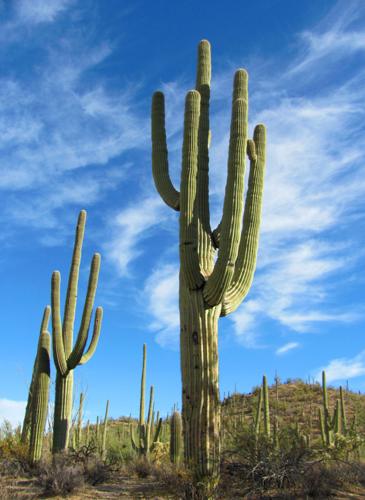
Lately, we have turned to an icon of the Sonoran desert, the saguaro cactus, to gather genome sequence data and reconstruct where among the thousands of other species of cactus it belongs. Perhaps no plant is as firmly lodged in the imagination of people when they think of the deserts of North America than the saguaro, if for no other reason than their appearance on classic Bugs Bunny-Roadrunner cartoons or in Hollywood westerns.
Saguaros are exotic and charismatic creatures, among the largest, longest-lived cactus, and their exact origins remain a mystery. No cactus genome has yet been sequenced. The saguaro genome is relatively large compared with most sequenced plant genomes, with about 1.5 billion letters in its genome.
Together with a large consortium of Mexican and Arizona scientists, funded mainly by the University of Arizona College of Science and National Autonomous University of Mexico in Hermosillo, as well as colleagues at Arizona State University and a recent grant from the Tucson Cactus and Succulent Society, we have been gathering genome sequence data from saguaro samples across its geographic range in Sonora and Arizona.
The main genome sequence is being assembled from an individual plant from the Tumamoc Hill reserve in Tucson, which has a century-old legacy of studies of saguaros. One small chunk of the genome is now complete, the small separate genome of chloroplasts, which is the site of photosynthesis in plant cells.
Surprisingly, this chloroplast genome is the smallest yet found for any flowering plant that still undergoes photosynthesis — a fairly baffling finding. In the next year, we will assemble a draft sequence for the whole genome, identify a large fraction of its genes and map how these genes vary across the diversity of habitats found within the Sonoran Desert.
For me, much of the pleasure in this work comes from alternating between massive but esoteric computational challenges and the in-your-face biology of such an interesting and extreme organism as the saguaro. Genomes like this are assembled first by breaking them into billions of small pieces, sequencing each of those, and then using algorithms on large computers to put the puzzle together.
But, living where we do, all of the members of our team have the singular pleasure of being able to turn their eyes away from the computer screen from time to time and look out their windows at this striking cactus, which is now beginning to give up its secrets.

