

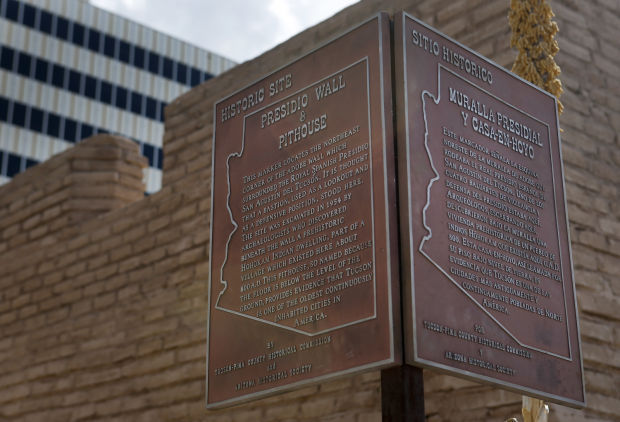
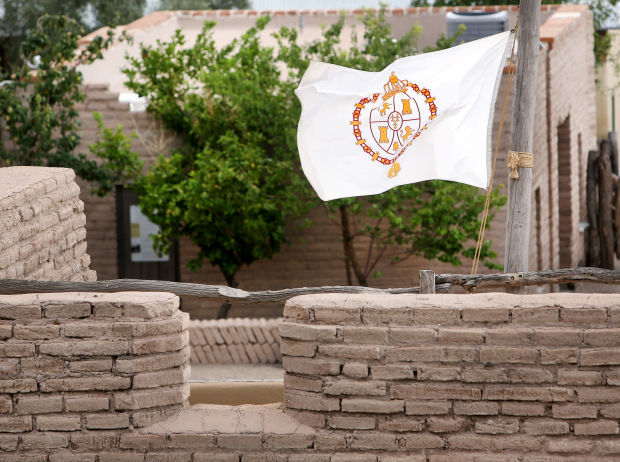

Our presidio is experiencing some growing pains. It’s to be expected.
Seven years after the wooden gates were opened to the adobe walls, the reconstructed Presidio San Agustín del Tucson evokes a sense of Spanish colonial Tucson.
A component of the original Rio Nuevo plan, the recreated presidio was seen as a magnet for locals and tourists. While it has attracted visitors, the presidio has not lived up to its potential.
But the presidio’s energetic supporters are intent on increasing community involvement and the number of visitors. There are plans afoot to expand its programs, revenue and support base in the form of volunteers.
“There’s room here to make a more family venue,” said Amy Hartmann-Gordon, the presidio’s executive director.
She is its only paid employee — and part time at that.
What the presidio lacks in a paid staff is made up through a nucleus of volunteers and board members of the Tucson Presidio Trust for Historic Preservation, the group that operates the emblem of our past. They are people who love Tucson and its history.
The presidio holds living history days, in which about 50 individuals dress up and portray colonial residents.
“Fridays at the Fort” is another event for schoolchildren who can participate in colonial-era games and chores, said Hartmann-Gordon.
Visitors can count on a squad of 15 docents who rotate their volunteer time Wednesdays through Sundays, providing historical facts and context about the presidio, located at 196 N. Court Ave.
The restored presidio occupies a small part of where the original Spanish garrison was established in 1775, when a small detachment of colonial soldiers, led by Lt. Col. Hugo O’Conor, traveled north along the Santa Cruz River from the Tubac presidio.
That was in August, and by October, construction of the first fort began across the river from an O’odham village called Chukson.
A year later, more soldiers and families came to the new presidio. Several years later, the colonists enlarged and improved the presidio’s walls to better protect the newcomers from Apache attacks.
The presidio was later occupied by Mexican troops after Mexico gained independence from Spain in 1821.
When the next wave of newcomers arrived in 1856, two years after Tucson became part of the Union, the Americans began to dismantle the presidio walls. By 1918, the last segment of the historic walls disappeared.
The walls were found by what is today’s boundary of Washington, Church, Pennington and Main streets. Pedestrians can walk the perimeter of the original presidio, guided by pavement markers.
But ask any Tucsonan walking downtown where the reconstructed presidio is located, and you’re likely to receive a dumbfounded look. Its hidden location, coupled with little public awareness, makes it harder for the Presidio Trust to increase the presidio’s presence.
Hartmann-Gordon said the focus has been on the details of the venue and its programs, to ensure historical accuracy. “But now it’s time to widen the scope,” she said.
One way will be to increase public and private contributions, she said.
The presidio has received financial support from Cox Charities, the Marshall Foundation, the State Council on the Humanities and the Southwestern Foundation for Education and Historic Preservation.
And a recent Internet campaign collected a modest $6,000, Hartmann-Gordon added.
But it is people power that will boost the presidio.
Erica Coleman, a Presidio Trust board member, is one example of the kind of Tucsonenses needed. She’s a recent graduate of the University of Arizona, and brings media and marketing knowledge to the presidio’s projects.
With her father, who now portrays a Spanish presidio colonial soldier, Coleman visited historical places around the country as a child. “I knew the history of other cities, but didn’t know the history of Tucson,” she said.
She’s looking inward now to help the presidio expand outward.

