


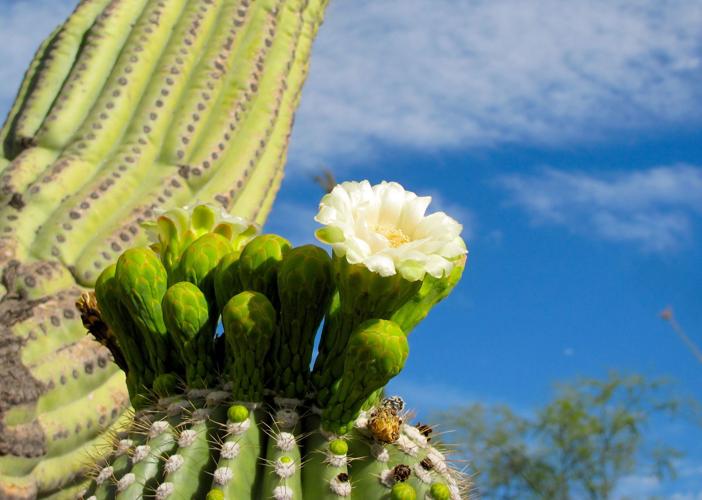
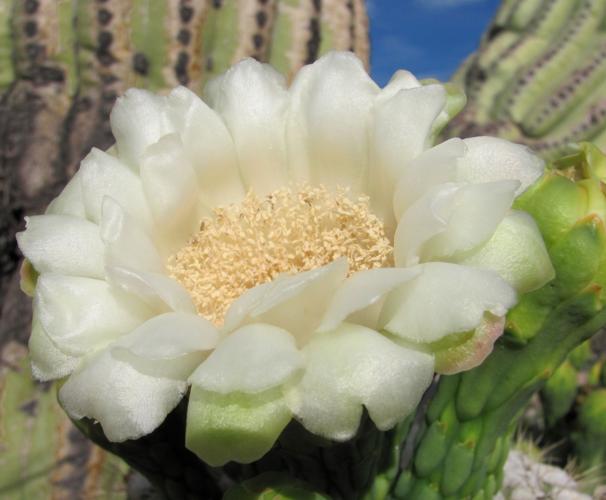
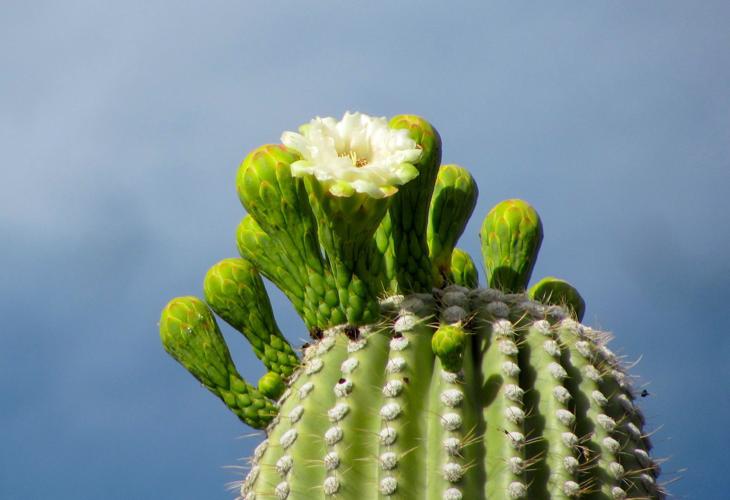
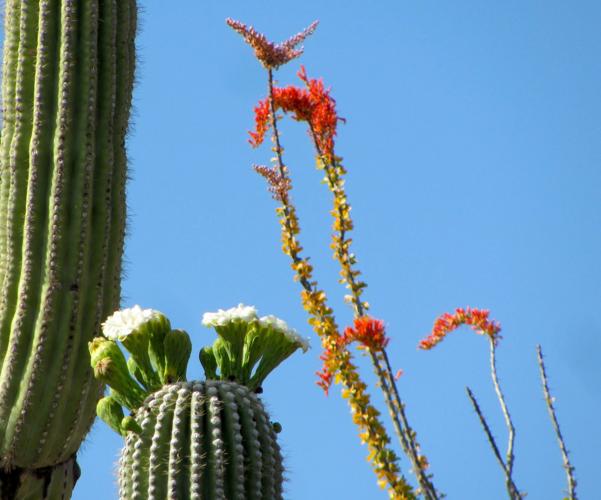


Saguaros could qualify as the superstars of the desert on the basis of their stately form alone — but this week they’re adding a sort of “coup de bloom” with their first brilliant white flowers of the season.
“Some saguaros usually start blooming by mid-April, but not a whole lot of them” this early in the year, said John Wiens, nursery horticulturist with the Arizona-Sonora Desert Museum, west of Tucson. “Late April to May is when lots of them are blooming, and they can continue into the early part of June.”
A few of the prickly giants break the mold when it comes to flowering.
“Saguaros can bloom at any month of the year,” Wiens said.
Even in December and January?
“Yes,” Wiens said. “There’s always an oddball here and there.”
SAGUARO BLOOMS 101
Wiens and a Saguaro National Park visitor guide provided some intriguing saguaro flower facts.
“An individual bloom opens somewhere around dusk,” Wiens said. “It stays until midmorning the next day, and then that’s it for that one flower,” which wilts by afternoon.
According to the Saguaro Park guide, “The spectacle repeats itself night after night for about four weeks until as many as 100 flowers have bloomed on each saguaro.”
Flying animals pollinate saguaro flowers in the few hours when they are open.
Pollinators include white-winged doves, lesser long-nosed bats, honeybees and moths.
They become powdered with sticky pollen as they feed on the flower’s nectar. Then they travel from flower to flower, transporting pollen and fertilizing as they go.
“Because saguaros are night bloomers, they are perfectly co-evolved with nectar-feeding bats,” Wiens said. “The white flowers are visible at night, and they have a kind of cantaloupe smell that bats find irresistible.”
Following the blooming season, saguaro fruit ripens in June and July. The Saguaro Park guide notes that the sugary pulp of each fruit contains as many as 2,000 seeds.

