



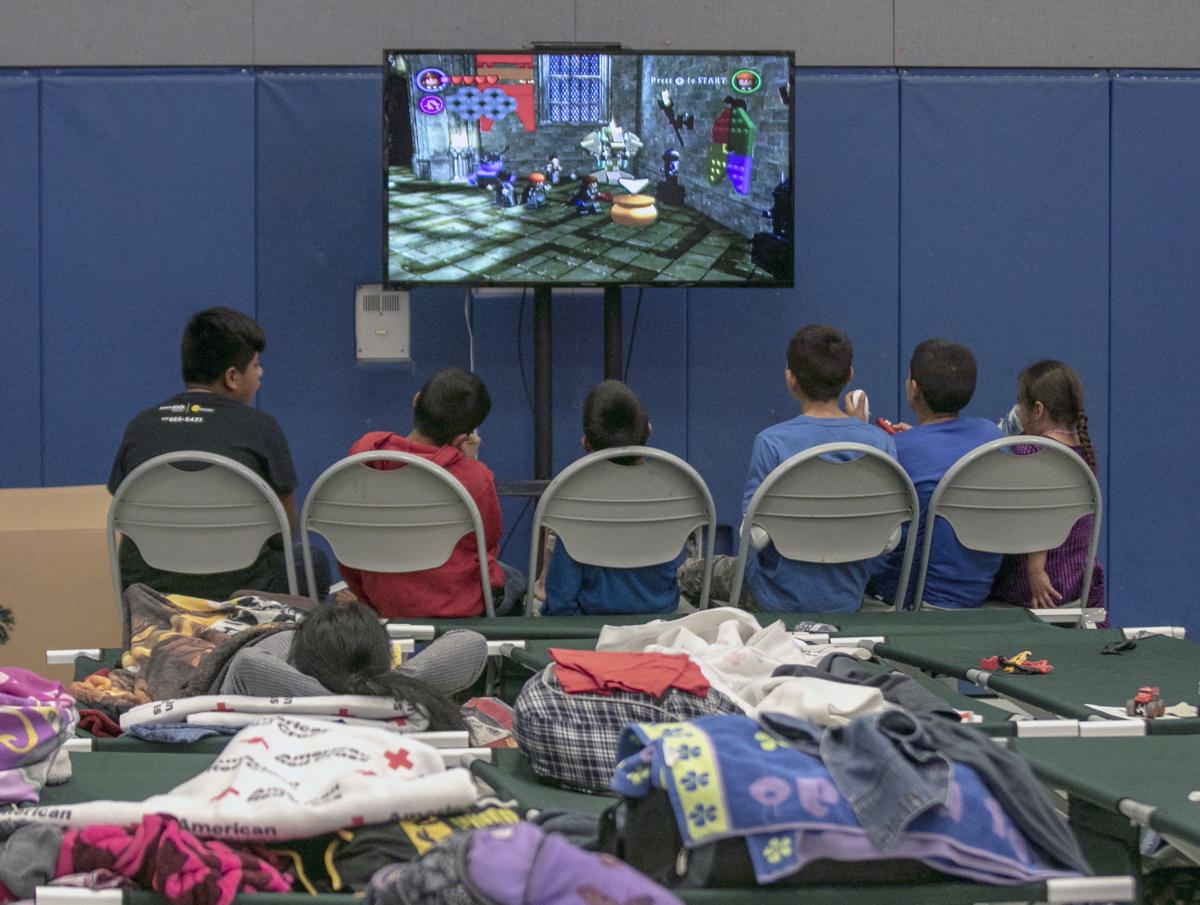
The city of Tucson is housing migrant families at a recreation center as federal agencies and local shelters struggle to find space for them.
On Thursday afternoon, about 60 people, mostly families from Guatemala, were eating lunch, packing clothes or asking questions about their immigration papers. Several children crowded around a television screen mounted on the side of the room as they played a video game.
City officials expect another 20 children and parents to be housed at the recreation center in the next few days, said Andrew Squire, a spokesman for the city.
The recreation center remains open to the public and no services are affected, Squire said.
“The kids are loving being here, it’s a rec center,” Squire said, noting the center employees are trained to take care of children.
A few employees will stay at the center overnight with the families, but they are managing the schedule to minimize overtime pay, he said.
The city is providing in-kind services to care for the migrant families, but is “not spending any cash,” he said. Instead, faith groups are donating food and other items for the families.
Elsewhere in the recreation center, kids were kicking around a soccer ball on a basketball court or throwing a plastic ball back and forth on a racquetball court. When the time came, they lined up for plates of black beans, rice, tortillas, chicken and mixed vegetables prepared by volunteers. Parents filled cups with coffee from a large cooler.
Federal immigration agencies process the families and release them at local shelters, such as churches and Tucson’s former Benedictine Monastery. Those shelters are struggling to keep pace.
Tucson officials received calls Sunday night from federal immigration officials and Catholic Community Services saying they were out of space, Squire said.
“We cannot allow people to just be dropped in the street with no knowledge of where they are, what they’re doing or anything else,” Squire said.
The families at the recreation center otherwise would have been dropped off at the Greyhound bus station, which could have created a public safety issue, Squire said.
The city of Yuma also is facing the challenge of finding housing for migrant families. Yuma officials recently declared an emergency in an effort to obtain more resources from the state and federal governments.
“We have no plan to declare an emergency,” said Tucson Mayor Jonathan Rothschild.
He applauded Tucson’s “social infrastructure” that has responded to the need to house migrant families, such as the former monastery and other shelters, community food banks and other charities.
“We have a long history of caring for people in these situations,” Rothschild said.
City officials were told to expect to house families at the recreation center for several days, but in what is “clearly an uncertain situation,” Rothschild said he could not say for sure how long the families would be there.
Berta Alicia Martinez, 36, said she was grateful to land at the recreation center as she folded donated clothes on one of the dozens of cots set up Thursday afternoon.
She and her daughter Sulmi, 13, traveled by bus from their home in northern Guatemala, which had “so much violence,” she said in Spanish. They crossed the border near Lukeville earlier this week with about 100 other people.
Martinez plans to ask for asylum, but she said the Border Patrol agents who picked them up did not ask about asylum claims. The agents took her fingerprints, had her sign a document and asked her where she was going in the United States.
“It’s called Kentucky,” Martinez said when asked where she was headed.
Her journey through Mexico was “complicated,” she said. She paused for a moment as if to hold back emotion and said, “yes, we suffered, we suffered a little.”
Martinez and Sulmi, who wants to study to be a teacher, were on their way to reunite with her husband. He has worked in Kentucky since Martinez was pregnant with Sulmi.
“She’s going to meet her father,” Martinez said with a broad smile.

