

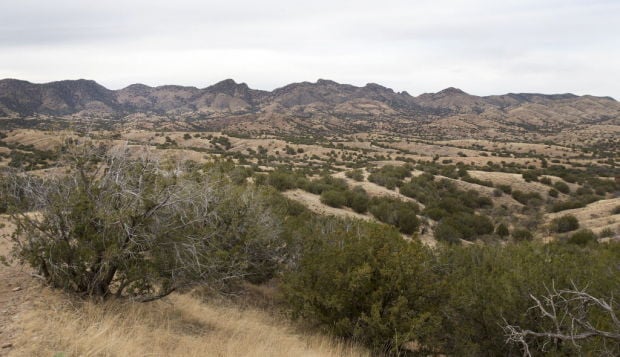

The proposed Rosemont Mine won a big legal victory Tuesday when an Arizona Court of Appeals panel overturned a lower court ruling blocking the mine’s air-quality permit.
The three-judge panel ruled that a Maricopa County Superior Court judge erroneously ruled in March 2015 that the Arizona Department of Environmental Quality’s approval of the air permit was “arbitrary and capricious” and “an abuse of discretion.”
The appeals panel concluded that, contrary to arguments made by the mine’s opponents and the lower court judge, that “substantial evidence supported the department’s determination that the proposed Rosemont Mine will not exceed air quality standards.”
Barring a successful appeal, this ruling means that two hurdles remain for the proposed open-pit copper mine southeast of Tucson. It would be the third-largest copper mine in the U.S. and employ about 400 people.
But it’s been dogged and delayed for years over concerns — all denied by the mining company — that it could harm air and water quality, dry up neighboring wells and streams and damage critical habitat for the endangered jaguar and other imperiled species.
Still needed are a final decision by the U.S. Forest Service on the project’s overall plans and a Clean Water Act permit decision by the U.S. Army Corps of Engineers. The agencies have said they expect to make decisions this summer.
The appeals court ruled in favor of the ADEQ and Rosemont on how a range of technical factors was used to calculate whether the mine would violate air quality standards. Superior Court Judge Crane McClennen, in agreeing with a long list of arguments presented by a group opposed to the mine, had ruled that the ADEQ’s action in granting the permit to Rosemont Copper was “contrary to law.”
The appeals panel, including Presiding Judge Diane Johnsen, disagreed point by point.
The lawsuit was filed in 2014 by Save the Santa Ritas, a coalition of community and environmental groups that oppose the mine.
“We’re pleased at the court decision. ADEQ issues permits that are both protective of human health and the environment,” said Timothy Franquist, ADEQ’s air quality division director. “We believe that Rosemont met that ultimate goal and we’re pleased to issue the permit.”
Save the Scenic Santa Ritas, maintaining Rosemont officials “cooked the books” on its air pollution modeling to obtain the permit, said Tuesday that it will carefully examine whether to appeal the ruling to the Arizona Supreme Court. The group also unsuccessfully challenged ADEQ’s aquifer protection permit for the mine in court.
“What is not in dispute is that this project will cause significant environmental devastation, including significant air pollution that threatens the health of Southern Arizonans,” said Gayle Hartmann, the group’s president, in a prepared statement.
Patrick Merrin, a vice president for Hudbay Minerals Inc., which proposes to build the mine, said in a prepared statement, “We are pleased with the court’s decision that validates the Arizona Department of Environmental Quality’s hard work and depth of expertise when it granted the air permit.”
The appeals court panel sided with ADEQ and took issue with the Superior Court ruling, on these and other issues:
- Save the Scenic Santa Ritas argued that a computer model used by Rosemont Copper and OK’d by ADEQ didn’t use conservative enough data to predict air emissions from the mine. The appeals panel countered that Environmental Protection Agency regulations don’t demand use of the most conservative data. The primary goal should be to most accurately estimate emission levels, the panel said.
- Opponents argued the model was invalid because it used background air quality data gathered at several rural locations instead of from Tucson. Experts for Rosemont and ADEQ testified that emissions from Tucson wouldn’t significantly influence air quality at the mine site, partly because prevailing winds don’t blow in that direction. The appeals ruling said, “We cannot say the department abused its discretion” in accepting rural data.
- Rosemont used a monitor at Chiricahua National Monument, 100 miles to the east, to estimate background levels of ozone and particulates near the mine site. Opponents said the company should have used data from a monitor at Saguaro National Park-East, which is only 32 miles away. The appeals panel agreed with an ADEQ expert who had testified that the Chiricahua and Rosemont monitors share similar elevations and are similarly far from urban centers.
- The opponents had challenged the ratio of nitrogen dioxide to nitrogen oxide that Rosemont had estimated would occur in emissions from trucks the mining company uses to haul ore to processing facilities and wastes to tailings piles. Opponents said the company should have used a much bigger ratio than it did — up to 50 percent compared to 5 percent. An ADEQ expert testified the lower ratio is reasonable, pointing to two studies the expert said were reliable that used ratios of 2 to 6 percent.

