

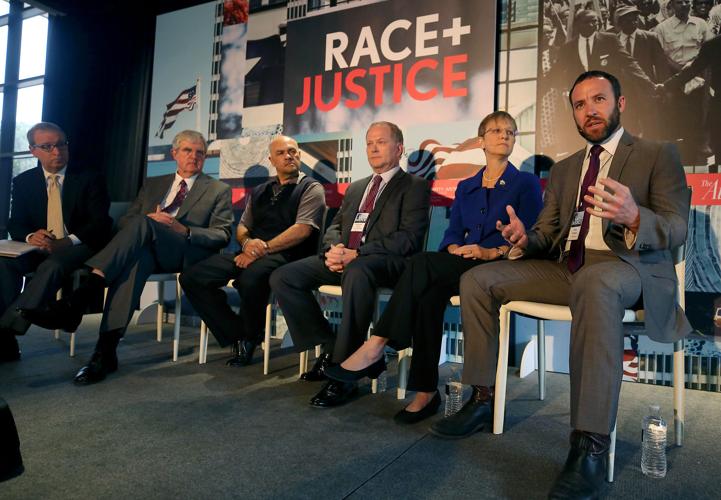

Tucson was picked by The Atlantic magazine as one of the national sites for a community summit on race and justice because of the city’s location near the border and the willingness of local leaders to find ways to reduce the jail population, the forum’s organizer said.
On Tuesday, the spotlight descended on Tucson as the national news outlet hosted a forum of local community leaders who are seeking to reform Pima County’s criminal-justice system.
With previous visits to Charlotte, North Carolina; Los Angeles; and Washington, D.C., Tucson became the fourth stop in The Atlantic’s Race + Justice summit, which examines the state of criminal justice in each city and what is needed to create a more effective and equitable system.
Pima County is one of 25 locations participating in the John D. and Catherine T. MacArthur Foundation’s Safety + Justice Challenge, a national initiative to reduce over-incarceration by changing the way the country thinks about and uses jails. Last year, the county was awarded $1.5 million from the challenge to invest in programs and strategies to reduce the average daily jail population over the next three years.
AtlanticLIVE President Margaret Low said while Tucson’s ties to the border and having officials willing to explore jail issues were among the reasons the forum was held here, it was also an important part of the conversation to try to understand how in a county that is still predominantly white, two-thirds of the jail population is made up of people of color.
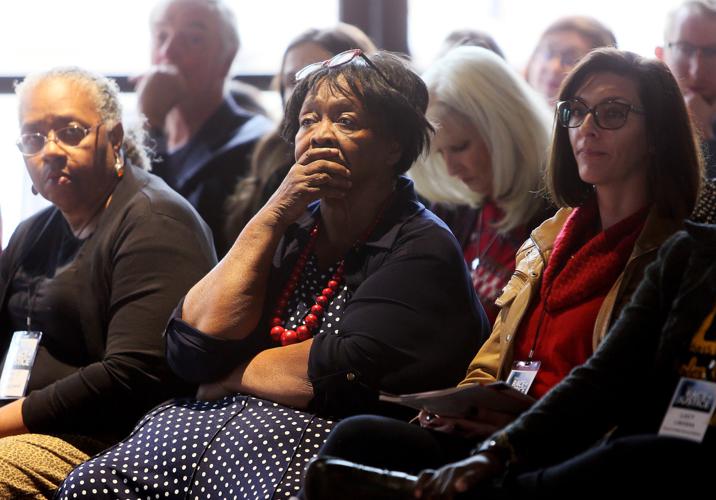
More than 200 community members attended the event at the Tucson Museum of Art, with high school and college students, activists and local professionals on hand.
The state of justice
Local justice leaders differed slightly as far as what metrics would be a good measure for a successful justice system, but the consensus was that there is work to be done to achieve the desired level of success.
“One of the most meaningful metrics would be if people on this stage were out of a job,” said Pima County Public Defender Joel Feinman, adding that racial disparities in the court system are actually increasing, with more minorities being charged with crimes.
Amelia Cramer, chief deputy Pima County attorney, said safety and justice are the key metrics the county needs to work toward.
“The system is exactly backwards,” Cramer said, after sharing stories of two recent cases . “Someone who posed a dangerous and violent threat to the community was out of custody while awaiting trial, and a woman who was suffering from a mental illness was in custody.”
For Manny Mejias, Pima Prevention Partnerships re-entry coordinator, a successful system would include therapy for people entering the system.
“Therapy is key. People don’t just wake up one day and decide they’re going to be a criminal. Things happen,” Mejias said with experience, having spent time in prison.
Pima County Administrator Chuck Huckelberry said a measure of success would include better outcomes for “those involved or entwined in the system,” and reducing the overall cost. Last year, the county spent $284 million on the criminal-justice system, $46 million more than 10 years ago, Huckelberry said.
“That’s money that can’t be spent on job training or treatment,” he said, adding the cost is 60 percent of the county’s general fund.
As part of the challenge, the goal is to reduce the county jail’s population by 25 percent, from 2016’s average daily population of 2,136. But officials differed on whether the county is on track to meet the goal.
Cramer said she was hopeful and that the percentage of people in jail on pre-trial status for misdemeanors has “shrunk tremendously.” Because of changes to the Pima County’s Pretrial Services Division’s screening and assessments, more judges are releasing nonviolent offenders to therapy and supervision instead of locking them up, Cramer said.
Feinman disagreed , saying the county is not on track at all.
“Every year, we file more and more felony cases than ever before and more drug cases than ever before,” Feinman said, adding that in 2016, drug charges represented 36 percent of people accused of felonies.
“We need to think about what we’re arresting and prosecuting people for,” said Feinman, who ran for Pima County attorney last year. “We’ve defined ourselves into a system of mass incarceration.”
But the biggest barrier in improvements to the system comes from the Legislature, as Arizona is one of only a few states to not adjust its “truth in sentencing” guidelines to accommodate nonviolent offenders. Both violent and nonviolent offenders are required to serve 85 percent of their sentences, a requirement most states have removed for nonviolent crimes.
Pima County Superior Court Presiding Judge Kyle Bryson said under the law, judges don’t have much flexibility when it comes to sentencing, as they have to adhere to state guidelines.
If leaders would lobby the Legislature for changes to “truth in sentencing” guidelines, the decriminalization of marijuana and the allocation of more funds for rehabilitation and less for prisons, it could go a long way to changing the system, Feinman said.
Pima County Attorney Barbara LaWall, who declined an invitation to participate on the panel, was sitting in the front row. During the question and answer period, she addressed Feinman’s statement about lobbying.
“One of the biggest barriers I see to creating change is the state Legislature’s insistence on private prisons,” LaWall said. “Until we end that, we can’t do anything about lobbying.”
LaWall said private prisons are an incentive to legislators and “their friends,” and as a result, “We can’t even get in to talk to them without them shutting the door.”
While Feinman agreed about the penchant for private prisons, he said he “fundamentally disagreed” this was the problem, saying that only 15 percent of Arizona inmates are in private prisons.
Enforcing the law
Traditional views of what makes a successful law enforcement agency, such as arrest and crime rates, shouldn’t be applied in Tucson, since it’s a unique community with different expectations than in other parts of the country, said Sheriff Mark Napier.
“We’ve got to get away from crime count as a measure of success,” he said. “We have to look at being engaged with the community and what the community wants from law enforcement.”
County residents are focused on social justice, and the key is to figure out how to make the system equitable for all community members, he said.
“Anyone who thinks there’s a level playing field in this country is just being disingenuous,” he said. “If this were a public health problem, we would approach it differently.”
Police Chief Chris Magnus said success for him is a community that believes its police are legitimate.
When it comes to immigration enforcement, Magnus and Napier agreed that while their departments will work with federal law enforcement , local officers and deputies won’t take on extra immigration duties.
“Taking it further, moving local police into a program that essentially deputizes them to be immigration officials is a massive mistake,” Magnus said. “It undercuts trust in police, especially in communities like ours.”
The Sheriff’s Department doesn’t have the resources or the inclination to adopt federal enforcement policies, Napier said. “Immigrants are not our enemies, Mexico is not our enemy.”
Neighborhood connectors
The disparity in people of color who are incarcerated in the county jail is impossible for minorities in the community to ignore, some said.
“We need as a community to look at the people who we’re criminalizing,” said Lola Rainey, a former prosecutor and founder of the Tucson Second Chance Community Bail Fund.
In neighborhoods south of 22nd Street, the residents are primarily people of color who struggle with a lack of basic resources, said Jacob Robles, a member of Flowers and Bullets, a group that works to create outlets for underserved youth and communities.
“For us, having public safety doesn’t mean having more cops policing our neighborhoods,” Robles said. “Sometimes it’s necessary, but in my community, policing and incarcerating always leads to more problems. Public safety is different for us.”
Rainey pointed toward a “revolving door of poor people” coming in and out of Tucson City Court who are subject to driver’s license suspensions because they can’t pay fines, which she said is an example of how Pima County criminalizes poverty.
“If we want to change things, we need to look at how we let our local criminal justice system get out of hand,” Rainey said.

