


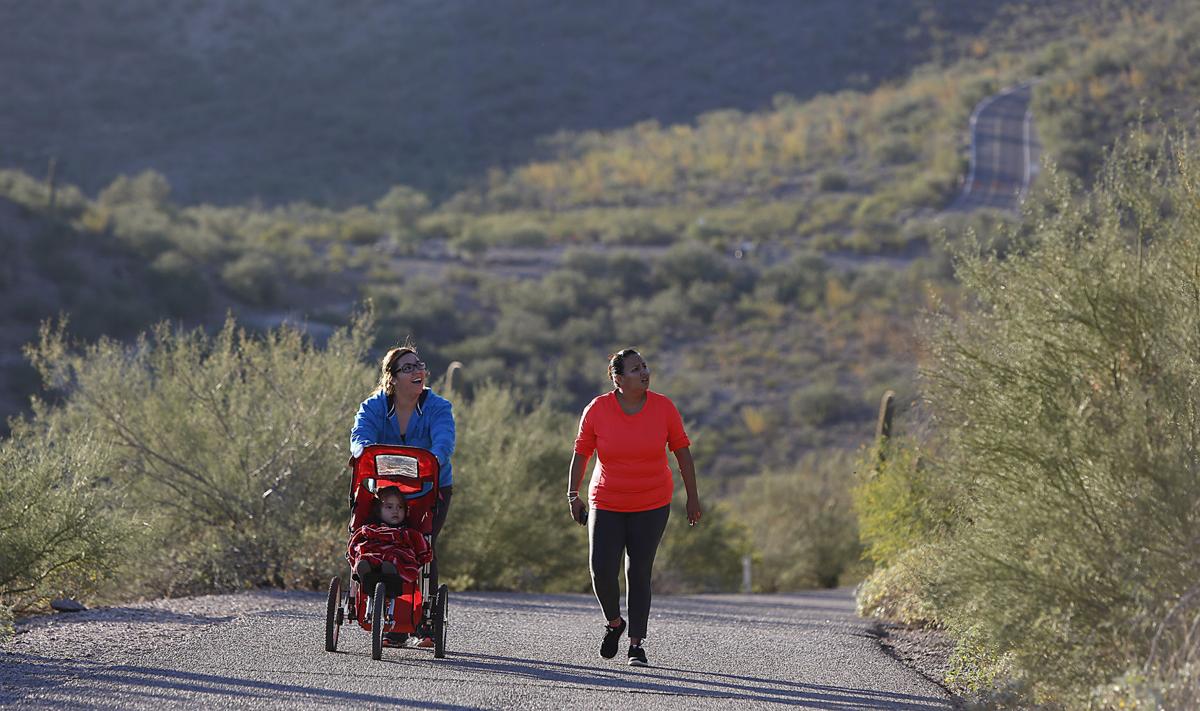
Retired engineer Greg Smith was surprised Monday when University of Arizona police interrupted his morning walk up Tumamoc Hill and told him to leave.
Smith said he knew he wasn’t technically supposed to be on the road after 7:30 a.m., but it’s a walk he takes at the same time about three times a week with hundreds of other people.
University of Arizona police say there is no change in enforcement policy on the hill, but when they are called there, or encounter walkers during routine patrols of the university property, they tell them to leave if they are violating the posted policy that prohibits walkers from 7:30 a.m. to 5:30 p.m. weekdays.
Ben Wilder, interim director of Tumamoc, said he is working toward making the hours reflect the reality of how people use the road for exercise. People routinely walk throughout the day, despite the signs, he said.
Smith said he was halfway up the 1.5-mile trek at about 8:45 a.m. when a University of Arizona police truck drove up and stopped. He was told to leave, which he did.
He said other walkers ignored the order and he encountered about 20 people walking up as he walked back.
UA Police Officer Rene Hernandez said officers don’t regularly patrol the hill, but do respond to complaints from employees or walkers. The most common one is that someone is walking a dog, which is always prohibited. He said officers have responded seven times in the past three months.
Dogs are not allowed because they could potentially interfere with wildlife on the hill, which has been a botanical and biological preserve since 1903.
UA Police Chief Brian Seastone said his officers don’t routinely enforce the hours on Tumamoc. “Today they just happened to be out there on a regular patrol,” he said.
Wilder said he wants any changes to be made as part of a comprehensive policy that involves the walkers, estimated at up to 1,500 per day, in caring for the hill.
Smith said he’d be happy to help with stewardship of the hill and said most walkers are protective of it. “It’s really rare I see anyone acting poorly,” he said.
Smith said when a man attempted to walk his dog there recently, he turned around after a series of walkers told him pets weren’t allowed.
Wilder said a historical “lack of enforcement and lack of clarity have made a really bad situation for the UA police.”
He is meeting this week with an advisory committee and with Tucson Councilwoman Regina Romero, who represents the area.
Wilder said he also wants to incorporate concerns expressed in surveys of hill walkers.
“We’re actively working with all parties to make it a better environment for those who love the hill,” he said.
For his part, Smith said he intends to start walking nearby “A” Mountain, despite the fact that it is “not as good a climb and the drivers are not great at sharing the road with walkers.”

