



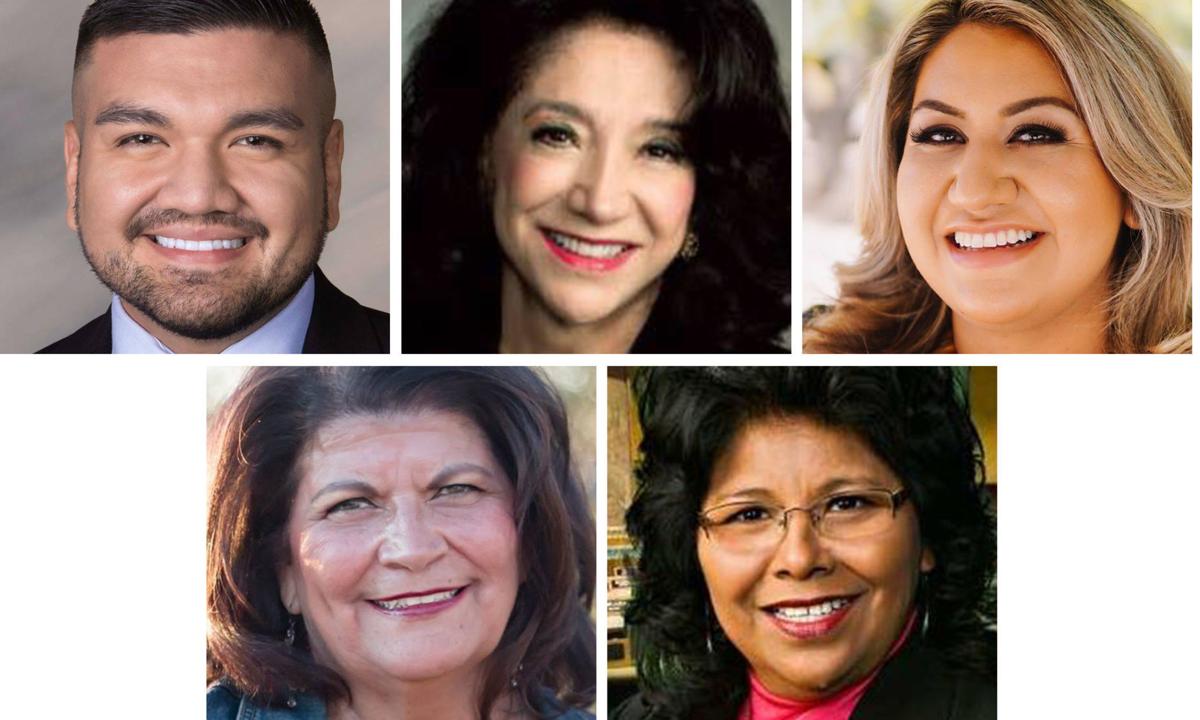
The Democratic primary in Tucson’s Legislative District 3 pits the old guard against the new guard for three open seats from a district with no Republican contenders.
All three current lawmakers in the district are hitting eight-year term limits this year, but only one has decided to retire. The other two sitting lawmakers, Sen. Olivia Cajero Bedford and Rep. Sally Ann Gonzales, are attempting to swap chambers to stay at the Capitol.
But the seatmates are not working together on that effort. Each has forged alliances with their own set of political newbies they’re hoping to guide into office after the Aug. 28 primary in the Democratic stronghold district.
Cajero Bedford has formed a slate with newcomers Andrés Cano, who is also running for the House, and Betty Villegas, who is seeking the district’s Senate seat.
Meanwhile, in her bid to move up to the Senate, Gonzales is working with House candidate Alma Hernandez, though she said the two aren’t technically teaming up.
In a district where U.S. Rep. Raúl Grijalva’s name looms large, the dividing lines fall along his endorsement. Cajero Bedford, Cano and Villegas all have the backing of the longtime congressman. Gonzales and Hernandez do not.
The Democrats have little differences in the way of policy. All list increasing education funding, and protecting women’s health and the environment among their top priorities. They all cite a need for criminal justice reform in the largely working-class district, which encompasses Tucson’s west and southwest sides including University of Arizona and downtown, stretching from Ryan Airfield in the southwest, to Prince Road and about First Avenue in the northeast.
The differences, they argue, are in the way they’d represent the district.
Gonzales, who was elected to the House in 2010, after serving four years there in the 1990s, said she deserves another term, this time as a senator, because she’s been a voice for people of color, for teachers and the rural working class.
As a member of the Pascua Yaqui Tribe, she’s one of only four Native Americans in the Legislature, and the only one from Southern Arizona.
While none of her bills have been signed into law in the past eight years, that’s more common than not for Democrats.
But she noted that this past legislative session, she got a Republican to sponsor a bill, which was previously backed by Democrats, to exempt American Indians from work requirements and lifetime limits instituted by the Arizona Health Care Cost Containment System.
“On most reservations, the unemployment rates are the highest in the state. And people can’t really meet those work requirements because there’s no jobs to have in rural communities in Arizona,” she said.
And she noted that she supported legislation prohibiting public money from being used as payment for a victim of sexual harassment or sexual assault, making a point to note that Grijalva spent $48,000 on a severance package to a victim of workplace harassment. That harassment was not sexual.
“My opponent has his endorsement,” she said.
Villegas, a political newcomer who spent her career working for Pima County, said Gonzales, “votes right” but that’s not all there is to being a lawmaker.
“The difference is how do you involve your community to get to that vote. … I believe the biggest difference between us is how we get to that vote, how we engage our community,” she said.
That’s where Gonzales has failed, she said.
She noted Gonzales had one of the worst attendance records in the Legislature in 2017, though it improved this year. And Villegas said she’s running to give voters a choice – something they haven’t had in the House since 2010.
“She hasn’t had a (Democratic) opponent (since 2010), so she hasn’t had to really work to get elected until this year. And whether I win or lose, it’s good for her to have to work for it,” she said.
Villegas said in her career as an Affordable Housing Program Manager at Pima County, from which she retired in 2016, she helped a lot of people avoid foreclosure, and would like to take her expertise on affordable housing to the Capitol.
Though she hasn’t ever held elected office before, she said she’s familiar with politics, government and state laws, and would be a “quick study” on other issues at the Capitol.
Villegas said Gonzales’ focus on Grijalva’s endorsement is overblown, and that the two are longtime friends.
“The relationships I’ve built in this community started as friendships, not as political alliances,” she said.
HOUSE SEATS
The three-way Democratic primary for the district’s two House seats features one seasoned politico and two newcomers.
Cajero Bedford, a 16-year veteran of the Capitol, has politics in her blood. Her father was elected to the Legislature in 1968, and her mother was appointed to the post when he died five years later, and served another 24 years.
“A Cajero has been in the Legislature for 45 years,” she said.
And while some of her fellow Democrats, namely Hernandez, say it’s time for new blood at the Capitol, Cajero Bedford argues “experience counts.”
For the last 14 years, she’s served on the powerful Appropriations committees, both in the House and Senate, and said that insider knowledge of the state budget process allows her to unmask cuts and policies Republicans try to slip into the budget unnoticed.
But she hopes next year will be different, and that the Democrats will have an ally in the Governor’s Office, as she expects Gov. Doug Ducey to lose his re-election bid.
“I’m glad to be doing what I’m doing, even though it’s tough for a Democrat. But I’m also passionate about it now because I feel very strongly that we’ll have a Democratic governor. … That was a big motivator to continue,” she said.
Hernandez didn’t return multiple calls for comment as of the Daily Star’s deadline. But at a recent debate hosted by the Arizona Citizens Clean Elections Commission, she argued it’s time for LD3 to send new blood to the Capitol.
Cano, who has teamed up with Cajero Bedford for the district’s two House seats, said he’s both new blood, and steeped in old Tucson.
At 26 years old, he has more than a decade of government and political experience under his belt, having started as a summer intern for Pima County at the age of 14. Since then, he’s interned for two members of Congress, served on former Gov. Janet Napolitano’s Youth Commission, and now works as a political aid and community liaison for Pima County Supervisor Richard Elías.
Like the others, he said he’d be a solid vote for Democratic values. But he also wants to look for opportunities to work across the aisle to get things done, especially on issues where he agrees with Republicans, like criminal justice reform.
“My job when I get elected is to stand true to my values, but also look for those windows of opportunity,” he said.
As a young LGBT Latino and the first member of his family to graduate college, Cano describes himself as part of the emerging class of leaders of tomorrow. And that parallels how he sees the district: As an emerging hot spot that needs an infusion of new leadership.
“Just as the voters have an opportunity to elect new leaders for the first time since 2010 in this district, we also have a completely different political and economic landscape — you have the downtown economy thriving, you have the west side beginning to get lots of private and public infrastructure invested. So I think it’s an emerging district as well,” he said.

