




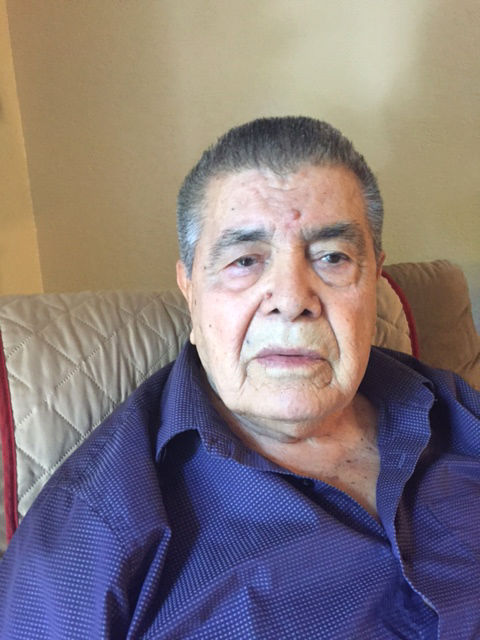
Antonio Olivares was in his 20s, living in his hometown along the Rio Sonora, when he crossed the international border and traveled north to work in Walla Walla, Washington.
He went legally.
Olivares was one of the estimated 2 million Mexican workers, known as braceros, who were contracted to work in U.S. agricultural fields under a binational guest worker program that began in 1942 to keep America fed during World War II. It ended 22 years later in 1964, filled with controversy because of exploitation of the workers and the changing social landscape in the United States.
This weekend, a photo exhibit opened at the Tucson Desert Art Museum, on the city’s northeast side at 7000 E. Tanque Verde Road, focusing on the bracero experience.
The exhibit, Bittersweet Harvest, is organized by the National Museum of American History and set up for travel by the Smithsonian Institution Traveling Exhibition Service with funding from the Smithsonian’s Latino Center.
Rhonda Smith, the museum’s director, said the exhibit has been a one-year undertaking. In addition to the exhibit, which runs through Feb. 14, 2016, two free lectures will be held Jan. 9, with Olivares to talk about his bracero years, and on Jan. 23 with three academics who will focus on the politics of the program and its ramifications.
“This exhibition is going to take you through their road to the Desert Southwest and what happened here and even after they were placed back in Mexico,” Smith said.
Braceros worked in more than half of the states, but the large majority toiled in Arizona, California, New Mexico and Texas.
They were contracted for less than two years and required to return to Mexico, but they could be contracted again. In the 22 years, the program had more than 4.5 million contracts.
Now 87 years old and living with his wife, Amanda Olivares, on Tucson’s west side near Cholla High Magnet School, Olivares said his work, first in Washington and later in California, was difficult. backbreaking and poorly paid.
“The truth was I just worked,” he said while sitting in his living room. “There were good times, bad times ... but I went to work.”
After several years of working in the fields, Olivares returned to Hermosillo, Sonora, where he married his wife in 1960. There they began raising their family, which eventually grew to six children.
But Olivares, like all the other braceros, were owed back wages.
Under the contract, 10 percent of the workers’ earnings were set aside and remitted to Mexico with the promise that the braceros could retrieve their money after they completed their contract. However, miscommunication and mismanagement of the program left the workers with a broken promise.
Violeta Domínguez, who will be part of the Jan. 9 panel at the museum, has since the late 1990s labored on behalf of the braceros to recover their lost wages. She said that after tremendous pressure, from workers, their families and supporters on both sides of the border, the Mexican government paid some workers. But many more remain unfulfilled.
“It’s the government’s responsibility to return the money to the workers,” said Domínguez, a researcher at the University of Arizona’s Norton School of Family and Consumer Sciences. Domínguez has worked with Tucson’s 120 former braceros and their families to recover their money.
“There are thousands of braceros who are in limbo, not an official list of workers, like Antonio,” said Domínguez. “Many are sick and unable to pursue their money.” And they are dying.
Domínguez said the photo exhibit is necessary to preserve the memory of braceros’ experience.
With the exception of not having received his 10 percent, Olivares doesn’t harbor any ill will toward the program. It allowed him to work and eventually he was able to come north permanently, where he and his wife raised their three sons and three daughters, all of whom except one live in the United States, and to guide them through their schooling and share in their professional successes.
“Once I emigrated, I was free,” he said.

