



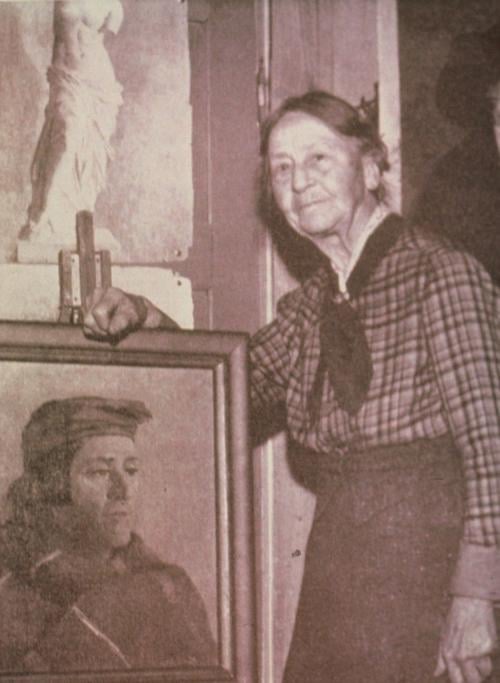
Born Feb. 8, 1861, in Waukegan, Illinois, Kate Thomson Cory was one of six children, although only she and a brother survived infancy.
Supposedly, Abraham Lincoln, before he became president, and Civil War Gen. Ulysses S. Grant occasionally dined at the family home. When her father became a stockbroker in New York City, 19-year-old Kate entered art school and graduated from New York’s Cooper Union for the Advancement of Science and Art in 1887.
She established herself as a commercial artist in New York but when artist Louis Akin invited her to join an art colony he said he was establishing on the Hopi mesas in northern Arizona, Kate readily accepted. However, when she got off the train in Canyon Diablo, about halfway between Flagstaff and Winslow, and made her way by buckboard to Oraibi on Third Mesa, Kate discovered she was the only artist in residence — the art school never materialized. Deciding to stay a few weeks to sketch and develop some new ideas, Kate remained with the Hopis for seven years.
She moved into a small apartment in one of the highest houses in Oraibi. “You reached it by ladders and little stone steps,” she said, “and made your peace with the growling dogs on the ascent; but oh! The view when you got there.”
The Hopi people were very curious about this small, pale woman who had moved into their community, and Kate often returned to her apartment to find an entire family rifling through her papers and belongings while their dinner simmered over her fireplace. Yet the Hopi developed a deep fondness for the woman they called “Paina Wurti,” or painter woman.
During the seven years Kate spent with the Hopis, first at Oraibi and later at Walpi on First Mesa, she took over 600 photographs, considered one of the largest pictorials of the Hopi people as well as one of the most accurate depictions of their culture. They allowed her to view ritualistic ceremonies and invited her into sacred kivas never before seen by outsiders.
Using very unstable nitrocellulose film, Kate filtered rainwater to develop her pictures, after first extracting drowned bugs and rodents from the murky waters. Photographers today are amazed at her accomplishments under these almost primitive conditions.
She witnessed life-changing moments such as the ouster of the Hopi faction known as “Hostiles” by the “Friendlies” in 1906, recording the dissidence with her camera. When she lost the negatives, she painted the event in a mural titled “Migration” showing Hostile men, women and children being forced from their Oraibi homes.
Her eye for detail missed little and her paintings showed her admiration and respect for the Hopi people as she painstakingly recorded meticulous details of ceremonies and costumes.
Her artistic endeavors also included experimenting with poetry and prose. In a journal that she maintained from July 1909 until December 1910, she described the rich hues of the desert after a rainstorm:
“While I watch & listen to the flood, the distant mesa across the desert has dyed a deep rich blood color & a long slender span of rain bow has blended into the evening clouds, & the sky west grown radiant & paled.”
Several of her articles depicting life with the Hopis were published, including a description of the celebrated Snake Dance. And she learned to communicate with her neighbors by translating over 900 Hopi words and phrases.
As isolated as she was on the mesas, Kate maintained her connections with the art world. She spent time in Hollywood as a consultant on western films and had showings of her paintings in Los Angeles.
By 1912, Kate was finding it more difficult to climb the steep hills and hundreds of steps to her Hopi home.
She moved into Prescott and built a house resembling a typical Hopi dwelling.
Unconcerned about money, she often traded her paintings rather than selling them. People living in Prescott thought her eccentric when she came into town wearing rumpled, ragged clothing, although in 1915, Sunset magazine named her one of Arizona’s most interesting westerners.
By now, Kate preferred painting landscapes instead of people but was commissioned in 1913 to paint the portraits of the president of the Arizona Senate and speaker of the House of Representatives.
At the beginning of World War I, Kate headed east to work with the Women’s Land Army, a group involved with establishing Victory Gardens to support the war effort. She also designed camouflage airplane equipment for Standard Aircraft of Newark, New Jersey, and found time to exhibit some of her paintings at New York’s Society of Independent Artists.
Back in Prescott, Kate became involved with the Smoki, an organization dedicated to preserving Native American cultures.
She created the Smoki sun symbol and worked with Arizona historian Sharlot Hall to design the cover for a book Hall wrote about the Smoki.
Many of Kate’s paintings, her journal, and Hopi dictionary are on display at Prescott’s Smoki Museum (now known as the Museum of Indigenous People).
Kate also designed the cover of Hall’s first book of poetry, “Cactus and Pine: Songs of the Southwest.”
In 1929 when plans were drawn up to build Boulder Dam on the Arizona/Nevada border, 68-year-old Kate picked up her brushes and canvas and set out to record the area before it was flooded. She camped at the site for days, her only companion an old prospector who prepared her food and probably kept her out of harm’s way.
In 1956, at the age of 95, Kate moved into the Arizona Pioneers Home in Prescott. She died June 12, 1958.
Kate Cory’s abundant portfolio of paintings and photographs illustrates an intense cultural sensitivity to Hopi rituals and ceremonies. Because the Hopi have not allowed photographs to be taken of some of their ceremonies since around 1917, Kate’s collection is a valuable record of the Hopi people that can never be replicated.

