


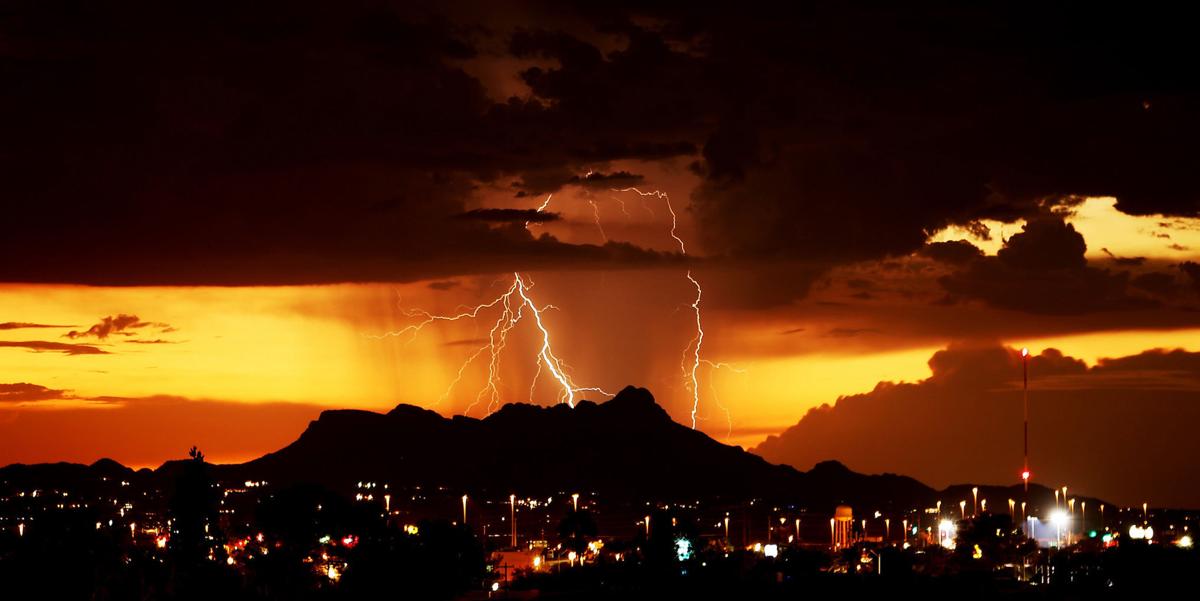
Saturday is the official last day of the monsoon season, but it seemed to have ended long before now. Meteorologist are stumped as to why.
July was the wettest July on record in Tucson when 6.8 inches of rain fell at the airport. Some parts of town saw even more rain that month. But with the exception of one day of rain in August, the rest of this year’s monsoon season — officially June 15 to Sept. 30 — left us hanging out to dry.
The total rainfall for the season was 8.57 inches, which is well above a normal monsoon rain total of about 6 inches. Tucson got 75 percent of its total participation in three weeks in July, said Michael Crimmins, University of Arizona meteorologist, in a tweet.
After the soggy July, things dried out: 1.74 inches fell in August, and a mere 0.03 of an inch fell in September. Both months of rainfall were below normal, which are 2.39 and 1.29 inches, respectively, according to the Tucson National Weather Service.
Despite the dry spell, the Tucson airport was only shy 0.05 of an inch of rain to tie for the 10th wettest monsoon on record. This summer ended up being the 11th wettest monsoon on record in Tucson, according to the NWS.
July did all the heavy lifting, getting us above the average monsoon rainfall of 6.08 inches in under three weeks.
“I was just trying to make sense of it,” Crimmins said when trying to figure out what caused this strange monsoon. “But I don’t know.”
“It wasn’t El Niño or La Niña. They’re not in play right now.”
Monsoon season starts when mid-level winds, at about 10,000 feet, shift from the southwest to southeast.
This is caused by the northward movement of a high pressure system, referred to as the monsoon ridge, said Aaron Hardin, meteorologist for the Tucson NWS.
This pattern ushers in subtropical moisture to our usually dry area.
This year, the ridge slid back south earlier than normal, limiting our access to moisture and leaving us dry, Crimmins said.
“In August, it was in the early spring, late fall position,” which isn't where it normally is during that time, Crimmins said.
But, “There’s not one silver bullet answer,” he said. Ultimately, “This will require more study.”
Crimmins also suggested this might also be the monsoon’s typical weirdness, which Tucsonans know so well.

