



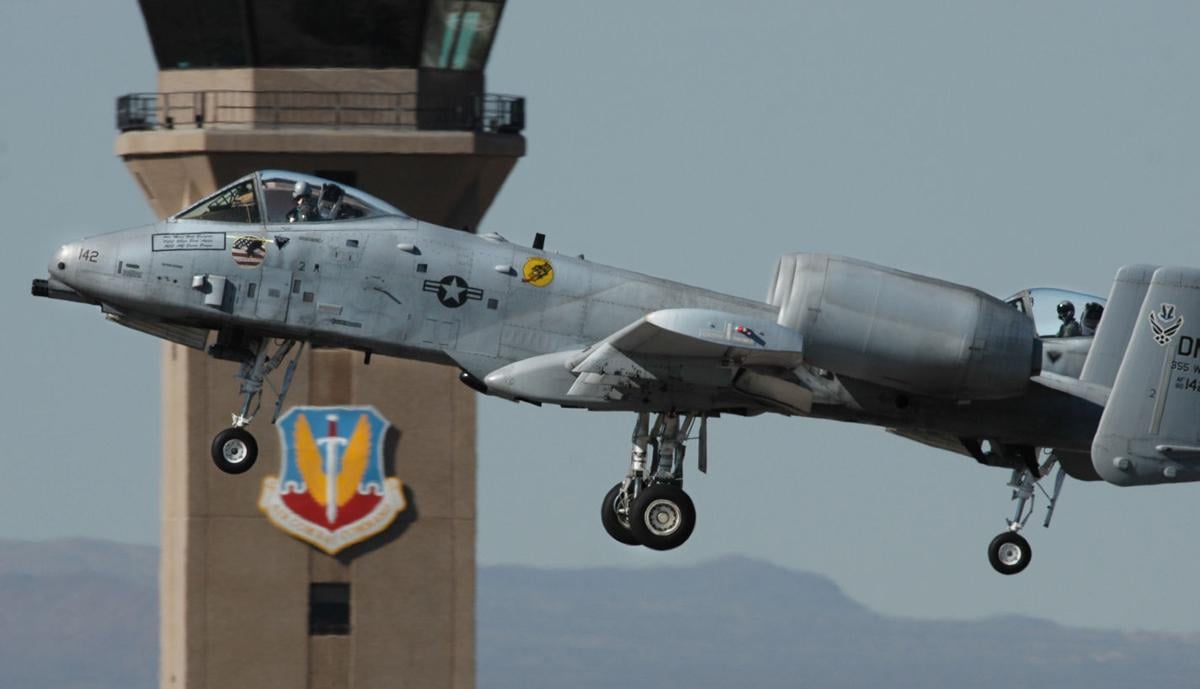
The Air Force plan to retire the A-10 Thunderbolt II ground-attack jet could create capability gaps in close air support missions, particularly in coordination of combat-rescue operations, the Government Accountability Office says in a new report.
Meanwhile, the Air Force hasn’t fully studied the potential cost savings of retiring the A-10, a mainstay of operations at Davis-Monthan Air Force Base, the GAO said.
The Air Force has proposed retiring all of the nation’s A-10 “Warthogs” by 2019, citing intense budget pressures. A-10 supporters in Congress, including Arizona Sen. John McCain, blocked the retirement plan during consideration of the defense budget last year and are on a path to do the same this year.
In preliminary findings of a study ordered by Congress last year, the GAO said that Air Force divestment of the A-10 “will create potential gaps in CAS (close air support) and other missions,” noting that the Pentagon is planning to fill some of those gaps by using other manned and unmanned aircraft until the multirole F-35 Joint Strike Fighter is operational.
However, Air Force documentation shows that the F-35’s close air support capability will be limited for several years, and scrapping the A-10 “would increase operational risks” in one Defense Department planning scenario set in 2020, the GAO said.
McCain, chairman of the Senate Armed Services Committee, said the report underscores concerns he has been raising for years about the Air Force’s “misguided attempts to prematurely retire this vital aircraft.”
“The A-10 is the best close air support weapon in our arsenal and is playing an important role in the fight against ISIS in Iraq and Syria and in NATO’s effort to deter Russian aggression in Eastern Europe,” McCain said in a news release.
McSally, a former A-10 pilot and squadron commander, said in a prepared statement that the GAO report confirms what she has said all along in hearings and public appearances, that “retiring the A-10 without a replacement would create dangerous capability gaps and put American lives at risk.”
“While this report is welcome news, it will not eliminate the threat to the A-10,” she said, vowing to keep fighting to save the plane.
Retiring the A-10, the GAO report said, would cut the only Air Force fighter specifically used to direct combat-rescue operations, referred to as the “Sandy” role after the radio call sign used for such planes. Such missions entail coordinating rescue operations, escorting rescue helicopters and suppressing enemy forces.
The GAO also cited Air Force studies showing the A-10 is the best aircraft to counter the threat of swarming small boats, and said its retirement could make it more difficult to train and certify joint terminal attack controllers, or JTACs — ground troops responsible for directing air strikes.
The GAO noted that the Air Force is considering a number of steps to fill the capability gaps, including moving A-10 personnel to F-16 and F-15 units that will have an increased focus on close air support and studying how those planes can replace the A-10. The Pentagon also is planning to increase the use of simulators for JTAC training, the GAO said.
The agency found that the Air Force’s decision to scrap the A-10 was driven by budget cuts that prompted prioritization of so-called fifth-generation aircraft such as the F-35, operational readiness and multirole aircraft above “single-role aircraft” like the A-10.
But the GAO also said the Air Force has not fully assessed the cost savings that would result from the A-10’s retirement or its alternatives.
In its fiscal year 2015 budget request, the Air Force estimated that divesting the A-10 would allow it to save $4.2 billion over its 5-year budget plan. But the GAO said the Air Force’s estimated savings “are incomplete and may overstate or understate the actual figure.”
For example, the agency said, scrapping the A-10 would prompt increased use of other aircraft capable of performing close air support, offsetting some expected savings from mothballing the A-10.
On the other hand, the GAO said, the Air Force didn’t examine estimated savings from things like software and structural upgrades that won’t be needed if the A-10 is retired.
The Air Force also did not fully analyze the potential savings from alternatives to retiring the A-10, the agency said.
In a response to the GAO, the Air Force said the agency did not fully consider the potential risks to air-superiority and global-strike capabilities that could be created by the added cost of retaining the A-10 fleet.
For example, the Air Force cited a January study by the service that showed a limited supply of experienced fighter maintenance personnel was constraining the readiness of existing aircraft and the rollout of the F-35.
But the GAO said the Air Force doesn’t have enough data to evaluate the impact of keeping the A-10.
“Without a reliable cost estimate, the Air Force does not have a complete picture of the savings it would generate by divesting the A-10 and does not have a reliable basis from which to develop and consider alternatives to achieve budget targets or assess the impact on other missions such as air superiority or global strike,” the GAO said.
The GAO made no recommendations in its preliminary report but said it plans to conduct a more detailed study of the A-10 divestment issues and report those findings later this year.
Pending versions of the fiscal 2016 National Defense Authorization Act would fully fund the A-10 fleet and block its retirement for a year. But President Obama has threatened to veto the legislation, accusing Congress of padding its request for war funding to get around controls on the Pentagon’s base budget.

