



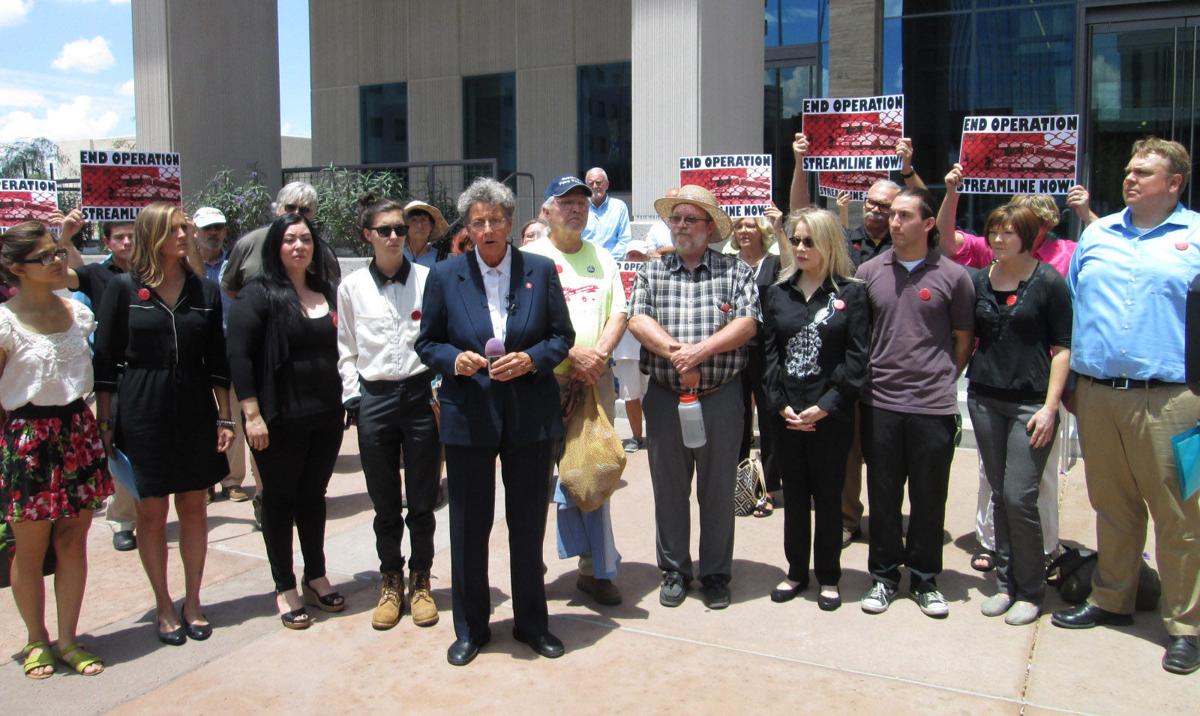
In the downtown county Consolidated Justice building, with its freshly furnished seats, flooring, jury boxes, lawyer’s tables and judge’s podiums, 12 defendants, one by one, walked to the courtroom microphone on Monday afternoon.
While the courtroom trappings were new, the cause of the defendants was anything but.
The defendants earlier this year were found guilty of interfering with traffic and causing a public nuisance in an October 2013 protest against Operation Streamline, the government’s get-tough, assembly-line prosecution and incarceration of undocumented immigrants. The protestors had chained themselves to the parking lot entrance at the Evo A. DeConcini Federal Courthouse and blocked buses transporting the detainees.
At the hearing, before Pima County Justice Court Judge Susan Bacal announced her sentences, the defendants rose to the podium to state their case.
Their words, both compassionate and defiant, would enter into the public record. Their righteousness, based on their first-hand observations and experiences, would filter out of the courtroom and into the public square. And their convictions, stout and true, would echo with their hopes that others would come to understand that Operation Streamline is a travesty.
This was their moment.
Steve Johnston, a 70-year-old activist and community volunteer, said he crawled under the immigration bus on Oct. 11, 2013, for the immigrant families he has come to know. Like the family of Carlos Omar Perez.
“They have worked hard and saved, volunteering for the entire 25 years at Casa Maria soup kitchen, raising talented and honorable kids. They are the kind of people our country needs, but one traffic stop tomorrow and they could be whisked away from their families, rushed through some fantasy court proceeding, and deported, perhaps to be caught up in Streamline while returning across the desert to the family,” Johnston told the court.
The defendants represent a cross-section of Tucson. Their ages range from 22 to 70. One is retired public school teacher. One is an evangelical Christian. One works for a local food bank and another plays in an orchestra. And some have family members who are undocumented, like Michelle Raygada.
Her uncle was apprehended in El Paso and deported to Peru, a county he had left 15 years earlier. There he was diagnosed with cancer and lacked the means for medical treatment. Meanwhile, Raygada’s cousin, who has qualified for temporary work permit under the government’s deferred action program, cannot visit his sick father, she said.
“Through these experiences and just by living in the borderlands, I have finally opened my eyes to the systems in place in this country that separate families, that keep folks on the bottom, most of them black and brown and native, living lives in fear. These systems keep us struggling to keep our families together, to live with those we love, to live free, and even just to live. And Operation Streamline is a part of that,” Raygada said.
Proponents of Operation Streamline claim it is a deterrent and an effective method of prosecuting undocumented immigrants. But in a May report by the Office of the Inspector General, the watchdog agency said the Border Patrol does not know the program’s effectiveness or its full costs.
The shackled detainees are rushed through court in a single afternoon. They get a few minutes with a lawyer and plead guilty. They leave with criminal convictions and are sent to the growing number of private prisons in this country.
“I locked myself under the Operation Streamline bus as a true expression of my faith. I believe in a God of radical love and inclusion who sets the captives free. Operation Streamline is a modern-day slave trade steeped with racism, selling shackled migrants to fill the beds of private prisons for 30, 60, 180 days, and years if caught again,” said Maryada Vallet, who has bandaged and treated immigrants found crossing the desert.
“I listened to the courageous stories of people risking their lives to escape violence or poverty, and like my own father and mother, they would do anything to give their children the brightest future possible,” she said.
Neither she or her co-defendants, who were given time served and not sentenced to further jail time, apologized for their acts of nuisance.
No apologies were needed.

