

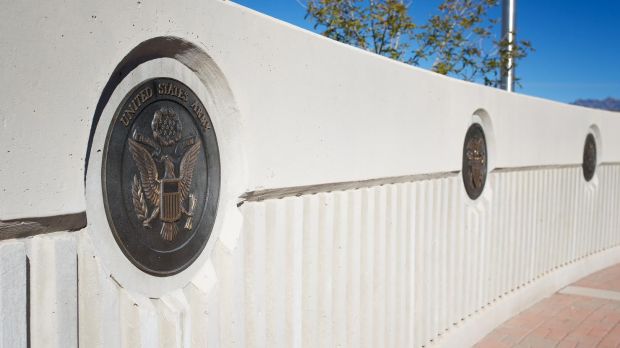
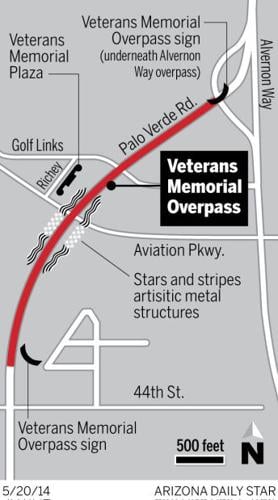

Veterans Memorial Overpass and the Veterans Memorial Plaza were built in 2005. They are named in honor of all veterans — the U.S. Army, Navy, Air Force, Marines and Coast Guard, said Priscilla S. Cornelio, director of the Pima County department of Transportation.
As Memorial Day approaches, Street Smarts is sharing the stories of four local veterans. Here is the third:
James H. Witherspoon was born to Theodore and Leslie Witherspoon in Sheppard, Ark., on Feb. 14, 1931. His dad soon left and Witherspoon, his two brothers and his sister were raised by their mother and three aunts. The family was sharecroppers and raised cotton to sell and gardened vegetables for the family to eat.
Witherspoon recalled that as a kid, he would mount the large pigs on the farm and ride them like cowboy Nat Love until they bucked him off.
He graduated from a high school, then segregated, in Hope, Ark. (birthplace of former President Bill Clinton), where he ran track, played basketball and football, and was in the 4-H Club. He received a 4-H Club scholarship to attend Philander Smith College, a historically black college in Little Rock, Ark.,, where he studied physical education through his sophomore year.
In 1951, he came to Tucson to visit his sister, and decided to stay to earn enough money to buy a car. He stayed with her and found work at Grand Central Aircraft Co. on Sixth Avenue, taking B-29 Superfortress bombers out of mothballs by scraping off the coating to get them ready for action in the Korean War. He purchased a 1949 Ford Convertible before the year was over.
The same year, he met Clara Davis, who had just graduated from Tucson High School. After only a few weeks of seeing each other, they decided to elope, marrying in Florence in June 1952. They had five children: Cherry, Terrie, Cathy, James Jr. and Andrea..
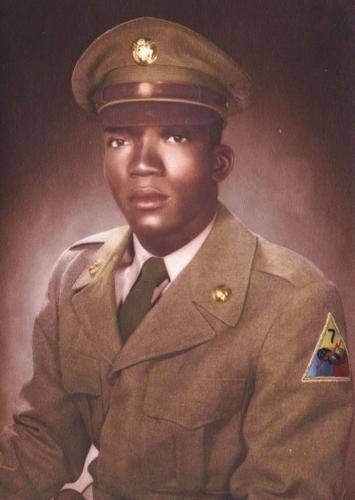
The next month, Witherspoon received notice to report to Phoenix to take a physical. He passed and was sent to Camp Roberts in California for basic training and then was placed with the 7th Infantry Division, a segregated unit with about 350 men.
He served as the radio operator and carried a carbine, and on several occasions engaged in battle. One time, he was in the trenches, on Pork Chop Hill, taking mortar rounds. His unit was flanked by South Korean troops on the right and Ethiopian soldiers on the left. A large wave of North Koreans rushed the hill and the two sides fought hand-to-hand with bayonets. Eventually the first wave was defeated, but a second and third wave followed. Again, the Americans prevailed.
The lieutenant, with only about 25 or 30 men left in his unit, wrote a coded message asking whether to retreat or to hold his position and gave it to Pfc. Witherspoon, who tucked it into his pants, and ran towards headquarters. A South Korean soldier who was attached to Witherspoon’s unit to help with electrical communication went with him, but before reaching their destination he took a direct hit from a mortar shell, killing him instantly and throwing Witherspoon up the hill. Soldiers pulled him into a bunker where he stayed for a little while.
In July 1953, the war ended and Witherspoon joined three other members of Item Company and formed a quartet called The Buccaneer. They toured the bases of South Korea doing USO shows.
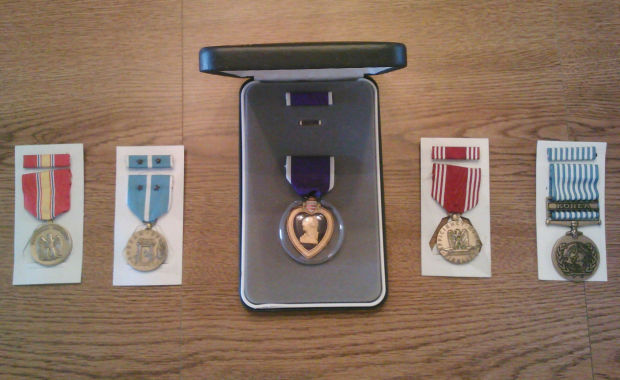
In 1954, after about 13 months in Korea, Witherspoon was honorably discharged and learned that his commanding officer had recommended him for two Bronze Service Stars and a Purple Heart. He also received the National Defense Service, Korean Service, Army Good Conduct and United Nations medals.
He returned to Tucson, finding employment at the VA Hospital as an orderly. He wanted to expand beyond his barber’s license, which he had received previously from Tucson Barber College, and take advantage of the G.I. Bill for returning soldiers, he applied to Tucson Beauty College (not to be confused with today’s Tucson College of Beauty), but was rejected because of his race. He then applied to Thelma Walker Beauty College in Phoenix and was accepted. His wife also attended the school.
After graduating, the couple returned to Tucson. A few years later, they opened the Witherspoon House of Beauty, 1700 S. Park Ave. They ran it together until 1970, and then Witherspoon ran it himself until he retired in 1989. The building is now occupied by Unique Styles By Pamela and Co.
Today, he enjoys his collection of 9 or 10 cars, a ‘75 Cadillac El Dorado being his favorite. He also plays the electric bass guitar and enjoys listening to jazz and blues.

