





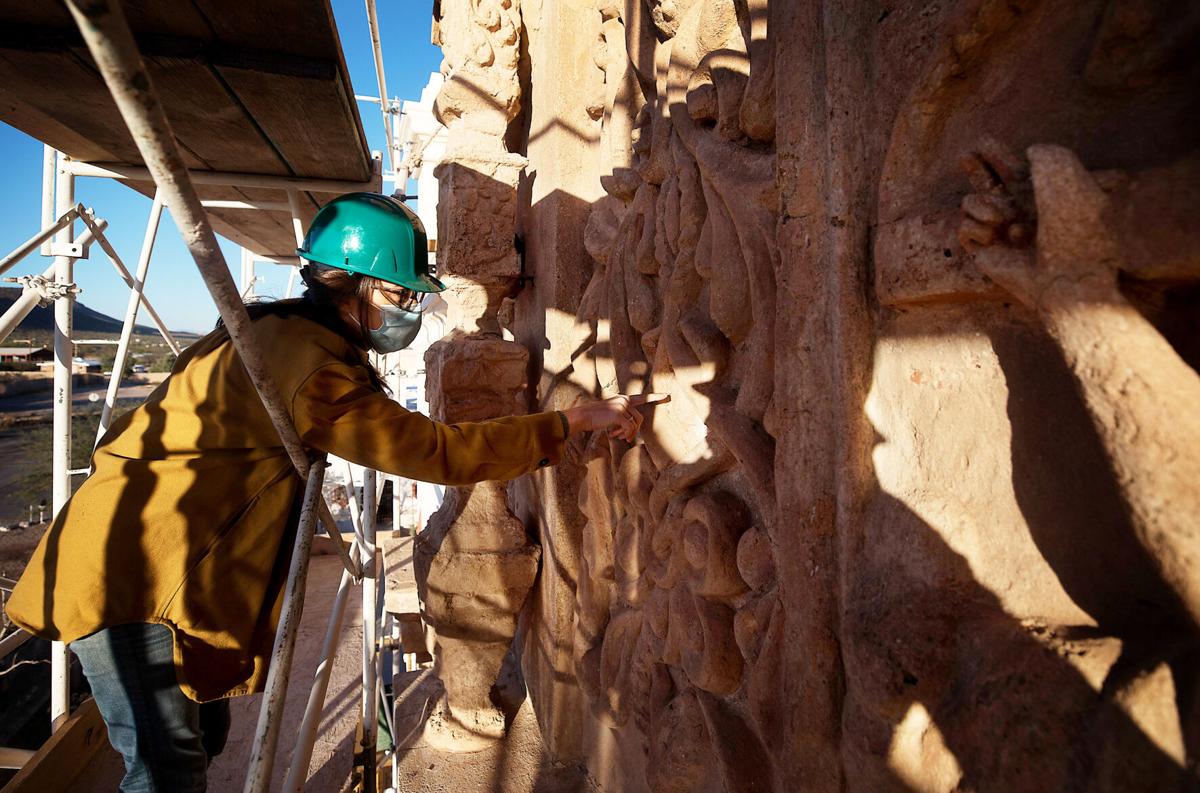
Art conservators found something staring back at them when they climbed the scaffolding last month to study the façade of Southern Arizona’s most famous church.
As it turns out, the doomsday mouse at San Xavier del Bac has round, metal nails for eyes.
That was news to Tim Lewis and Matilde Rubio, who have worked on artwork at the mission for decades.
“We never noticed that before,” Lewis said. “That’s what we like about this work: It’s never boring. Even as long as we’ve been doing it, we still get surprised.”
The cement cat on the opposite side of the façade has no such eyes, and maybe we should all be thankful for that. Legend has it that the world will end if the cat ever catches the mouse.
Who gave the mouse its competitive edge and why remains a mystery, though experts believe the round cut nails that were used do not date to the mission’s construction in the late 18th century.
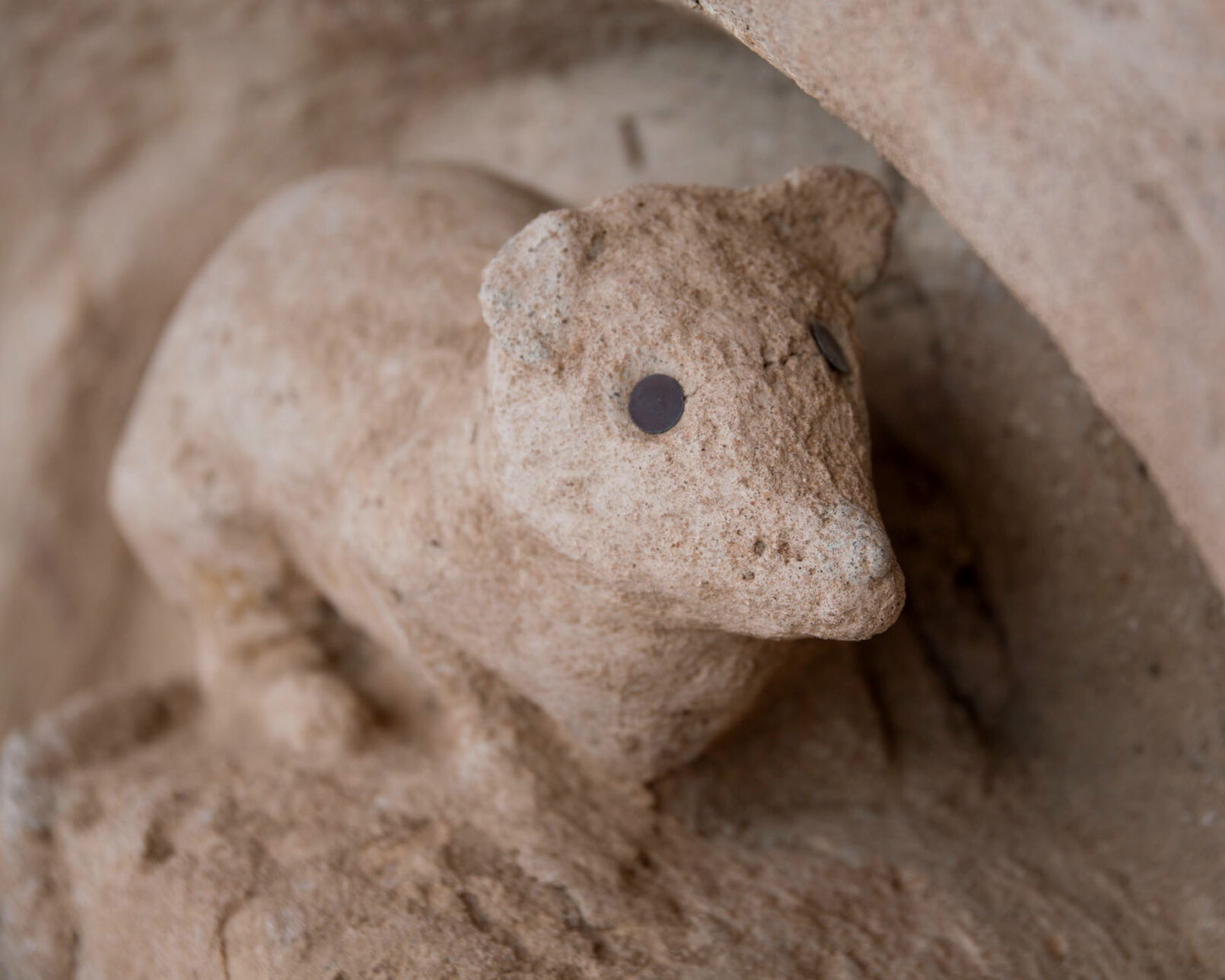
Tiny nails mark the eyes of a cement mouse that perches on the façade of Mission San Xavier: Experts believe the round cut nails do not date to the mission’s construction in the late 18th century, but when and why they were added to the mouse remains a mystery.
Mouse eyes were not the only surprise discovered during a monthlong inspection of the ornate entrance to the more-than-225-year-old building.
Something else they had never previously noticed: “The two lions on either side — one is female and one is male,” Lewis said.
Fellow longtime conservator Matilde Rubio said she was struck by how many of the original pigments — iron-oxide red, ochre yellow, manganese black and white lime wash — can still be found in the nooks and crannies of the façade, including spots that are nearly impossible to see from the ground.
Conservation project manager Starr Herr-Cardillo said she was surprised by how intricate the original detailing work was from close up.
“It was very painterly up there. You can see brushstrokes,” she said. “To think that it’s been up there for 200 plus years in extreme sun, heat, weather and crazy temperature swings — those are pretty harsh conditions for materials, and there’s still so much there.”

Scaffolding at Mission San Xavier was put up as part of the Patronato Conservation Project.
Expert eyes
The recent inspection was organized and paid for by Patronato San Xavier, the nonprofit that has overseen preservation and fundraising for Arizona’s oldest intact European structure since 1978.
Working from scaffolding erected above the entrance to the church in late October, the study team examined every inch of the façade to assess its condition, map its flaws and plan future repairs.
They took photographs with a kind of portable microscope and went up at night so they could scan the molded plaster surface with ultraviolet and infrared light to pick up otherwise invisible details.
The team also studied similar features and restoration efforts at Tumacacori National Historical Park, 45 miles south of Tucson, and the Franciscan missions in the Sierra Gorda region of central Mexico.
Several experts joined the effort along the way, including University of Arizona professor Nancy Odegaard, who is chair of Patronato’s conservation committee and the head of the Preservation Division at the Arizona State Museum.
Frida Itzel Mateos González, a paint and plaster specialist from Mexico’s equivalent to the National Park Service, spent a week up on the scaffolding.
Wood restorer Luke Addington, who has already worked on San Xavier’s altar railing and east doors, came in to examine what’s left of the reconstructed balconies on the front of the church.
And preservation engineer Melvyn Green, who has worked extensively on Spanish missions in Southern California, sized up the structural integrity of the columns running up each side of the façade.

Conservator Frida Itzel Mateos Gonzáles conducts a "cleaning test" by removing 1950s-era cement-based stucco with a dremel.
Concrete concerns
This was Lewis and Rubio’s first in-depth look at the church’s decorative entrance since 2008, when the husband-and-wife conservators wrangled money for a shorter, partial assessment of its condition. The couple has been lobbying for a longer look ever since.
“The façade to me is very significant, because it welcomes the people to come in,” said Lewis, who grew up on the Tohono O’odham Nation and has attended services at San Xavier for much of his life. “You know, we just want to preserve what’s been here for 200 years.”
“I would say (the façade) is probably one of the least understood parts of this building,” Herr-Cardillo said. “Tim and Matilde have identified this as a priority for quite a while now. It’s just been on the waiting list, because there’s so much else.”
Rubio put it another way: “They finally realized that to do the work on the façade, you need conservators,” she said. “It is not a construction project.”
Mission San Xavier was built between 1783 and 1797 with kiln-fired adobe bricks and O’odham labor.
In the centuries since, the structure has been abandoned and restored several times, including an extensive conservation effort in the 1940s and 1950s that saw much of the building coated in concrete plaster made from Portland cement. That included the statues and decorative features of the façade, which were then painted in garish colors that didn’t quite match the earthier tones that had been there before.

A statue of Santa Barbara displays the original hand-painted detailing on the left and right side of her cloak at Mission San Xavier. As part of the Patronato San Xavier conservation project, the last remaining cement-based plaster on the exterior of the East Tower is being replaced with a traditional lime-sand plaster.
It wasn’t until decades later that caretakers discovered the protective plaster was actually damaging the walls and interior.
“The problem with concrete is it’s strong, but it also retains moisture,” Lewis said. “What we’re seeing a lot of is that the original material behind it sort of disintegrates.”
Most of the Portland cement on the exterior of the building has since been removed and replaced with new coats of traditional lime-washed plaster mixed with cactus juice, which allows the walls to breathe and dry out.
When the plaster-replacement work now underway on the east tower wraps up next year, the façade will represent one of the only sizable patches of Portland cement left.
Outreach upfront
Herr-Cardillo said any work there is unlikely to start for at least a year or two. First, they have to compile all the information they gathered over the past month, develop a restoration plan and raise the money they will need to execute it.
“An important part of that process is going to be sharing what we’ve learned widely and doing a lot of community outreach,” she said. “In developing our approach, it needs to be sound from a material standpoint and a conservation standpoint, but also it’s the face of the church. I feel like you need to bring people along with that decision.”
“Especially the community members around here on the reservation,” Lewis added. “This is still a working church. That’s what we have to understand.”
Rubio estimates it could take up to two years to carefully remove the 1950s plaster and recoat parts of the façade with a more traditional white or off-white lime wash similar to what was used in the 18th century.

Conservator Matilde Rubio removes a small sample of original finish for analysis.
There are no plans to repaint the once-colorful entryway beyond that.
Even if they wanted to, Herr-Cardillo said, they simply don’t have enough definitive proof of what it used to look like to try to recreate it. All they have are a few remaining details and a sense of the overall palette.
“The colors actually preserved pretty well,” she said. “We can see them well up there.”
Rubio is eager to get the job started. After 25 years of restoring and protecting the artwork inside Mission San Xavier, she considers the façade the icing on the cake of her career as a conservator.
“It could be maybe the biggest project that I do,” she said.
Mission San Xavier del Bac: 11 things to know
Mission's name
Updated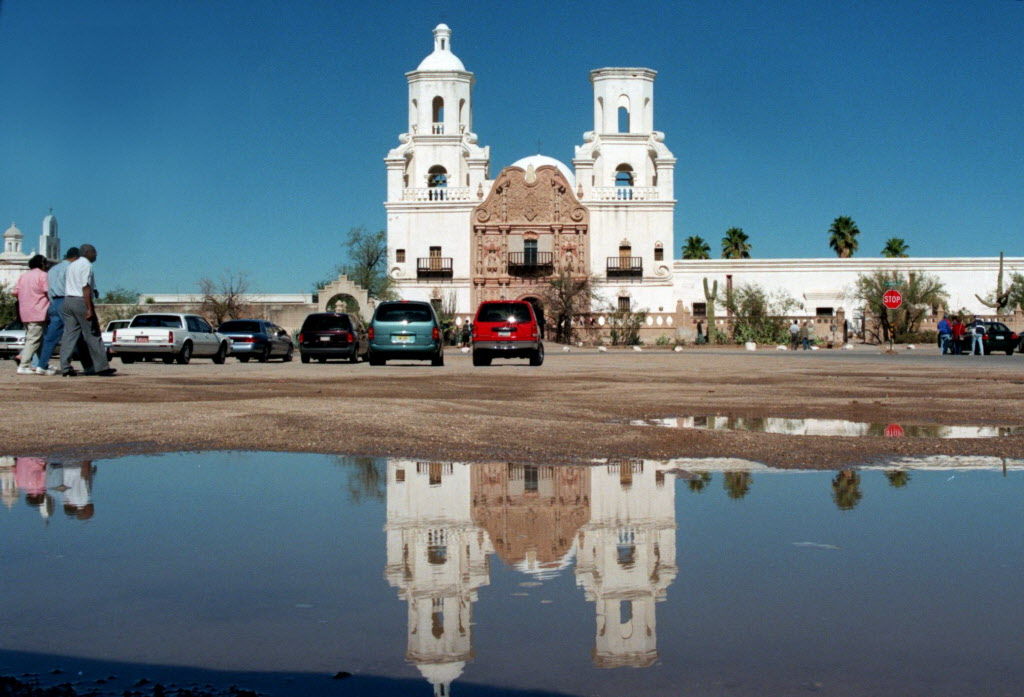
Here the mission is reflected off a puddle in the parking lot as visitors approach. Photo by A.E. Araiza, Arizona Daily Star 1996
Mission San Xavier del Bac is also known as the White Dove of the Desert. The del Bac part of the name is Tohono O'odham, meaning place where water appears. The mission was in an area of natural springs and the Santa Cruz River.
San Xavier uses classic form for churches
Updated
Religious followers and tourists visit San Xavier del Bac Mission while art restorers Tim Lewis and Matilde Rubio work on the area above the altar. Photo by A.E. Araiza/ Arizona Daily Star
Like many European churches, San Xavier design is classic cruciform - meaning a it's cross-shaped. The date of 1797 found above the sacristy is believed to be the finish date of San Xavier.
San Xavier reconstruction
Updated
Scaffolding reaches to the ceiling above the altar at San Xavier del Bac Mission in Tucson where Tim Lewis and his wife Matilde Rubio work on the restoration of the mission's interior for years. Photo by A.E. Araiza/ Arizona Daily Star
Over the years, Patronato San Xavier has raised more than $11 million for preservation and restoration work at the mission, including a multi-year project to restore the altar area and interior artwork. The Patronato is trying to raise more money to restore the East tower.
The mission is built of low-fire clay brick, stone and lime mortar. The church's interior is filled with original statuary and murals.
End of the world
Updated
Front of the Mission San Xavier del Bac showing the cat and mouse scene on the far left and right of the facade. Photo by Linda Seeger Salazar / The Arizona Daily
Legend has it that when the cat catches the mouse that the world will end, although no one appears to know why this scene is depicted on the front of the mission. Notice there are two cats and two mice, one of each in the bottom corners. - Arizona Daily Star
Lightning strike destroyed minitower
Updated
The west tower at the San Xavier Mission stands in contrast to the eastern one, which has been in disrepair for many years. The overall mission has needed extensive restoration over the years.
In 1939, lightning struck and destroyed the 18th-century lantern atop the west tower. It was rebuilt out of common house brick and mortar and rebuilt again 2007 using threaded fiberglass reinforcing rods in the minitower legs so that metal rods would no longer attract lightning.
East tower never completed
Updated
The east tower, at right, stands in clear contrast to the renovation and refinishing of the west tower at San Xavier Mission in Tucson. Photo taken Thursday, October 1, 2015. Photo by Ron Medvescek / Arizona Daily Star.
Why was the east tower never finished?
Because the builders ran out of money. The whole church is unfinished – you can even see bits of murals penciled – but never painted – on the interior walls. However, over the years people have figured out their own answers – legends, if you will – and here are some of the most common. All are great stories, which is why they are told and retold. But there is no documentary evidence for any of them:
• Someone fell off the tower, and work was halted.
• If a building was unfinished, its owners didn't have to pay tax on it.
• A cyclone blew the dome off the east tower, and it was never replaced.
- Jim Griffith for the Arizona Daily Star
Mission San Xavier del Bac's grotto hill
Updated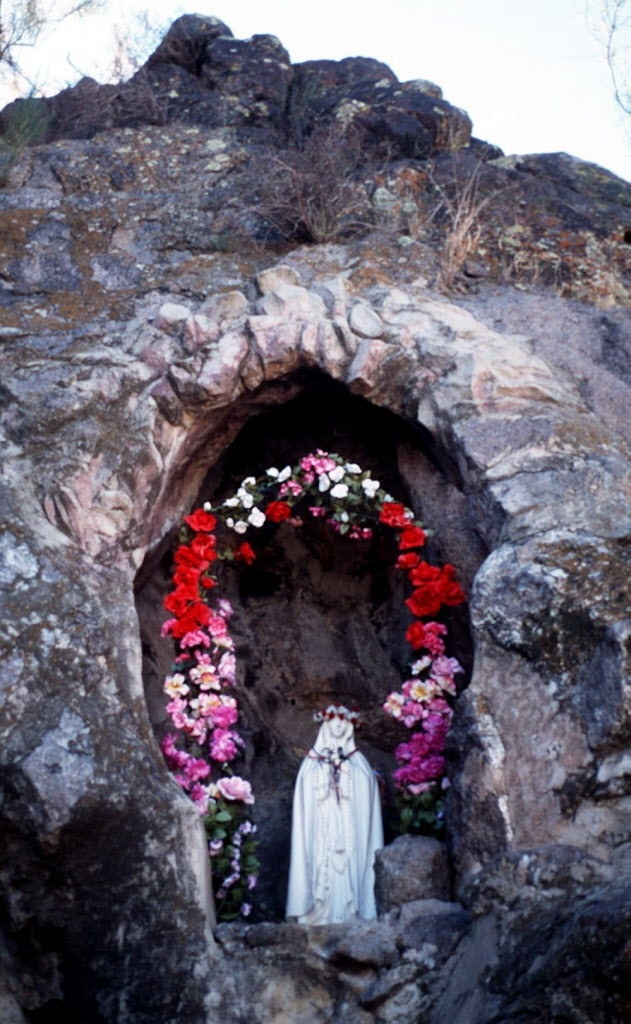
Replica of grotto at Lourdes above San Xavier. Sanctuary in hillside at San Xavier Mission. Photo by Sarah Prall, The Arizona Daily Star 1996
Many visitors like to combine a tour of the two-century-old church with a walk around nearby Grotto Hill.
An easy quarter-mile path winds around the hill just east of the mission — affording an overview of the grounds and big vistas of the mountain ranges near Tucson.
The hill is named informally for a small religious shrine tucked into a rocky grotto on its flanks. The shrine is a place of quiet reflection and prayer for some who walk the trail.
Others stop to peer up at a cross atop the hill.
As you amble clockwise around the trail, you’ll see the mission and grounds, the Tucson Mountains, the Catalina Mountains, parts of the Rincon Mountains and Mount Wrightson. - Arizona Daily Star
Mission abandoned and damaged
Updated
San Xavier del Bac Mission in 1887. Photos from Historic American Buildings Survey, HABS AZ-13. Photographer Leo Goldschmidt.
The mission was abandoned briefly from 1837 to 1859, falling into disrepair until the Diocese of Santa Fe began fixing the church. In 1887 an earthquake knocked down the mortuary wall and damaged parts of the church.
Tornadoes spare mission
Updated
Rubble from a destroyed building after a tornado touched down near Mission San Xavier del Bac on the Tohono O'Odham reservation on Aug. 27, 1964, and killed a mother and child. Tucson Citizen file photo
The first fatal tornado in state history struck Aug. 27, 1964. The tornado skirted San Xavier Mission and rolled through an Indian village, destroying four homes. One family was particularly hard hit: Two family members were killed by the tornado and eight were injured.
A second tornado killed one person and injured 40 on June 23, 1974 as it tore through a mobile-home park near the San Xavier Mission, touching ground for about three minutes, long enough to demolish 19 mobile homes.
No it's not a mummy
Updated
San Xavier Mission's west chapel contains a glass box with a statue in it. Photo by Jim Davis, Arizona Daily Star 1992.
Inside the church, many visitors see the reclining statue in the glass case in the west transept, and think it's a mummy of some kind. The real story is even better. It's a statue of the crucified Christ, and was originally at Tumacacori Mission (now Tumacacori National Historical Park, partway to Nogales).
When that community was abandoned in 1849 due to Apache raiding, the people moved to San Xavier, bringing their saints with them. Along the way, the statue of Christ lost its legs. By the 1890s, it was displayed in the west transept as the entombed Christ.
Around the time of War I, the statue was redefined as a reclining St. Francis Xavier, placed in a glass case, and there it remains, the object of considerable popular devotion. - Jim Griffith for the Arizona Daily Star
Watch brick work on San Xavier tower room
Updated
Photos of Mission San Xavier del Bac taken by the National Park Service for the Historic American Buildings Survey in 1940 and taken again fr…

