



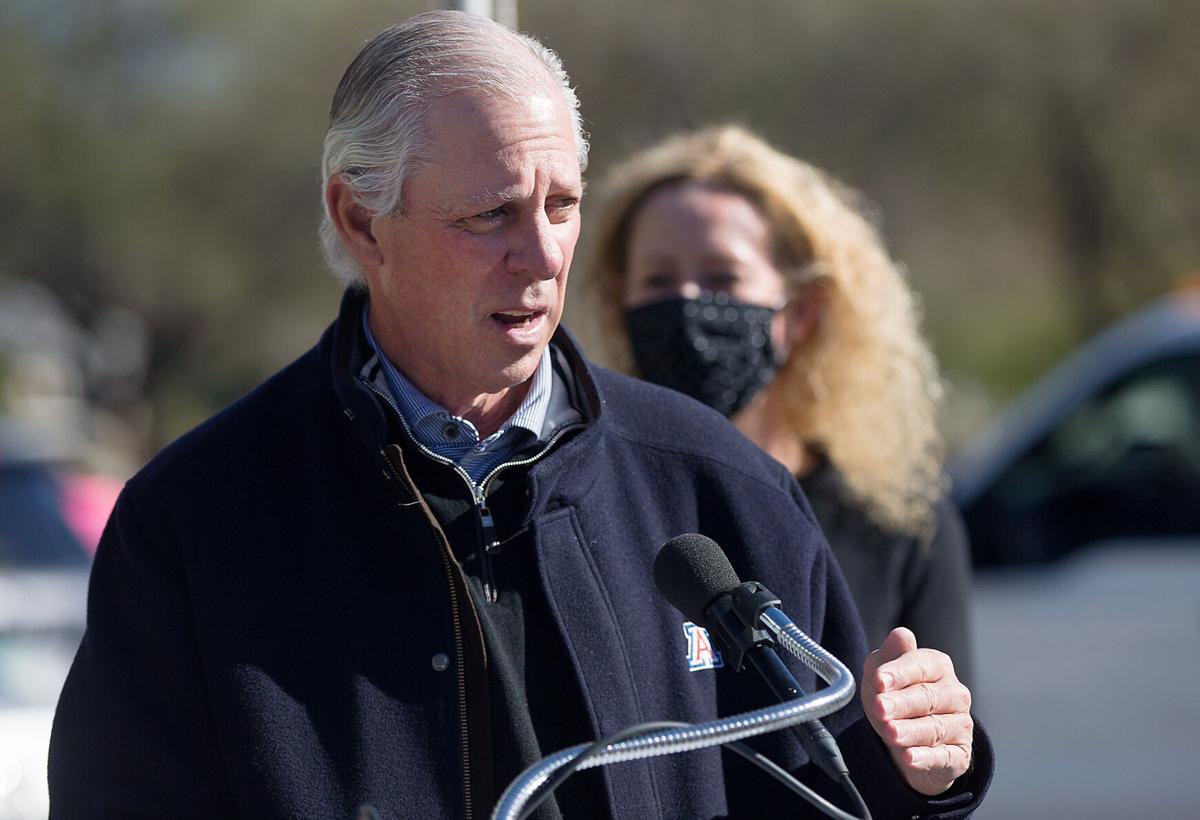
University of Arizona President Robert Robbins is set to keep leading the school until at least June 30, 2024.
On Thursday, the Arizona Board of Regents approved a one-year extension of Robbins’ contract during a meeting at Northern Arizona University in Flagstaff. His most recent contract before this one, which was approved this time last year, had extended his term through 2023.
Robbins’ latest contract, which goes into effect Friday, bumped his annual base salary up 8%, from $698,625 to $754,515. The board also raised his retirement contributions from 18% to 21%. When those and other benefits are accounted for, Robbins’ total compensation is estimated to be about $1 million.
According to a salary tracker by the Chronicle of Higher Education, as of 2020 Robbins was the 24th-highest-paid public college leader in the United States.
The board also extended Arizona State University President Michael Crow’s contract through 2026 on Thursday and increased his base salary from about $714,000 to $771,282. Additionally, Crow received a $50,000 bonus Thursday for achieving his at-risk compensation goals over the past three years. As of last year, Crow was the ninth-highest-paid public college leader in 2020, earning an estimated total compensation package of roughly $1,099,760, according to the Chronicle’s tracker.
NAU President José Luis Cruz Rivera was hired earlier this year with a base salary of $515,000, so his contract was not up for an extension.
Robbins, who was making $1.2 million a year as CEO of Texas Medical Center before taking the top job at the UA, was originally hired in 2017 under a three-year contract with a pay package valued at approximately $988,000. That included a $600,000 base salary and roughly $388,000 in additional benefits. Those included a $10,000 car allowance and a $70,000 housing allowance, $108,000 in pension contributions and $200,000 in private funds from the UA Foundation for an Endowed Presidential Leadership Chair.
Soon after that, Robbins’ base salary was increased to $675,000 after his housing allowance was eliminated because he opted to make the presidential residence in Sam Hughes his home.
In 2018, the Board of Regents agreed to raise the base salary of each of the three university presidents by 3.5% annually between 2019 and 2021.
That got Robbins’ contract up to $698,625 in 2019. But, the uncertain economic picture created by the COVID-19 pandemic pushed the board to suspend those raise schedules in 2020 and 2021 until it took further action — which it did Thursday.
Over the next few years, Robbins could also stand to make up to an additional $195,000 if he achieves multiple at-risk compensation goals. Any previously assigned at-risk goals have been abandoned to focus on COVID-19 response, and each president will move forward with new plans.
Each individual goal has a cash value assigned to it. Robbins’ one-year and multi-year goals, which were proposed and amended Thursday, are as follows:
Annual goals
$25,000: Implement a new budget model to replace Responsibility Centered Management and develop and begin implementation of a plan to reduce college and department overhead costs by at least $10 million through centralization of support services like information technology, human resources, finance, marketing, communications and fundraising.
$25,000: Develop a strategy to raise higher-education attainment in Southern Arizona through collaborations and initiatives. The plan will include collaboration with Pima Community College to advance Southern Arizona toward reaching the state’s Achieve60AZ goals.
$25,000: Make substantial progress toward creating a Center for Advanced Immunology at the Phoenix Biomedical Campus.
Multiple-Year Goals
$20,000: Increase student retention to 85.5%.
$25,000: Use the UA’s Washington, D.C., office to increase federal research funding by 10%.
$30,000: In collaboration with UA Global Campus and its board, make substantial progress toward improving the student experience and outcomes of UA Global Campus. Measures should include an improvement in the online course completion rate, a decrease in the online student attrition rate, and the number of Global Campus courses taught by faculty who are benefits-eligible.
$25,000: Implement an information technology security framework that includes: an IT security strategic plan, articulated roles and responsibilities, policies and guidance, training in security awareness, and processes for monitoring and evaluating the effectiveness of school’s IT security practices.
$20,000: Collaborate with ASU and NAU to substantially raise the research potential of the UA College of Medicine Phoenix.
With students back at UA for the fall semester, here's a look at the Tucson campus over the years compared to now.

