



Buenos Aires National Wildlife Refuge lies about 60 miles southwest of Tucson on Arizona Highway 286.
Baboquivari Peak, the most sacred place to the Tohono O’odham people, looms in the distance as the highway cuts through the 117,464-acre refuge, past grasslands, cottonwoods, mesquites and jumping cholla.
At mile marker 17, the road dips down into a dry creek bed, one of dozens that cross the road between Three Points and Sasabe. But this spot is different.
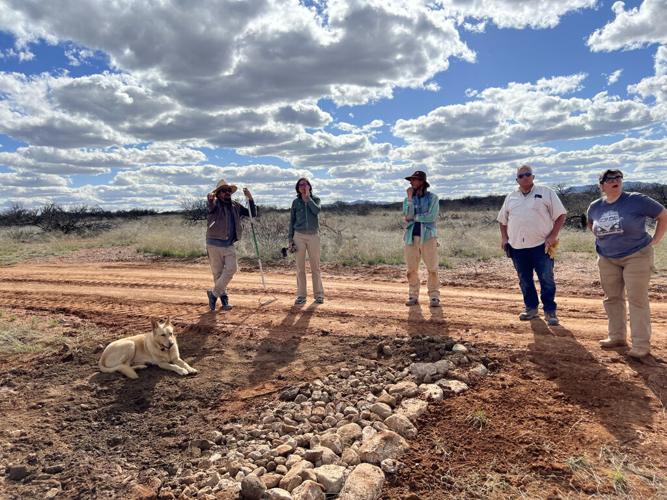
Just off the highway and through a fence a few yards down the wash, small stone walls, rock aprons and strategically placed branches mark the scene of a renewed effort to tame this ephemeral stream known as Arroyo Hondo.
The nonprofit Altar Valley Conservation Alliance recently collaborated with the wildlife refuge on an erosion control and restoration workshop in the refuge.
During the week-long workshop, about 30 volunteers worked at two project sites: Arroyo Hondo and a tributary to the Puertocito Wash, a key drainage farther southeast towards Arivaca.
Excessive erosion can form deep cuts in a flow channel, dropping the streambed below the reach of plant roots in nearby riparian and floodplain habitats that depend on the water.
Strategies to control erosion are varied and depend on the environment. The refuge has historically relied on small, simple restorations, often building on and improving existing structures to extend their lives and positive impacts.
Reducing erosion helps improve both water quality and retention, says Omar Ore-Giron, one of the restoration experts who led the workshop with the alliance.
Improvements along the Puertocito Wash can have a literal trickle-down effect for Tucson residents because water from the Altar Valley eventually flows north into the Avra Valley west of the city on its way to the Santa Cruz River.
The Arroyo Hondo site is significant because the wash cuts through high-quality habitat for the masked bobwhite quail, a critically endangered bird once thought to be extinct in its native Southern Arizona and Northern Mexico.
Buenos Aires National Wildlife Refuge was established in 1985 to protect a reintroduced population of the quail and some of its last remaining habitat.
Pronghorn have also been reintroduced in the area.
Water works
Other restoration experts who helped lead the workshop late last month included permaculture consultant, designer, author and educator Brad Lancaster and wildlife and restoration ecologist Kyle Thompson.
The workshop continued the efforts of Bill Zeedyk, a retired U.S. Forest Service wildlife biologist and riparian restoration expert, consultant and author. In 2016, Zeedyk surveyed the entire refuge and identified some sites that would be of high value for restoration.
He concluded that even small projects on tributaries to the Puertocito could “lift the functions in the whole wash,” said Julia Guglielmo, conservation and science director for the Altar Valley Conservation Alliance.
“The best thing you can do is influence as much water as possible,” Guglielmo said.
Ore-Giron said that through their efforts, they hope more water will be stored in the upper parts of the watershed.
“It’s really a process-based, low-tech solution that we’re trying to implement,” he said. “Some of these original structures weren’t as effective as one would have hoped. We notice there isn’t sediment that’s building up, so we are looking to see if we can implement a different method here.”
Small rock structures and branches were positioned in and around the wash to slow the flow of water and allow more of it to seep into the ground or be taken up by plants. As those wash-fed plants grow, they will become erosion control structures themselves.
Much of the work was done by hand with some assistance from a backhoe loader to move larger quantities of material.
Ore-Giron likened it to fixing a broken bone. “The doctor will set the bone, but the body will heal it,” he said. “So that’s what we’re doing. First, setting some things, and then letting the system heal itself.”
The Altar Valley Conservation Alliance is a watershed-based nonprofit founded by ranchers in 1995 to protect the valley as a natural area and a working landscape.
The restoration work is part of that effort, one designed to improve conditions for both wildlife and livestock.
“So the refuge is funding this project, and the alliance manages it, which is really cool,” Guglielmo said. “The refuge has been helping us to get all the different clearances, do some of the planning, and helped us identify the priority areas to work in.”
The Arroyo Hondo site was an easy choice, she said, because it already provided habitat for the masked bobwhite, and volunteers could reinforce Zeedyk’s existing stone structures with more erosion controls made from rock, dirt and brush.
At the tributary site, meanwhile, the crew stabilized the outflow from an existing cattle tank to prevent head-cutting and erosion and installed rolling dips to improve road drainage and reduce maintenance.
Lessons to learn
Some volunteers were novices at watershed restoration. Others were experts in the field whose lives and livelihoods revolve around this kind of work.
Catherine Jennings has a property close to the refuge in Three Points, where she dreams of starting a sustainable farm using only rainwater. She said she joined the workshop to gather knowledge she can apply to her farming practices.
Carmen Crisantes flew in from San Antonio, Texas, to participate. She said she had been following Brad Lancaster’s work for a long time and was thrilled to finally put into practice some of the skills she had learned from him.
Lancaster said these restoration techniques have wider applications.
“This workshop is about learning to read and work with natural flow patterns of water and sediment,” he said. “It’s a great model for how to work in rural settings and our more urban-built environments, such as within and beside the arroyos you find in Tucson. We’re focusing on waterways and adjacent floodplains, which you encounter in our city.”
The workshop was held in late March to take advantage of mild temperatures — good for both working and camping — and gentle, early spring rains that would help the newly built structures settle ahead of heavier summer storms.
Guglielmo plans to return to the sites after the first monsoons of the year to assess how the newly built erosion controls held up. She said water will be the true architect of these systems, shaping how the structures settle and respond to the rains.
Guglielmo also plans to partner with Ore-Giron on future restoration workshops in the area.
These types of gatherings do more than bring landscape stewards together to network and swap information, they said. They help us build a relationship with the land itself and learn to follow the lessons it has to teach us.
Thirty animals were relocated to Bueno Aires National Wildlife Refuge. Videos and photos courtesy of Arizona Game and Fish Department.

