



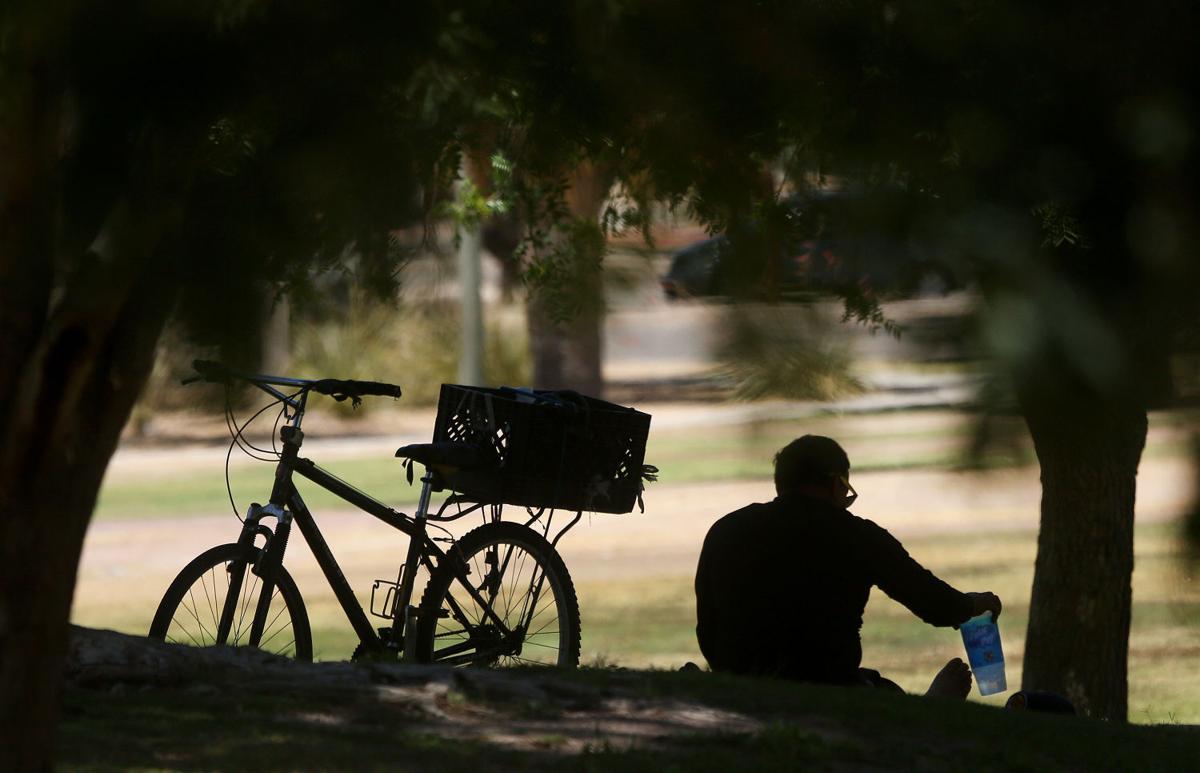
Tucsonans are being urged to conserve water this weekend as record heat is likely to spike demand.
But Tucson Water officials say they don’t expect problems in meeting demands unless pumps or other major water-supply components go out of service. They’re urging conservation as a precaution.
Indeed, residents today use far less water during the scorching June weather than a decade ago — just as they do year-round, Tucson Water statistics show.
Tucson Electric Power is not urging its customers to conserve electricity because it has plenty to meet any likely increases in summer demand, utility spokesman Joe Barrios said. While power lines and other parts of TEP’s system are more vulnerable to outages during the heat, the utility isn’t expecting widespread outages, he said.
Peak usage expected Sunday, Monday
Hot weather means peoples’ outdoor gardens, lawns, trees and shrubs need more water, as do their swamp coolers. It also requires more water to keep cooling towers and evaporative condensers operating properly for cooling systems in large apartment and office buildings and stores, said Tucson Water spokesman Fernando Molina.
On a typical June day, the water utility’s 700,000-plus customers use about 99 million gallons. This June’s peak use so far was 116 million gallons on June 6, when the mercury hit 111 degrees. On June 8, when the high was 104 degrees, Tucson Water users soaked up 115 million gallons.
On Sunday and Monday, when the temperature is expected to hit 114 and 112 degrees, respectively, Tucson Water is expecting customers to use about 120 million gallons daily. That’s still well below the 149.8 million gallons that people slurped up back on June 26, 2007, the highest water usage in the last 10 years. When all reservoirs, wells and pumps are in service, the water system can provide up to 196 million gallons a day.
Nevertheless, areas with more-isolated water systems such as Three Points and the neighboring Diamond Bell Ranch area southwest of Tucson could be vulnerable to water-supply reductions, but not complete cutoffs, if booster pumps go out of service, Molina said.
Another area that could have problems if a booster pump or well fails is an east-side area stretching from Broadway and Kolb roads to Tanque Verde and Houghton roads.
The reservoir that normally serves that area, near Harrison and Kolb roads, is out of service because of rehabilitation work that started last fall, Molina said. The homes get water from neighboring areas, but if a pump or well fail, “then we might have some issues providing sufficient water into the area,” he said.
“It would not be a catastrophic failure, and most customers would likely notice reduced water pressure,” said Molina.
10 percent cushion
The heat also requires more electricity to run air conditioners.
Tucson Electric Power says its system has the capacity to deliver to its 420,000 residential and business customers 10 percent to 15 percent more electricity than the most demand it expects to get from its customers at any one time this summer — 2,300 megawatts. Its record peak demand was 2,390 megawatts, during 108-degree weather on July 15, 2010.
The only way TEP is encouraging energy conservation is by posting tips on its website and social media on how residents can save electricity to hold down their summertime bills, spokesman Barrios said.
There’s always potential for power outages in small areas if demand is “really, really high and if a component fails,” Barrios said. But that’s not the same as not having an adequate supply, he said.
During the heat wave of two weeks ago, the utility had some outages that cut off power for a few minutes to an hour or two to groups as small as one to 10 customers and as large as 50 to 75 customers, he said.
Summer heat places stress on the utility’s equipment in two ways, Barrios said.
First, high temperatures generally put more stress on items such as a household air conditioner. Second, the more power the utility delivers, the hotter its equipment becomes.
Anyone who loses power is asked to call TEP at 623-7711.

