

In the midst of most crises — including a global pandemic — Arizona Wildcats know the best plan is to bear down.
Wildcat fans worldwide will have the opportunity to do so virtually with the 2020 University of Arizona Arthritis Center “Bear Down for Health: Sport and Science in the Era of COVID-19” livestream panel discussion and reception at 11 a.m. Wednesday, Sept. 16.
The free online event, which will be followed by a virtual reception fundraiser to benefit the center, will focus on the future of college athletics at the UA and on a national level while highlighting the scientific and public health impact of COVID-19. Special guests for the discussion include UA athletics director Dave Heeke; Dr. Daniel Derksen, UA Health Sciences associate vice president for health equity, outreach and interprofessional activities; and Dr. Janko Nikolich-Zugich, chair of the Department of Immunobiology at the College of Medicine-Tucson and co-director of the UA Center on Aging.
“We’re very fortunate to have this group of experts here at the University of Arizona for this very timely topic. We’re extremely grateful that they have made time in their busy schedules to come together to address this topic for our Bear Down for Health virtual event. Their expertise and perspectives will be relevant to a broad audience in these challenging times, beyond the impact of COVID-19 on sports,” said Arthritis Center Director Dr. C. Kent Kwoh.
Kwoh expects the virtual discussion and reception, which will include an interactive question-and-answer session, to appeal to all ages and life stages.
Nikolich-Zugich is excited about the opportunity to discuss his role as principal investigator in development of the UA COVID-19 antibody test, which recently received full FDA approval and is available to the public at 30-plus locations statewide. Financial support from the state of Arizona seeks to facilitate testing for at least 250,000 people; more than than 25,000 have taken the test to date.
“This is a voluntary test, so it is difficult to predict how many people will end up testing. A lot will depend on the spread of COVID-19 in the community. There is no set goal, but this and similar tests will give us an idea of how much of the population may have immunity. We are still low as a state, probably in the range of 5 to 7%,” said Nikolich-Zugich, whose efforts are central to the UA’s Test, Trace and Treat COVID-19 Response Plan.
He said he is cautiously optimistic about the plan.
“We are dealing with young people that are at the age where risky behavior abounds. Our plan can be — and is — very good, but it will all depend on the collaboration of every staff, student and faculty member,” he said.
During the event, Nikolich-Zugich said he looks forward to countering some of the misinformation that is circulating about various aspects of COVID-19, including immunity.
Nikolich-Zugich said there are still many unknowns about the virus, including the length of immunity in people who had mild symptoms or no symptoms.
“Our studies show that even in these people, antibodies last for at least three months. There usually is a relationship between dose of the virus and the intensity of the immune response. What that will mean in terms of length of immunity at the lower SARS-CoV2 virus doses, we don’t know yet,” he said.
Overall, Nikolich-Zugich also anticipates offering people important takeaways about the pandemic. He emphasized the importance of not underestimating the virus.
“Thinking it is not going to hit you is not a good strategy. This virus can kill you, even if you are young and healthy, and you can also transmit it to family members who are more vulnerable than you. Hopefully those facts have become clear to everyone,” he said.
In addition, Nikolich-Zugich encouraged people to stay the course using masks and social-distancing, and to continue to stay informed as more science surrounding the virus unfolds.
“This is not our normal life. The virus is not allowing us to interact normally and have fun. It has been one big slog and ordeal, and we are wearing masks and being socially distant, but we don’t have many other tools. This is not a virus with a political color. No virus I have seen before has voted, but they kill indiscriminately and if we ignore them, they will do what they have evolved to do. Only we can stop them,” he said.

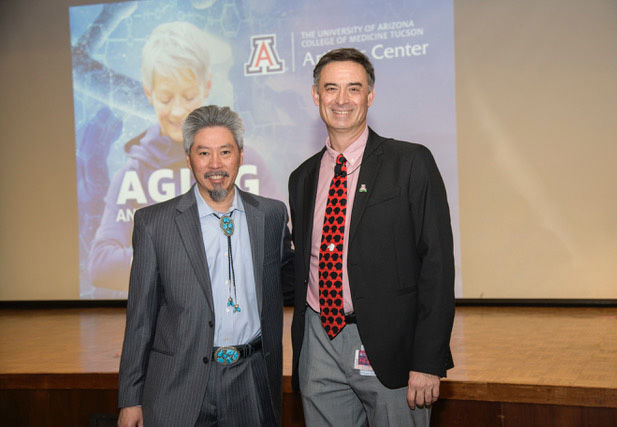
Fundraiser sponsors include Arthritis Center Advisory Board Chairman Dr. Hal Tretbar, left, and Arthritis Center co-founder Dr. Robert G. Volz, center. Dr. Mike Dohm, of the center’s advisory board, is at right.
Those facts have caused concern for many patients of the Arthritis Center, which pivoted early on during the pandemic to telemedicine with a combination of telephone and video visits, according to Kwoh.
He emphasized that the UA is fortunate to have long-standing expertise in telemedicine through the Arizona Telemedicine Center led by Dr. Ronald Weinstein, who shared best practices with the center. Both physicians and patients are adapting to the situation, according to Kwoh.
“For some patients, it has improved access and they much prefer telemedicine visits. For some of our older patients, they have found the current technology for video visits somewhat challenging. Of course, for some issues, patients need to be seen face to face. We are now doing a combination of face-to-face and telemedicine visits, depending on the patients’ problems and preferences of the patients and providers.”
As the COVID-19 situation continues to evolve, Kwoh acknowledged that the UA Arthritis Center, like many facilities nationwide, will face difficulties with fundraising that is vital for research. He credits Silver Sponsors of the upcoming fundraiser such as Dr. and Mrs. Robert Volz, co-founder of the center, along with Finley Distributing and center Friends, for their ongoing support. Additionally, he said the backing of other donors and individuals is critical to the success of the facility, which is the only multidisciplinary center dedicated to arthritis in Arizona and the only one of its kind in the Southwest.
“Their support is critical to allowing us to fulfill our groundbreaking research, clinical and specialized care efforts, and educational and community outreach missions,” Kwoh said.
Photos: University of Arizona – Then and Now – Part 3
University of Arizona: Football stadium
Updated
The horseshoe-shaped University of Arizona football stadium is clearly visible on campus on September 10, 1968 in Tucson.
University of Arizona: Football stadium
Updated
The Meinel Optical Sciences Building at the University of Arizona in Tucson on July 23, 2018. It was originally built in 1970 and with the expansion of the west wing in 2006 has evolved into a four story structure above ground with three levels below. There is a 100-foot vertical test tower; laser beam, glass technology and solar energy laboratories; offices and classrooms.
University of Arizona: Adminstration
Updated
A couple of students walk along the University of Arizona Mall in front of the new Administration building being erected on January 3, 1966.
University of Arizona: Adminstration
Updated
Constructed in 1966, the University of Arizona Administration Building is not only occupied by the provost and vice presidents it is also used by student services and business offices including financial aid, the registrar's office and graduate college in Tucson on July 16, 2018.
University of Arizona: Mall
Updated
University of Arizona students enjoy a warm fall morning on the mall in Tucson, on October 1, 1968.
University of Arizona: Mall
Updated
Huge trees surround parts of Old Main, the original building at the University of Arizona in Tucson, including the balcony that overlooks the Mall on July 23, 2018.
University of Arizona: Mall at Campbell
Updated
A worker uses heavy equipment to place a palm tree along North Campbell Avenue near the easternmost side of campus at the University of Arizona, in Tucson on August 13, 1968. Some of the palm trees were transplanted from different parts of campus.
University of Arizona: Mall at Campbell
Updated
Cyclists ride along the entrance to the Mall at the University of Arizona in Tucson on July 25, 2018. The "Curving Arches (Homage to Bernini), right, was designed by Athena Tacha and is inspired by the work of Gian Lorenzo Bernini's St. Peter's Square. It was installed in September, 1981.
University of Arizona: McKale Center exterior
Updated
The new McKale Center is starting to take shape as construction continues at the University of Arizona in Tucson on August 4, 1972. The health and physical education complex, which will include a 15,000-seat basketball facility. McKale, named after legendary coach James "Pop" McKale Center, will replace the aging Bear Down Gym and is expected to be ready for the upcoming 1972-73 basketball season.
University of Arizona: McKale Center exterior
Updated
The McKale Memorial Center at the University of Arizona is the home of the Department of Intercollegiate Athletics in Tucson on July 16, 2018. Named in honor of James "Pop" McKale, the former athletic and Arizona coach, it has a 14,000 seat arena and now houses a 10,000 square foot strength and condition facility and heritage center. In addition of being the venue for the basketball, volleyball and gymnastics teams it is also where past commencement ceremonies have taken place.
University of Arizona: Dorms
Updated
Trees and spacious parking is available for football fans and for residents of Santa Cruz Hall, middle, and Apache Halls, far right, at the University of Arizona on East Sixth Street, in Tucson on September 11, 1966. The new look for the school is part of a decade of planning to provide as much open space as possible.
University of Arizona: Dorms
Updated
A large eucalyptus tree provides plenty of shade on the southwest corner of Arizona Stadium and partially obscures Likins Residence Hall at the University of Arizona in Tucson on July 16, 2018. Built in 2011 the four to six story hall was designed around a hacienda-style interior courtyard. It is named for former UA President Emeritus Peter Likens.
University of Arizona: Coronado Dorm
Updated
Coronado, the 10-story women's dorm, is one of the latest structures built on the campus of the University of Arizona on September 11, 1966.
University of Arizona: Coronado Dorm
Updated
The Arbol de la Vida, middle, is the largest and newest honors hall at the University of Arizona in Tucson on July 16, 2018. The six-story hall is home for more than 700 residents and features striking architecture including sky bridges connecting five buildings.
University of Arizona: Physics, Math and Meteorology
Updated
One of the newer structures on the campus of the University of Arizona, in Tucson, is the Physics, Math and Meteorology building on the southern part of the school near East Sixth Street on January 3, 1966.
University of Arizona: Physics, Math and Meteorology
Updated
Once called the Physics, Math and Meteorology Building, it is now the Physics and Atmospheric Sciences Building at the University of Arizona in Tucson on July 16, 2018.
University of Arizona: Math building
Updated
Work is still ongoing at the new Math Building at the University of Arizona in Tucson on April 4, 1968.
University of Arizona: Math building
Updated
Built in 1968, the Mathematics Building at the University of Arizona, in Tucson, is located on the southern portion of the campus on July 16, 2018. The department has a long tradition of doing outreach to local schools with programs that support high school teachers and provide a research center focusing on improving the math education of low-income Hispanic students. The department makes major contributions to the overall mission of the UA and Tucson.
University of Arizona: Administration and Mall
Updated
The walkway and steps that lead up to the nearly finished University of Arizona Administration building on campus on September 11, 1966.
University of Arizona: Administration and Mall
Updated
Students take a short cut as they walk in front of the University of Arizona Administration Building on their way to the Student Union in Tucson on July 16, 2018.
University of Arizona: Steward Observatory
Updated
A photo of the Steward Observatory on the campus of the University of Arizona in March 1930. R.B. Streets, UA Department of Plant Pathology / UA Special Collections.
University of Arizona: Steward Observatory
Updated
The old Steward Observatory at the University of Arizona in Tucson on July 16, 2018. The first telescope and building were dedicated on April 23, 1923. The observatory is near the Education Building, left, and Modern Sciences Building. When constructed it was located on an isolated piece of university land that was once an ostrich farm.
University of Arizona: Homecoming parade
Updated
The University of Arizona Marching Band performs during the Homecoming Parade as they walk south along North Stone Avenue in October 1955.
University of Arizona: Homecoming parade
Updated
Pedestrians cross North Stone Avenue near West Council Street at the Pima County Public Service Center in Tucson on July 16, 2018.
University of Arizona: Mall and Old Main
Updated
The Student Union bell tower looms over the campus mall at the University of Arizona in Tucson, on October 1, 1968.
University of Arizona: Mall and Old Main
Updated
The Mall at the University of Arizona looking west in Tucson on July 16, 2018.
University of Arizona: Bear Down Gym
Updated
In the early spring of 1926 the metal framework for the new men's gymnasium at the University of Arizona is beginning to take shape. The structure is where the Wildcats are expected to play their basketball games, the first maybe as early as January, 1927. It is located east of the Old Main, the original building on campus.
University of Arizona: Bear Down Gym
Updated
Bear Down Gymnasium is still in use at the University of Arizona in Tucson on July 16, 2018. Constructed in 1926 as the men's gym it has served a number of different functions throughout its history. It was the main basketball venue until the McKale Center was built and during World War II it was made into a barracks for cadets in the Naval Training School. The Department of Campus Recreation uses the basement for activity classes, the main floor currently houses the Office of International Admissions, College of Letters, Arts and Science Academic Advising Center and the THINK TANK.
University of Arizona: Optical Sciences
Updated
The huge hole in the ground on the eastside of campus at the University of Arizona is going to be the new Optical Science Building on September 10, 1968, in Tucson.
University of Arizona: Optical Sciences
Updated
The Meinel Optical Sciences Building at the University of Arizona in Tucson on July 23, 2018. It was originally built in 1970 and with the expansion of the west wing in 2006 has evolved into a four story structure above ground with three levels below. There is a 100-foot vertical test tower; laser beam, glass technology and solar energy laboratories; offices and classrooms.
University of Arizona: McKale Center
Updated
Interior of the new McKale Center is starting to take shape as construction continues at the University of Arizona in Tucson on August 4, 1972. The health and physical education complex, which will include a 15,000-seat basketball facility. McKale, named after legendary coach James "Pop" McKale Center, will replace the aging Bear Down Gym and is expected to be ready for the upcoming 1972-73 basketball season.
University of Arizona: McKale Center
Updated
Participants in coach David Rubio's volleyball camp break out into groups at the University of Arizona McKale Center in Tucson on July 16, 2018.
University of Arizona: South of Bear Down Gym
Updated
A paid parking gate is located not far from the mall at the University of Arizona on September 11, 1966. The new look for the school is part of a decade of planning to provide as much open space as possible.
University of Arizona: South of Bear Down Gym
Updated
Likins Residence Hall at the University of Arizona, in Tucson, was built in 2011 and is next to Arizona Stadium on July 16, 2018. The four to six story hall was designed around a hacienda-style interior courtyard. It is named for former UA President Emeritus Peter Likins.
University of Arizona: Mall looking East
Updated
University of Arizona students enjoy a warm fall morning on the mall in Tucson, on October 1, 1968.
University of Arizona: Mall looking East
Updated
The Mall at the University of Arizona as seen from Old Main in Tucson on July 23, 2018. It is now the site of the USS Arizona Mall Memorial featuring medallions bearing the names of the 1,177 sailors and US Marines killed in board the ship on December 7, 1941.
University of Arizona: Football stadium
Updated
There is a new, open look at the football stadium, just east of the building where the baseball field is being developed on Sixth Street, on September 11, 1966. The new look for the entire school is part of a decade of planning to provide as much open space as possible. Moving the baseball field from Bear Down Gym is helping to create the open mall look that will be extended all the way to North Cherry Avenue. The university's aggressive building program amounted to about $8 million which includes the new administration building, the Space Sciences building and a new women's dorm.
University of Arizona: Football stadium
Updated
Construction of the Intercollegiate Athletics Indoor Sports Center at the University of Arizona continues in Tucson on July 16, 2018. Once the site of Sancet Field, the baseball complex has made way for the Arizona football team facility after moving to Hi Corbett Field. The $15 million indoor sports center which is expected to be completed in December 2018, includes a 90-yard field with a 10-yard end zone and full width, climate-controlled area for training and conditioning.
University of Arizona: Steward Observatory
Updated
A circa 1921 copy photo of the Steward Observatory at the University of Arizona in Tucson.
University of Arizona: Steward Observatory
Updated
at the University of Arizona in Tucson on July 16, 2018.

