


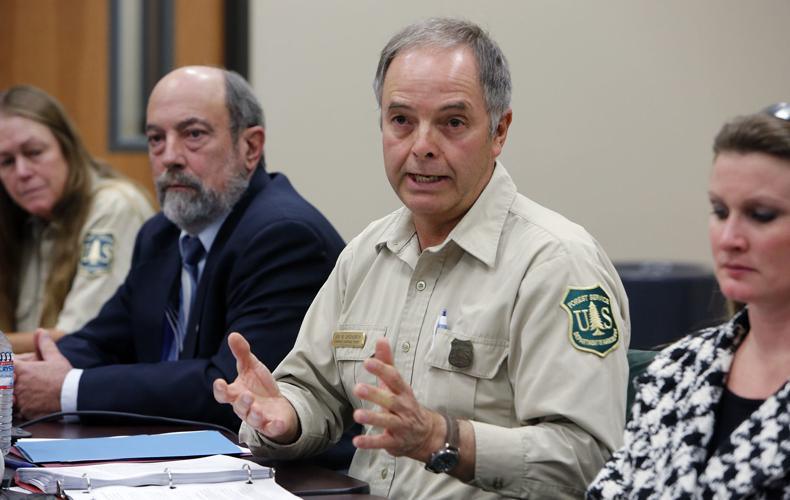

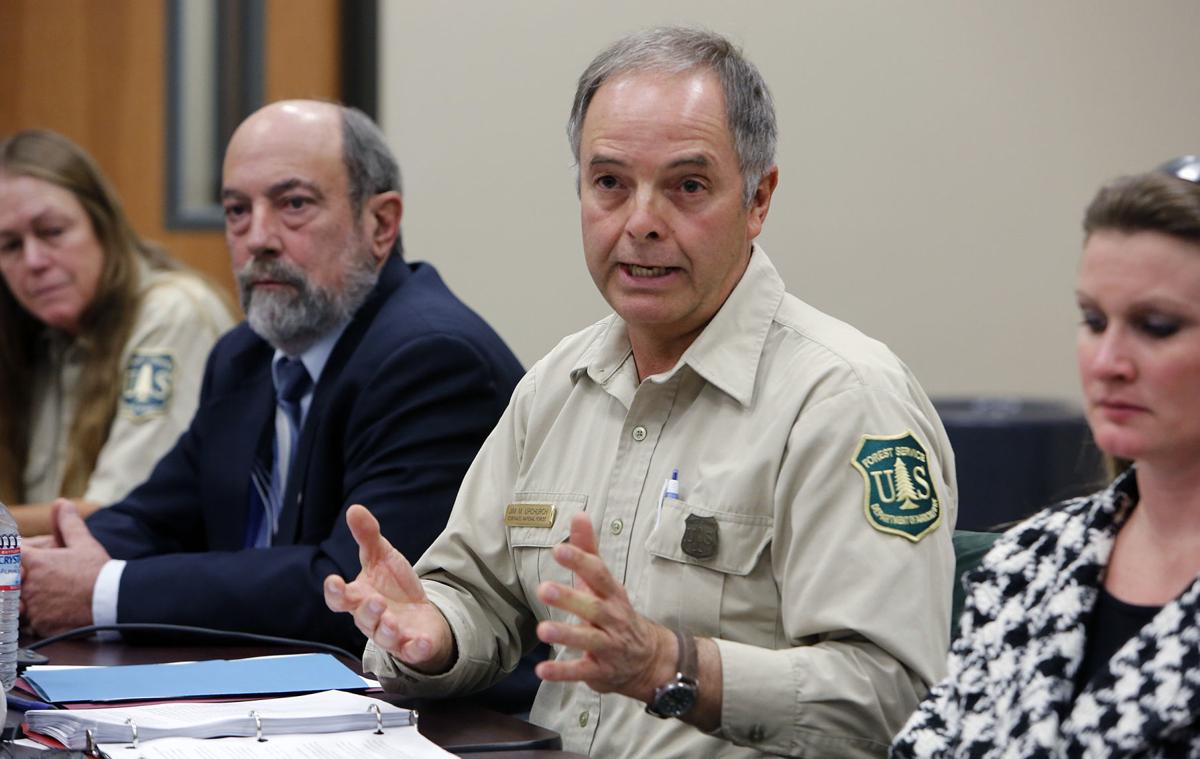
A former Coronado National Forest supervisor says his experience with the Rosemont Mine shows it’s time to overhaul the 1872 Mining Law.
Without that law — which opened the West to mining with no federal royalties and little environmental oversight — there’s a reasonable chance the Rosemont proposal would have been scaled back or reshaped, and it might have even been killed, said former forest supervisor Jim Upchurch.
As supervisor from 2010 to 2015, Upchurch oversaw many of the key steps leading to the Forest Service’s approval of the mine. He supervised preparation of the mine’s draft and final environmental impact statements in 2011 and 2013 and issued a draft decision approving the mine in 2013.
Later, as a deputy Southwestern regional forester in Albuquerque after leaving the Coronado, he also was involved in preparing the 2017 final Rosemont decision. It was written by current Forest Supervisor Kerwin Dewberry.
Retired from the service since January 2018, Upchurch said in a recent interview that while he ultimately concluded that the mine proposal would meet all applicable laws — a finding recently overturned by a federal judge — he was frustrated that the mining law sharply limited his flexibility in making decisions on the project.
In particular, he pointed to what he saw as the law’s limits on the service’s ability to say “no” to a mine on its land, on its ability to require mitigation for a mine’s effects, and on how broadly it can analyze its impacts.
It was frustrating as a public official not to be able to look at the whole project and make the best decision about the facts, he said.
“Right now, there is no flexibility,” said Upchurch, who now lives in Albuquerque. “It’s either ‘do this’ (what the mining company proposes) or do nothing. There’s not much leeway.”
The $1.9 billion Rosemont Mine carries the promise of 500 high-paying jobs over at least 20 years of operations. But the Forest Service and other federal agencies found it has myriad potential environmental effects.
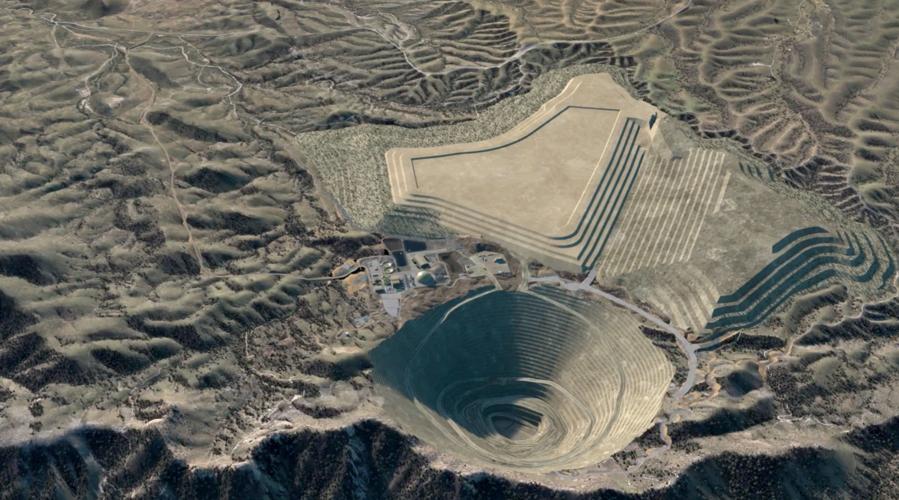
The mine, including an open pit more than a half-mile deep and more than a mile in diameter, would disturb about 5,431 acres of federal, state and private land, the Forest Service has said.
Not the best place for a mine, he says
Given the many environmental issues surrounding Rosemont, Upchurch said he felt that the site in the Santa Rita Mountains southeast of Tucson wasn’t the best place for a mine.
“That particular area has more endangered species than just about any other place in the nation,” he said. “It has significant water quality issues and significant archaeological issues. It’s also an important connectivity corridor for mammals from Mexico to the U.S.
“There are a lot better places where we could have mines with not so significant impacts,” he said.
Upchurch declined to say, however, whether he personally supports or opposes Rosemont.
He’s staying silent on that point because he expects to be called into court to testify on at least one of the five lawsuits now pending against Rosemont, he said. He doesn’t want to be accused of having a conflict of interest by taking a public position now.
He still sees both sides of the Rosemont dilemma.
Mines “are where the ore is. You can’t just move along because you don’t like that particular location,” he said.
At the same time, “that particular area has so many conflicts, it makes it difficult to come up with a solution that doesn’t affect significant resources such as (wildlife) migration, endangered species, water quality and air quality,” he said.
“I think there’s a place for mining. But there are places of such significance for other uses that you have to balance that out.”
He added that society still needs the ability to provide minerals from national forests.
Decisions do take too long, he says
Upchurch is also sympathetic with the mining industry on another key point — one that industry officials like to call “certainty.”
They want more predictability on how agencies will handle mining applications, and a shorter timeline for decisions.

Computer rendering of the pit and tailings pile at Rosemont Mine in the Santa Rita Mountains.
The Rosemont issue was stalled in federal agencies for 12 years after Rosemont Copper filed its proposed mining plan of operations. The final agency decision came in March 2019, when the Army Corps of Engineers approved a Clean Water Act permit.
“We’ve gotta come up with a way that doesn’t take 15 years to come to a decision,” Upchurch said. “We need amendments to the act to allow us to shorten the time span. That might be the trade-off we need to provide more flexibility in our decisions.”
2nd former supervisor to call for reforms
In calling for reform of the 1872 law, Upchurch joined Jeanine Derby, his predecessor as Coronado National Forest supervisor, who made a similar pitch in an August interview with the Arizona Daily Star.
Her comments came shortly after U.S. District Judge James Soto ruled that the Forest Service had erred in approving Rosemont by improperly interpreting that law.
The law has been highly controversial for decades, but mining company lobbyists and other backers have been able to stop Congress from making major changes.
The Mining Law of 1872 lays down in its first section the basic ground rule for mining that has infuriated critics ever since.
“All valuable mineral deposits in lands belonging to the United States, both surveyed and unsurveyed, are hereby declared to be free and open to exploration and purchase, and the lands to which they are found to occupation and purchase, by citizens of the United States and by those who have declared their intention to become such,” the law says.
In addition, the law says that anyone who locates minerals on the public domain “shall have the exclusive right of possession and enjoyment of all the surface” where the minerals are found, “and of all veins, lodes and ledges throughout their entire depth.”
The law contains no provisions for how a federal agency could say “no” to a mine on its land.
Since then, the Forest Service and the Bureau of Land Management have generally said they don’t have that power, unless the mine would violate an environmental law.
Besides that, Upchurch said it’s a “shame” that hard-rock mining companies pay no royalties to the federal government for minerals they extract from federal land.
Oil companies and non-hard-rock mining firms such as coal companies typically pay such royalties. Hard rock mining claim holders pay $225 in fees in the first year they file a claim, and $165 annually to maintain the claim.
It’s also a “shame” that the law doesn’t allow federal agencies to look as broadly at mine impacts as he would like, said Upchurch, referring to the “total effects of the project based on the totality of all the laws.”
For instance, he said, the Forest Service couldn’t base its decision on whether Rosemont is in the public interest, which the Army Corps of Engineers can. Federal laws and rules also limit how broadly the Forest Service can require mitigation for a mine’s impact, he said.
Native American concerns arise
“In a world where I could just make believe stuff, you’d be able to look at the mine’s effects on Native American culture,” Upchurch said. “And can we shrink it down so it’s not such a big impact, or having different alternatives, so it’s not such a big impact?”
He couldn’t require mitigation of Rosemont on land outside the Coronado National Forest, he said. He lacked legal jurisdiction on such lands.
Such a restriction is “pretty limited, since Rosemont may have impacts on Cienega Creek and other, sensitive Bureau of Land Management and Pima County lands,” said Upchurch.
Also, dealing with cultural resources on the mine site that were considered sacred by three Native American tribes was hard for the Forest Service, because “we were affecting something like 76 archaeological sites,” Upchurch recalled.
The National Historic Preservation Act requires federal agencies to prepare a mitigation plan for such projects and to prepare a memo of agreement for agency and tribal officials — which for Rosemont the tribal leaders refused to sign.
But if cultural artifacts are to be placed under 700 feet of mine tailings, “there’s not much you can do except try to minimize the effects,” Upchurch said. “The law doesn’t allow you to not put the activity on top of archaeological sites.”
With a more flexible mining law, “you could better design something to fit a particular landscape. If you hypothetically had that flexibility, there’s a reasonable chance you could do something different,” he said.
“Decision space was limited”
Unlike his predecessor Derby, however, Upchurch said he never felt pressure from Forest Service higher-ups to avoid raising controversial issues internally.
For Derby, those included whether Rosemont should be allowed to dump 1.9 billion tons of waste rock and tailings on nearly 2,500 acres of forest land, when its mining claims on that land hadn’t been proven valid.
Derby told the Star in early August that she was told by Corbin Newman, then the Southwestern regional forester, to stop questioning the legality of the mine on those grounds.
It turned out they were the same grounds Judge Soto used this summer to rule that the service’s approval of Rosemont was “arbitrary and capricious.”
“I don’t know her. I think I met her once. I don’t have any reaction to what she did or didn’t experience,” Upchurch said of Derby.
After he arrived at the Coronado and started work on Rosemont, it took him six months to quit asking questions about mining claims and whether he could say “no.”
“My questions were probably the same as for everyone: What is my decision space? Can I say no? Is there any avenue for me to say no?” he recalled. “I raised those questions with our Office of General Counsel, with the staff in the Washington office. I wanted to have as much decision space as possible.
“It was pretty unanimous, that my decision space was limited. The advice from counsel, from attorneys in the Washington office, is that we don’t go through a validity exam. There is an inherent right for a person with claims to be able to use the national forest,” he said.
“It wasn’t that I didn’t raise the issue. It was advice of counsel. That’s why we hire these people. It wasn’t like, ‘Be quiet, don’t raise the issues.’ It’s just this is precedent, the way the courts have ruled over the past 150 years of the mining act.”
As for Soto’s ruling stopping the mine, Upchurch said he wasn’t upset about it and didn’t feel that he and his agency were shot down.
“Our job was to do the best we could with the sideboards of the law that limits the discretion that we have,” he said. “I think we did really good work with what we have. I don’t have any qualms about the courts making a different decision. I knew it would go to court at some point. It’s not unreasonable to think the courts could come up with a different decision.”
But for now, Upchurch won’t say if he agrees or disagrees with the ruling. Again, as long as Rosemont is in the courts and he could be called to testify, he’s staying mum on such controversies.

