

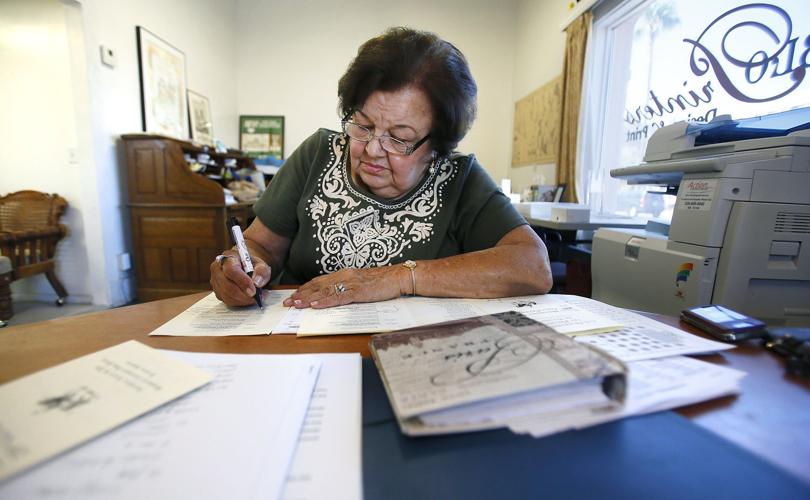

Annie Lopez‘s friends and family thinks she’s crazy.
“They tell me I should be resting,” Lopez said.
Rest is not in her vocabulary. Neither are the words retirement and relax.
At the age of 84, Lopez said she is on the run. Not from something, but to some place or meeting on her daily agenda.
Ask Lopez what keeps her on the go, she’ll say she doesn’t know. But if you pester her long enough, she’ll tell you it’s her love for her hometown.
Lopez, a first-generation Tucsonan who lives where the valley floor meets the Rincon Mountains, is the president of Los Descendientes del Presidio de Tucsón, a group devoted to keeping the past present. It is a nonprofit group with the principal goal of preserving our town’s rich history.
Lopez’s involvement goes back, way back, to the 1960s, when social changes were being created and demanded by young Chicanos and older Mexican-Americans in Tucson and the Southwest.
In Tucson, Lopez, as a divorced mother of five children, joined the Pueblo Area Council, a south-side advocacy, community organization. She was following the footsteps of her younger brother, Hector Morales, who was on the Tucson City Council at the time and had become a leading activist.
Morales, a Korean War vet, spearheaded efforts to establish fair housing and equal-employment regulations, and to eliminate the city sales tax on food and prescriptions. He also pushed for city water services to be extended to the Tohono O’odham and Pascua Yaqui tribes.
After his brief stint on the City Council, Morales became director of the Committee for Economic Opportunity, an anti-poverty program. He died in 2010.
Lopez said her brother introduced her and prodded her into community service and activism.
“That’s what it was, working with people in need of services,” Lopez said.
From the Pueblo Area Council, Lopez joined the Tucson Unified School District, working with parents of students at Richey, Borton and Pueblo Gardens elementary schools.
It was while Lopez was working at TUSD that she met Chuck Ford, an educator who later became Tucson’s first African-American elected to the City Council. When Ford served on the council, he recruited Lopez to serve as a trustee on the board of the public library.
Few Mexican-Americans, much less Latinas, were asked to serve on community boards and commissions. They weren’t invited. Over the years, Lopez did not wait for the invites.
Among the organizations, Lopez served on the board of La Frontera, the mental-health and services agency, which sponsors the annual Tucson International Mariachi Conference, the Mexican-American Unity Council, the League of Mexican-American Women and the Tucson Women’s Commission.
Peel back the layers of Lopez’s life and you’ll see Tucson through the ages.
Lopez grew up in a segregated, post-Great Depression, Tucson. The family lived on North Ninth Avenue, near West Speedway and North Stone Avenue, in an ethnically mixed neighborhood. But the social demarcations were clear.
African-American children attended Dunbar School. Mexican-American students went to Davis Elementary School in nearby Barrio Anita. And the white kids went to Roosevelt School, just north of Speedway and the Lopez home.
Her parents had migrated from Sonora and her father worked for Baffert and Leon, a wholesale grocer at East Toole and Stone avenues downtown, which today houses Sinfonía HealthCare Corp.
But for whatever reason, Lopez and her siblings went to Roosevelt, which was built in 1921 and named for President Theodore Roosevelt. No longer a school, the building is now part of Pima Community College’s downtown campus. Her family later moved to South Fourth Avenue, and Lopez graduated from Tucson High School in 1949.
Through the prism of her youth, Lopez saw Tucson develop, often unevenly, but still full of optimism and vigor.
That’s what she hopes she has brought to her hometown and organizations she was worked with: vigor and optimism.

